By the tiswa editorial team, from the official sources listed at the end of this guide. How we write our guides
Eight hours a day, or 48 a week, is the normal ceiling on actual working time under the Labour Law.3 Part-time work is measured against that number. A job that takes less than half of an organisation's normal day falls under its own section of the law, and a student offered an evening shift at a Riyadh mall or a Jeddah coffee shop should read that section before signing anything.
What is part-time work under the Saudi Labour Law?
It is work done by a worker who is not full-time, for fewer than half of the organisation's normal daily working hours, whether the hours are worked every day or on some days of the week.1 An 8-hour organisation means part-time is under 4 hours. A 7-hour one means under three and a half.
A full-time employee whose hours are cut temporarily, along with colleagues, for economic or technical reasons is not a part-time worker. Part-time is agreed from day one and written into the contract.
Can students work in Saudi Arabia part-time?
Yes. The law does not ask you to have graduated; what matters is the contract and the hours. The minister issues the rules for part-time work and the law applies within the limits the minister sets, with one exception: occupational safety, health and work-injury protection applies in full.1 An injury in a warehouse or a restaurant kitchen is covered the same way it would be for a full-time colleague.
During Ramadan the ceiling on actual hours for Muslim workers drops to 6 a day or 36 a week,4 so ask how your shift changes that month, especially if exams fall close to it.
What must a part-time contract include?
The implementing regulation sets out the contract rules:2
- It is written. A chat message is not a contract.
- It has a fixed term, with a start and an end date.
- It states the working hours, and they are under half of the organisation's normal daily hours.
- It can be renewed.
- If either side ends it without a legitimate reason, the other side may claim the wages for the rest of the term as compensation, unless both agreed otherwise.
That last clause matters more than students expect. On a six-month contract, walking out in month two without a legitimate reason has a price, and so does an employer ending it on a whim. Read the termination clause, and do not sign a contract that runs through finals without written terms for those weeks.
How many hours is part-time, and how is it different from flexible work?
Part-time is a fixed daily share of under half the normal day on a written contract; flexible work is paid by the hour and open to Saudis only.2 Side by side:
| Part-time | Flexible work | Full-time | |
|---|---|---|---|
| Hours | Under half the organisation's normal day | Hourly, up to 160 a month per employer | Up to 8 a day or 48 a week |
| Who can do it | Covered by the Labour Law generally | Saudi nationals only | Everyone |
| Contract | Written and fixed-term | Electronic, fixed-term, with an hourly wage | Documented on Qiwa |
| Suits | A steady daily shift | Scattered days and seasons | Life after graduation |
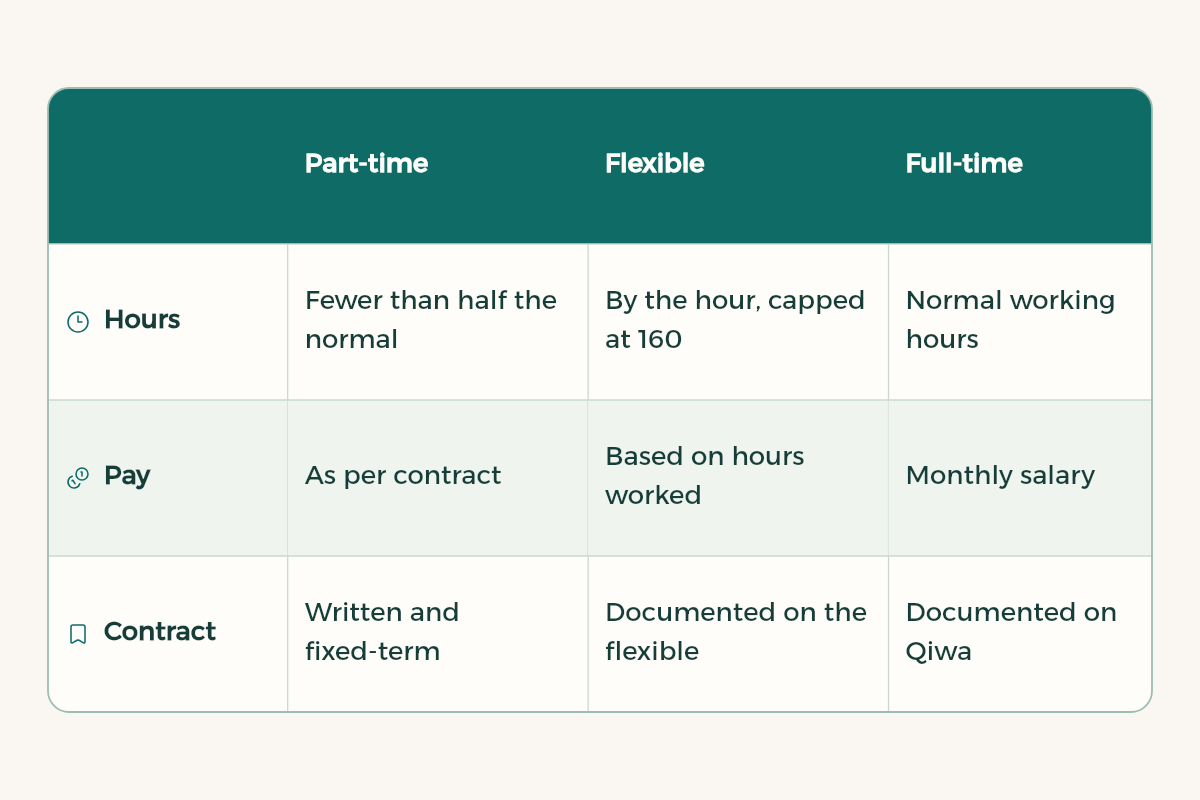
HRSD raised the flexible work cap to 160 hours a month with one employer.5 Registration is covered in flexible work in Saudi Arabia. International students cannot use flexible work, so ask your university's international students office what your residency allows before you accept any offer.
How do I check my contract on Qiwa?
Employees can see their current contract and the employer's details from their individual Qiwa account.6 Do it in your first week, not after the first argument about pay:
- Sign in as an individual
Use the individuals account on Qiwa, not a business account.
- Open your contracts
Go to Qiwa > Services > Employment Contracts and pick the current one.
- Compare the hours
Check the hours on the contract against the hours your manager actually rosters.
- Check term and pay
Start date, end date, the amount and how often it is paid.
- Save a copy
Screenshot it and keep it with any messages about exam weeks.
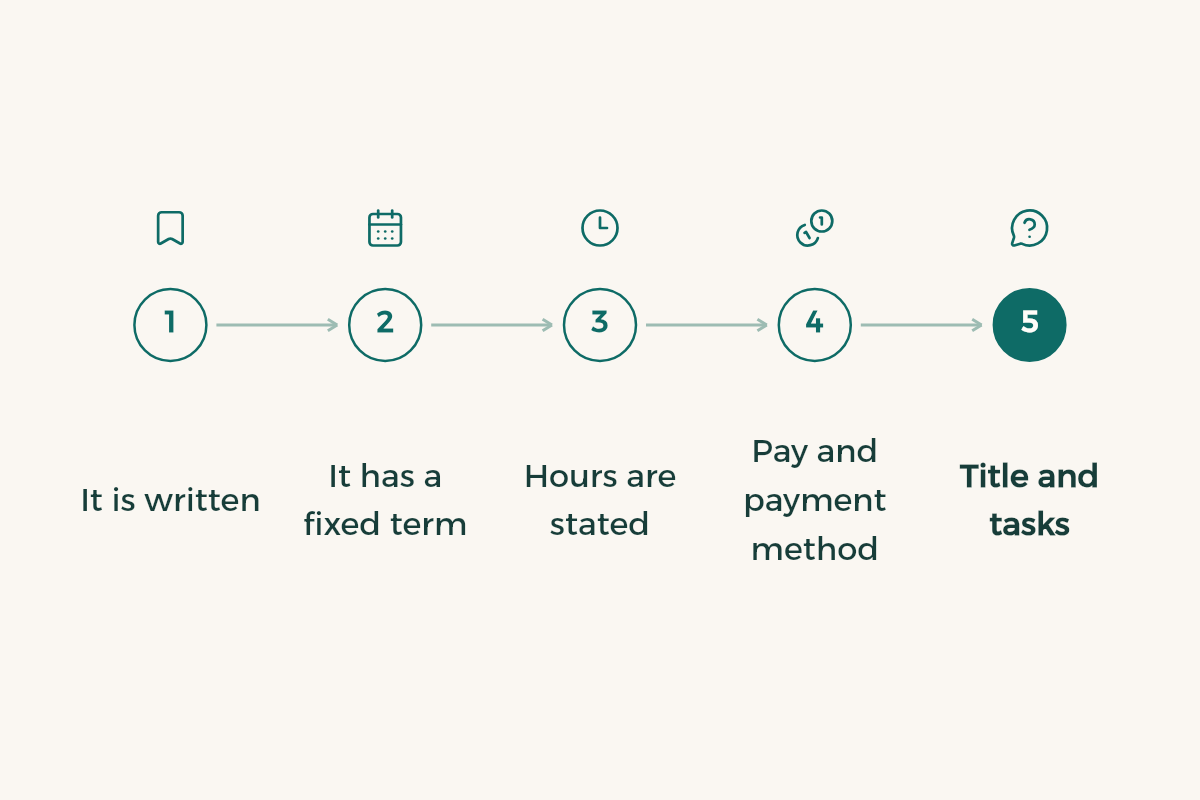
Every field of the standard contract is explained in the unified employment contract on Qiwa.
Do part-time workers get a break during a shift?
Yes. No worker may work more than five consecutive hours without a break for prayer and food of at least half an hour.7 Most part-time shifts are shorter than five hours, so the rule rarely bites. It starts to matter when a manager asks you to stay "one more hour" twice a week: a six-hour shift is no longer part-time in an 8-hour organisation, needs its break, and needs the contract changed.
What should I do about exam weeks?
Agree them before you start. Send your manager your fixed lecture times in writing, then forward the final exam timetable the day your admission and registration deanship publishes it, and ask for lighter shifts for at least two weeks. An employer who refuses that in week one will refuse it in week fifteen too, and it is better to find out before you sign. A week plan that fits an evening job is in a weekly study plan for students with evening jobs.
Mistakes students make before signing
- Accepting a verbal deal because the brand is well known.
- A contract labelled part-time with seven- or eight-hour shifts. That fails the definition; ask for the contract to match reality.
- Mixing up flexible and part-time, then finding the pay is hourly.
- A term that ends after finals with nothing written about exam weeks.
- Quitting halfway through without a legitimate reason, which opens a claim for the remaining wages.
Where can students find part-time jobs in Saudi Arabia?
Start on campus: libraries, labs and deanships sometimes hire their own students by the hour. Then try large retailers, coffee chains and licensed tutoring centres. Never pay a fee to anyone promising a job. Where to apply is in part-time jobs for students, fitting shifts around lectures is in part-time jobs and your timetable, and how to put the job on paper is in the CV guide for students.