By the tiswa editorial team, from the official sources listed at the end of this guide. How we write our guides
Your last lecture ends at two. Your shift starts at five. You get home after ten with a tired head, open the book and read the same page three times. That is not a willpower problem. The timetable was built for a student who does not work, and you are not that student.
How do you count your free hours in a week?
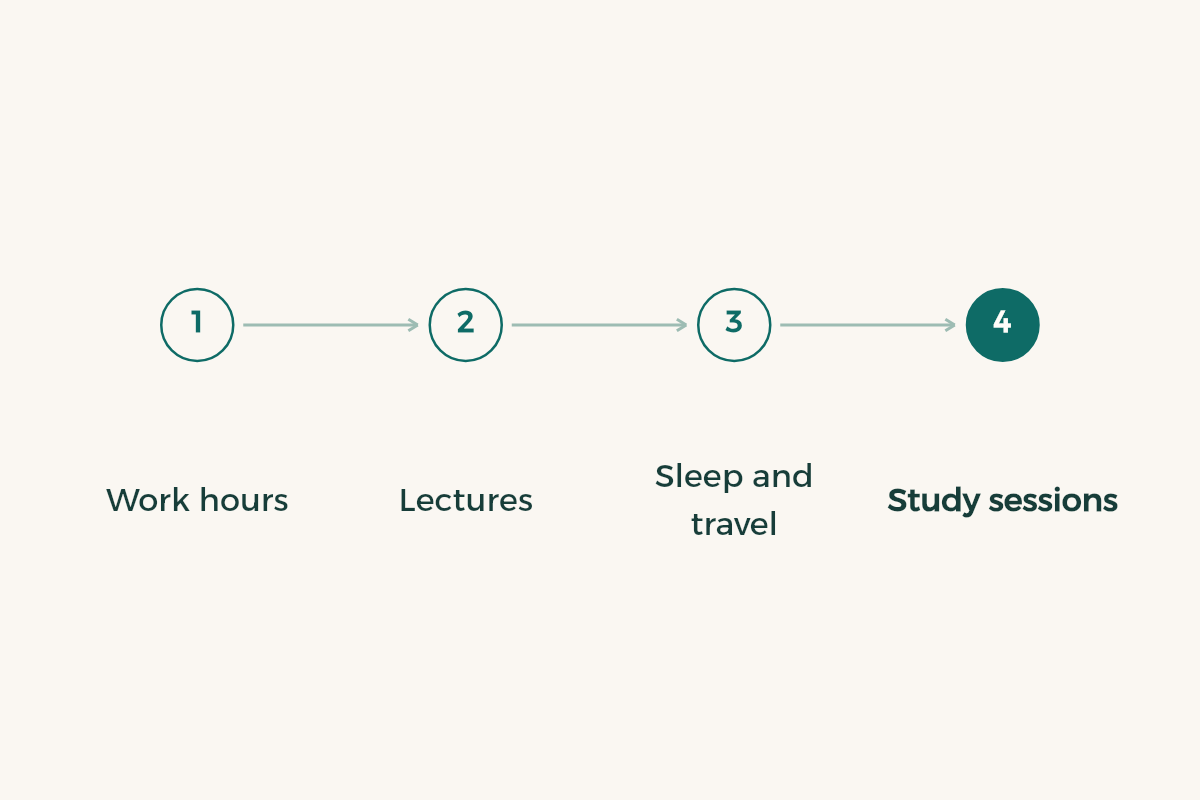
A week has 168 hours. Write the fixed ones first, in this order: sleep, then lectures with travel, then shifts with travel, then meals, prayer and family. Whatever is left is what you actually own. It does not grow because you decide to be more disciplined, and it is usually smaller than you pictured. That is useful, because you learn before you start that you will have to choose.
The University of North Carolina Learning Center suggests setting aside regular time each week for planning, setting only one or two goals for the coming week, and keeping spare time for the unexpected.1 That fits a working student exactly: a small plan you can carry out beats a big one that collapses.
- Write your real work hours
Not the contract hours. Write what happened over the last two weeks, including late finishes and the commute.
- Add lectures and labs
Mark the gaps between classes. They are the first hours to vanish and the easiest to use.
- Subtract sleep, travel and meals
Protect six or seven hours of sleep. A plan that borrows from it breaks before mid-semester.
- Cut what is left into sessions
Make each session 45 to 90 minutes and name it after one course, never just "study".
How do you share the hours between courses?
Not equally. Weigh each course with three questions: which deadline or test is nearest? Am I behind in it? What does failing it cost me this semester? A course with a test in ten days and a fast-moving lecturer gets more hours than a light one due in a month.
Take the dates from the course syllabus itself, since that is the source for your assessment dates, and ask the lecturer or advisor if something is missing instead of guessing. There is a way to move those dates into a weekly plan in using your syllabus to build a study plan.
Where does the hard course go?
Put it where your head is clearest. Someone who works evenings usually has two good windows: the gaps between lectures and the time before the first class. After a shift the mind is tired, so that slot is better kept for light review, such as running through flashcards or redoing a problem you solved before.
Pulling an answer out of memory works better than rereading, and it helps to forget a little before you return to the material.2 Spreading sessions across the week also helps more than cramming them into one night.3 This suits evening workers well: thirty minutes on five days beats two and a half hours on one day that ends with you asleep at the desk.
What does an example week look like?
The example below is an imagined student: lectures Sunday to Wednesday from eight to one, and three evening shifts. It is a model to edit, not an official schedule, so put your real hours in.
| Day | Morning and midday | Evening |
|---|---|---|
| Sunday | Lectures, plus a 60-minute session on the hardest course between classes | Shift |
| Monday | Lectures, plus a 45-minute session on a second course | 20 minutes of flashcards after getting home |
| Tuesday | Lectures, plus a 60-minute session | Shift |
| Wednesday | Lectures, plus a 45-minute session | Free: finish what slipped |
| Thursday | A long 90-minute session at your sharpest time | Shift |
| Friday | A 90-minute assignment session before the afternoon | Free |
| Saturday | One 60-minute spare block, then a 15-minute plan review | Rest |

Notice that shift evenings carry no heavy study, and that Saturday holds a deliberate empty block. That block is what saves the week when a shift runs late or a manager asks for an extra day.
What do you do when the week changes?
It will. An extra shift appears, a quiz is announced, someone at home is ill. The rule is to move the session, not delete it: open the plan, find which spare block is left, and put the missed session there. If it will not fit, keep the course with the nearest deadline and postpone the lighter one.
If you are weighing a second job or extra hours, count the cost against your timetable before you agree, as in comparing a part-time job with your timetable. And when tests get close, switch to the exam-week revision plan for an evening job, because an ordinary week is not an exam week.
How do you review the plan each week?
- Compare planned with done
Count the sessions that happened and write one reason for each that did not: shift, tiredness or postponing.
- Change the hours, not the intentions
If you missed more than half, the plan is bigger than your time. Cut sessions instead of demanding more of yourself.
- Pick two goals for next week
The UNC centre suggests one or two clear goals, such as finishing chapter three and the homework questions.1
- Add new dates first
Any new deadline or test goes into the plan before anything else.
If you want a ready frame, start from the study plan template and edit it with your shift hours. If your focus drifts, try the Pomodoro technique on a 45-minute session.
What mistakes break a working student’s plan?
The first is filling every hour. A plan with no slack cannot take a single change. The second is putting hard study after a shift and then blaming yourself. The third is cutting sleep and covering it with caffeine. The fourth is writing "study" instead of the course and the task, because a session with no name gets spent deciding. The fifth is building the plan once at the start of term and never opening it again.
If the job takes more than you can carry, that calls for a decision, not a better timetable: talk to your manager about hours, or ask your academic advisor what options your university offers.