By the tiswa editorial team, from the official sources listed at the end of this guide. How we write our guides
Thirty pages of a biology chapter. A classmate finished in an hour, and you reached page ten in two because every paragraph hides three words you have to look up. This is an invented scene, but anyone studying in a second language knows it. The problem is not intelligence or effort. It is that your timetable assumes a reading speed that is not yours, so you fall behind and decide you are weaker than the others.
How do you make a weekly study plan when you study in a second language?
Start like any timetable, with lectures and fixed commitments.1 Then add the layer everyone forgets: language time. A first read of a chapter in a second language usually takes longer than in your own, so do not give it the time your classmate gives it. Measure yourself once: read five pages of your course, note the minutes, then multiply to estimate a full chapter.
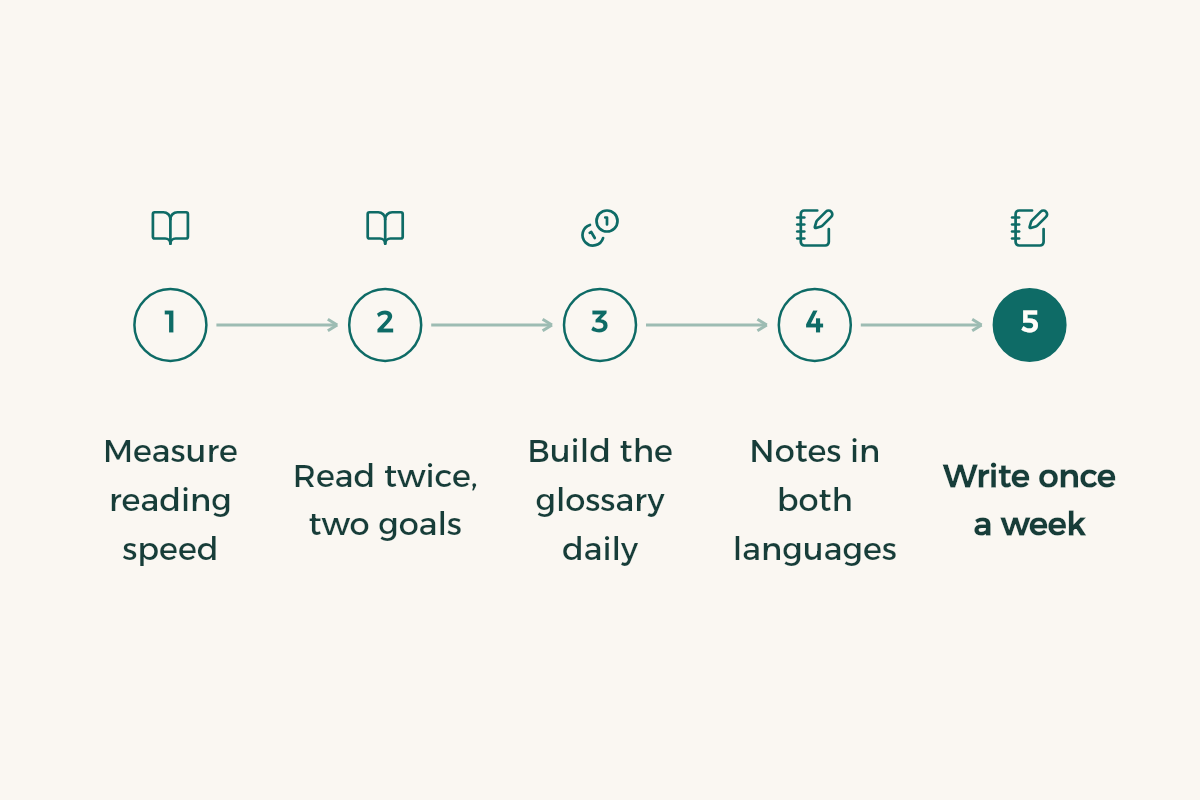
- Measure your reading speed
Five pages of the real course text, with the actual minutes, then estimate the chapter.
- Read twice with two goals
A fast pass for the general idea, a slow pass for detail and terms.
- Build the glossary daily
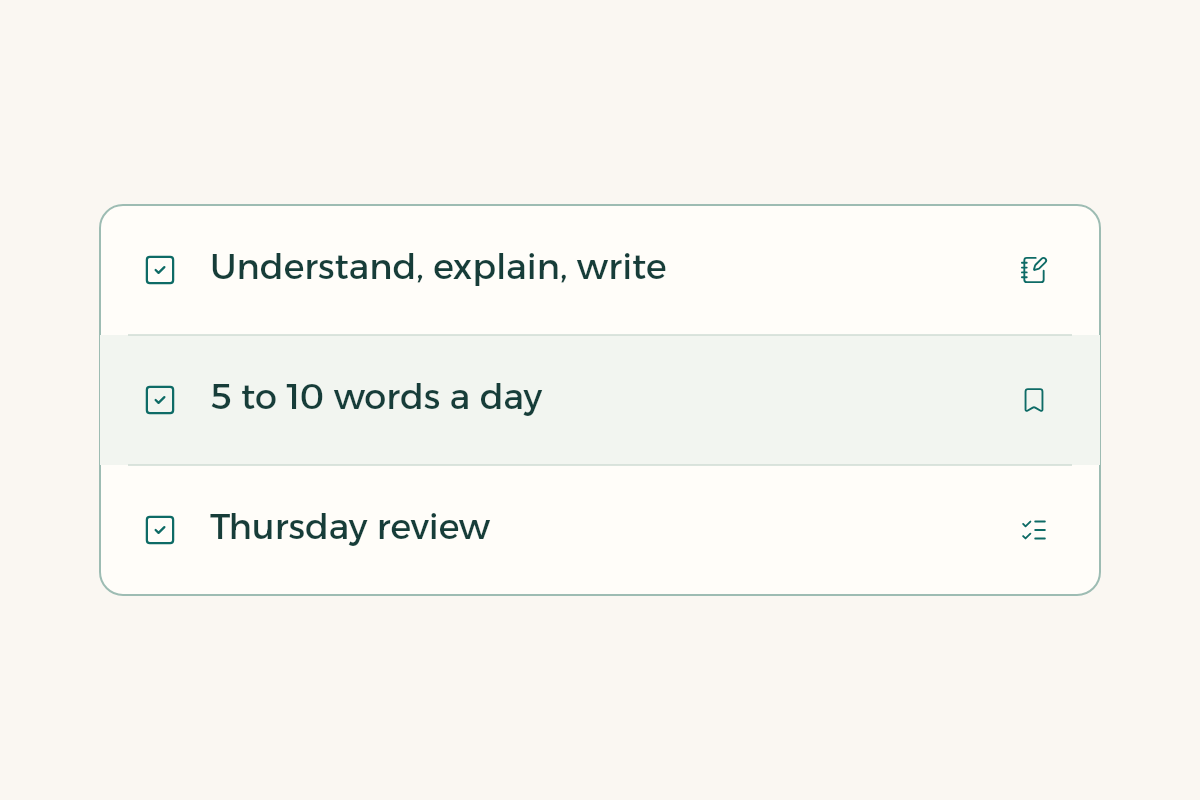
Five to ten words from today’s course: the word, its meaning in your language, and a sentence from the course itself.
- Take notes in both languages
Headings and terms in the course language, short explanations in yours, so the understanding stays and the word sticks.3
- Write once a week
One paragraph in the course language about a concept you learned, without looking at the book.
Why a small glossary every day rather than a huge one the night before? A word met five times in a week sticks better than one met fifty times in one night. The UNC Learning Center describes spreading study across shorter sessions,2 and the idea applies to vocabulary just as it does to concepts.
How to study a science subject in a second language without memorising blindly?
Understand first, then memorise. When you meet a new concept, read the course definition, explain it to yourself or a friend in your own language, then write the definition in the course language from memory. That three-step cycle stops you memorising a sentence you do not understand, and stops you understanding the idea in your language but lacking the words when the exam asks.
| Day | Language block (invented example) | Subject block |
|---|---|---|
| Sunday | Fast pass over the chapter and today’s glossary | Slow read of the first section |
| Monday | Quick review of yesterday’s glossary with flashcards | Course problems |
| Tuesday | A short paragraph written in the course language | Second section |
| Wednesday | A teaching video in the course language with subtitles | End-of-chapter questions |
| Thursday | Full glossary review and a self-test | Mind map of the chapter |
The table is an illustration. Take your own lecture and exam dates from the official schedule. Each day has a short language block and a subject block, and writing happens once a week because it is the heaviest skill. When exams get close, move to exam revision in a second language, which focuses on the glossary and timed practice.
How do you take lecture notes in a second language?
Do not try to write everything the lecturer says. Capture terms, numbers and examples in the course language, and add a word or two of meaning in yours. A few hours after class, reorganise the page: terms in one column, explanation in the other. The Cornell Learning Strategies Center describes note systems that separate raw notes, questions and a summary,3 which suits anyone who needs to come back to the material twice.
If the lecturer is quick, lean on the materials posted on the course platform and on lecture recordings where your university provides them, and check its policy before recording anything yourself. Do not rely on machine translation for definitions and exam wording; it can hand you a close word that does not match the course term.
How do you improve the language itself and not only the subject?
Set aside a short fixed window, twenty minutes a day, for the language: a short scientific article, or an open lecture in your field. Pick material from your own subject so language and content gain together. If your major is language itself, see AI for English language students for more ideas, and if you are in your first year, your first week at university helps set up the rest of your routine.
Review your week every Thursday for ten minutes: how many words did you add to the glossary, which chapter ran longer than planned, did you write your paragraph? Then adjust the next week. If pressure rises, splitting study time between subjects helps rebalance your blocks.
In the early weeks, do not compare yourself with someone who studied in this language at school. Compare yourself with two weeks ago: are five pages faster, can you read a passage without a dictionary? That comparison is honest and gives you momentum. If language is the biggest obstacle, ask your college’s language centre or academic support unit what it offers; we do not name a service here because it differs between universities.
Three mistakes come up often. One is reading a whole chapter once, quickly, and assuming you understood it. Another is building a giant glossary and never reviewing it. The third is translating every sentence into your language and revising from the translation, so you reach the exam without knowing the term in its own language. The cure is the three-step cycle and the small daily glossary.