By the tiswa editorial team, from the official sources listed at the end of this guide. How we write our guides
Paid and free masters are a question many students ask before applying, because fees affect the decision more than they expect. But the numbers circulating in forums can be out of date or belong to a different programme, so do not rely on them. This guide explains how to read a programme announcement, what to ask, and how to understand published discounts and free places, without quoting any amounts.
What is the difference between a free and a paid programme?
Some universities offer graduate programmes with no tuition for admitted students, while others run paid programmes whose fees are paid in instalments before each semester. You may find both types inside the same university. Both can award a master's degree, but the conditions and cost differ. Some students call the paid route the parallel master's, while the university uses its own official name, so read the name exactly as it appears in the announcement.
The key point is that a degree is not worth less because it is paid. The university sets the rules of the programme, the courses and the payment terms. So compare the two options on the same criteria: courses, supervision, duration, admission conditions and assessment.
Read the announcement before you calculate anything
The programme announcement is the only reliable reference. It usually sets out the admission conditions, the ranking criteria, the payment method and the withdrawal policy. As an example, Imam Mohammad Ibn Saud Islamic University publishes its graduate conditions each year when applications open. We covered its general conditions in the guide to masters in Saudi Arabia, so this guide will not repeat them.
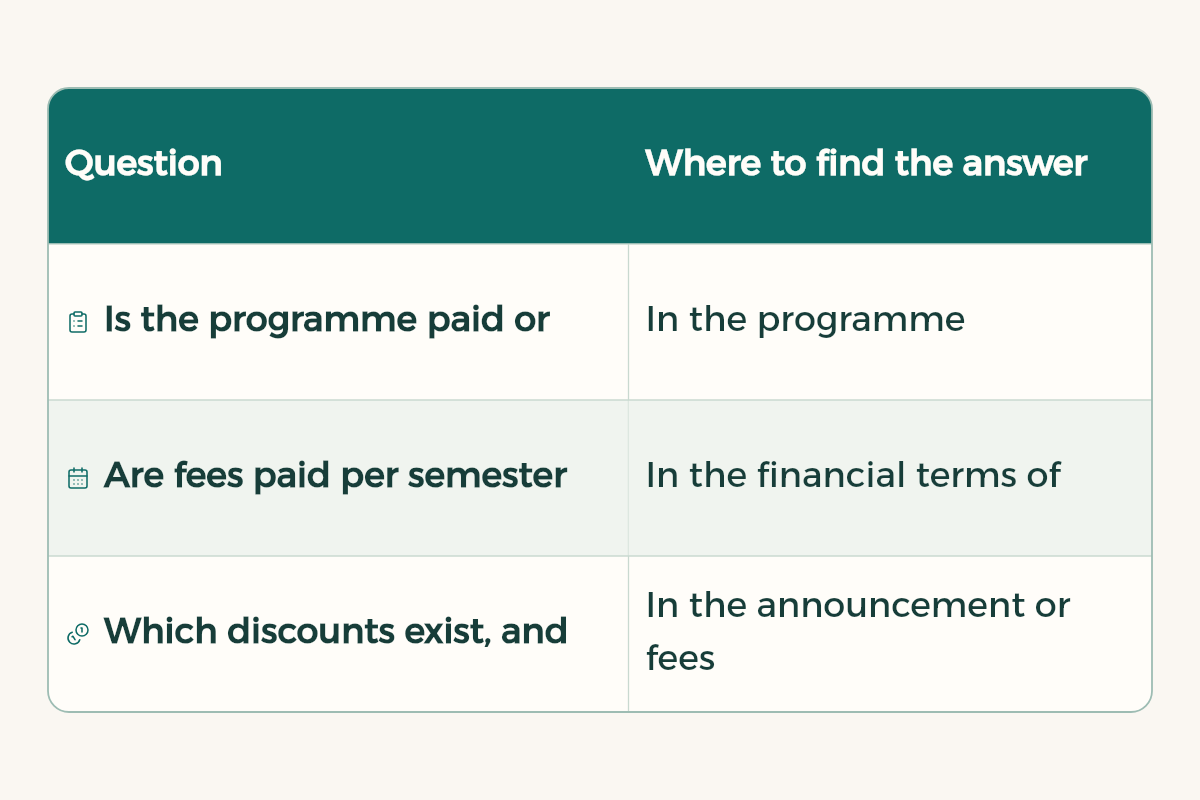
| Question | Where to find the answer |
|---|---|
| Is the programme paid or free? | In the programme announcement, and on the fees page if there is one. |
| Are fees paid per semester or once? | In the financial terms of the programme. Payment may be in instalments before each semester. |
| Which discounts exist, and for whom? | In the announcement or fees page. A discount often applies to a specific group, such as university staff. |
| What is the withdrawal policy? | In the fees regulation. It often sets a refund percentage that depends on when you withdraw. |
| Are there free places, and on what terms? | In the announcement. Free places are often reserved for high achievers under the university's rules. |
Discount percentages: how to read them
In the published Imam University example, fees were paid in instalments, with a 50% discount for university staff and their children and spouses, a 50% discount for beneficiaries of social security and charity, and a few free places for top students under university rules. The discount depends on the group, so it is not offered to everyone. The same guide refunded fees in full before course registration, and deducted 20% for withdrawal within the first three weeks. These are percentages from one programme, and your programme may differ.
At King Saud University's College of Social Sciences, the executive programme page says tuition is reduced by 25% for KSU staff students, including employees and their spouses and children. That shows the same pattern: a discount for a defined group, not a general price. For how the executive route works, read the executive masters guide.
Fees, VAT and the final figure
Some universities publish fees on a separate page and do not give figures in their FAQ. One university's graduate FAQ says its fees exclude VAT, and that Saudi citizens pay 0% VAT while non-Saudis pay 15%. So ask for the final total after tax, not only the base fee, and compare the totals rather than the headline numbers.
Withdrawal and postponement
Many students only discover that withdrawal has financial conditions after they have paid. So ask before you pay: when are fees fully refunded? Is anything deducted after study begins? Can admission be postponed? If you need to withdraw or pause, read the semester withdrawal guide and withdraw and reapply to understand the academic options.
What to ask before you pay
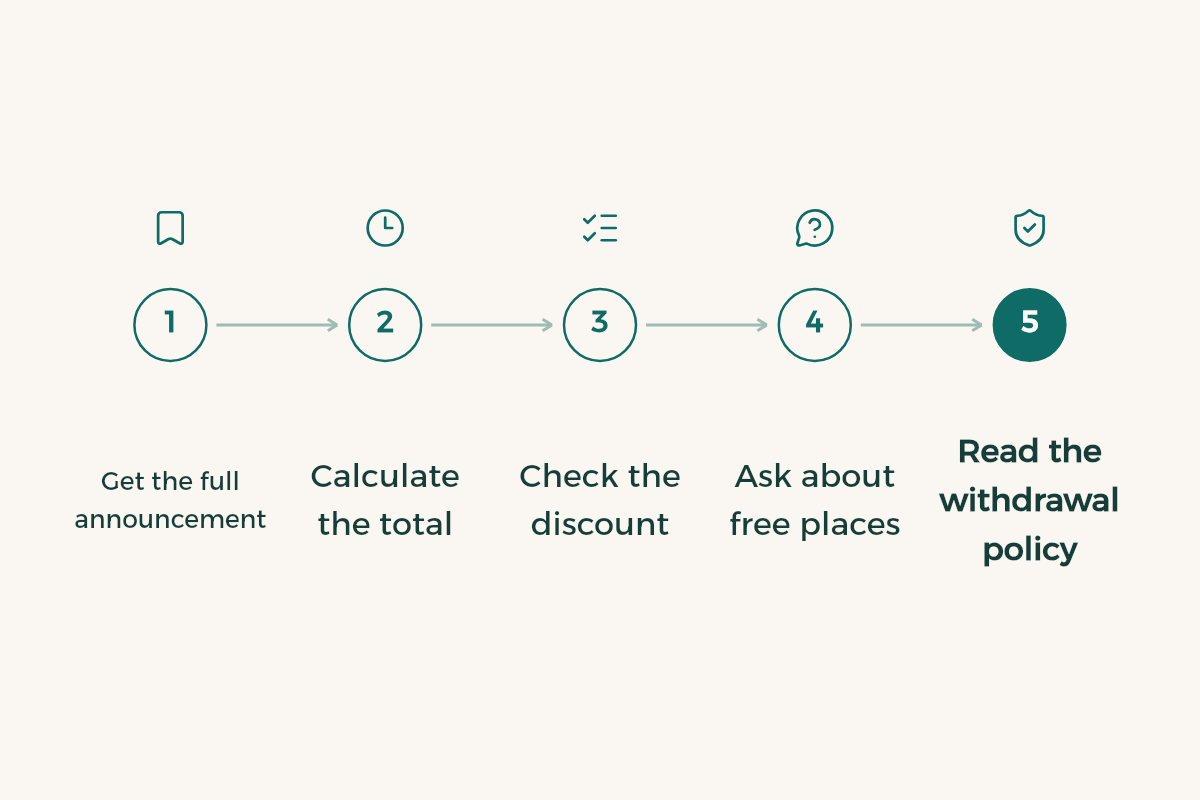
- Get the full announcement
Save a copy of the announcement and the programme conditions, and ask in writing about any unclear clause.
- Calculate the total
Ask for everything you will pay: tuition, tax if any, registration fees, and any fees for courses or the research.
- Check the discount
Know which group qualifies, which document proves it, and the deadline to submit it.
- Ask about free places
Find out how many places the university publishes, the eligibility rules, and whether a free place needs a separate application.
- Read the withdrawal policy
Know when fees are refunded in full and when they are reduced, before you pay the first instalment.
If the budget is the obstacle, start with a simple plan before paying, then compare options. A student budget and budgeting apps can help you do the sums without complexity.
Keep a paper trail
Every figure in this comparison should be backed by a document. Save the official fee schedule, the discount policy, every payment receipt and any letter about withdrawal or postponement. If a dispute arises later, a written answer from the university is far more useful than a memory of what someone said on the phone.
- Ask for the base fee in writing before you compare any discount.
- Upload the proof for a discount before the deadline, not after the first invoice.
- Check the withdrawal rule for the exact term you plan to enter.
Once the documents sit in one folder, the comparison becomes simple, and you can decide without pressure from an advert or a deadline you have not checked.
If you are looking for funding that covers study, read scholarships for Saudi students. Do not choose a programme on price alone: the right one fits your field and your research plan.