By the tiswa editorial team, from the official sources listed at the end of this guide. How we write our guides
Most people start looking at executive programmes the year a promotion goes to someone with a higher degree. That is a fair reason. It is also how people end up in the wrong programme, because "master's" covers two very different products. We use two official pages here: King Saud University's College of Social Sciences in Riyadh, and the Executive MBA at the KFUPM Business School in Dhahran.
What is an executive master's, exactly?
KSU's College of Social Sciences calls its executive master's a non-academic programme. It differs from academic master's degrees in objectives, courses and delivery, and it is aimed at practitioners and executives in government and the private sector.1 The same page states that completing it does not qualify you to apply to an academic doctoral programme.
Read that twice if a PhD is anywhere in your future. Then read PhD in Saudi Arabia, because the academic route has to start at the master's stage.
Executive vs academic master's: what actually changes?
| Executive master's | Academic master's | |
|---|---|---|
| Built for | Someone in a role who wants to apply what they learn on Sunday morning | A student who wants to specialise or research |
| Format | Applied courses, often in blocks that fit around work | Advanced courses plus a thesis or research project |
| Experience | Often required; KFUPM asks for 8 years | Rarely required |
| After it | No academic PhD route at KSU | The normal route into a doctorate |
| Fees | Fee-paying | Free regular places and paid tracks both exist |
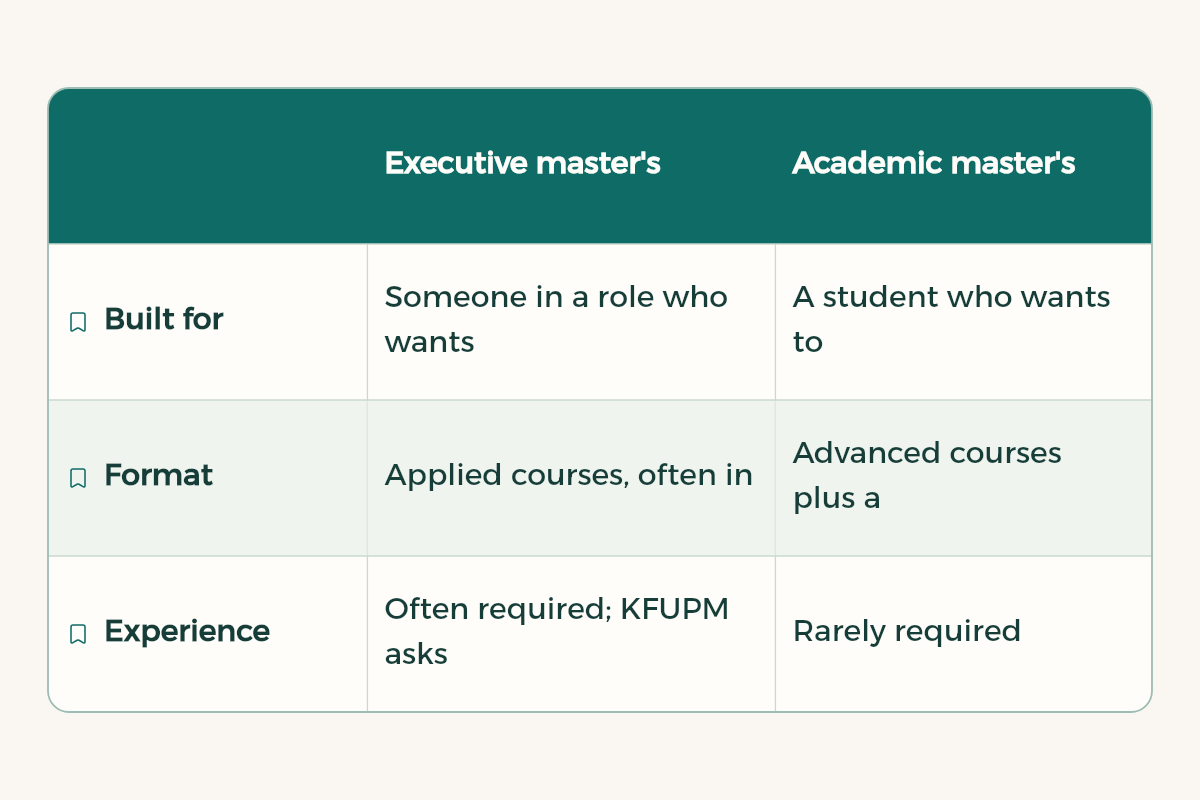
Fees and experience are obvious on day one. The doctorate row is the one people discover too late.
How to apply for masters in Saudi Arabia on an executive track at KSU
The college page does not list the conditions itself. It points to a separate requirements page on the Deanship of Graduate Studies site, and applications go in electronically through the Deanship portal during the announced admission window.1 So do not borrow the rules of a neighbouring programme, even one in the same college. Open your programme's own page and save a copy on the day you apply.
What does the KFUPM Executive MBA ask for?
KFUPM publishes far more detail, and it is a good picture of what a serious executive programme expects:2
- At least 8 years of work experience, 3 of them in mid-level management after graduation.
- A GPA of 2.50 out of 4.00, or equivalent.
- IELTS 6, TOEFL 70 or Duolingo 105. KFUPM graduates and graduates from the USA, Canada, the UK, Australia and New Zealand are exempt.
- A 43-credit-hour programme over four semesters.
Classes run every other week on Thursday and Friday, 7:30 a.m. to 4:30 p.m., in Building 24 on the main campus in Dhahran. The school has held AACSB accreditation since 2002.2 If you live in Riyadh or Jeddah, that is roughly two trips a month for 20 months. Price the flights before you price the degree.
Can I do a part time master degree in Saudi Arabia while working?
Yes, that is the whole point of the executive format. KFUPM's Thursday and Friday blocks are built around a working week. KSU's page does not publish a timetable, so ask the department for days and hours in writing. And get your employer's approval before you apply, not after you are admitted. Exams land when they land, including the week your team closes its quarter.
For a fully remote option, the two programmes above will not help: both are on campus. Licensed distance programmes are covered in online masters in Saudi Arabia.
Is there a free master degree in Saudi Arabia on the executive route?
Not that either official page shows. KSU offers a 25% tuition reduction to its staff, their spouses and their children, and the reduction also applies to continuing education programmes.1 A reduction implies a fee. Neither page publishes the base amount, so ask for it in writing. If cost is the deciding factor, a regular academic master's is where free places sit; compare them in paid vs free masters.
Mistakes we see before people apply
- Assuming the degree opens a PhD door.
- Comparing discount percentages without knowing the fee they come off.
- Registering first and asking HR second.
- Copying the MBA conditions onto a public administration programme in the same college, then finding the requirements were different all along.
The application, step by step
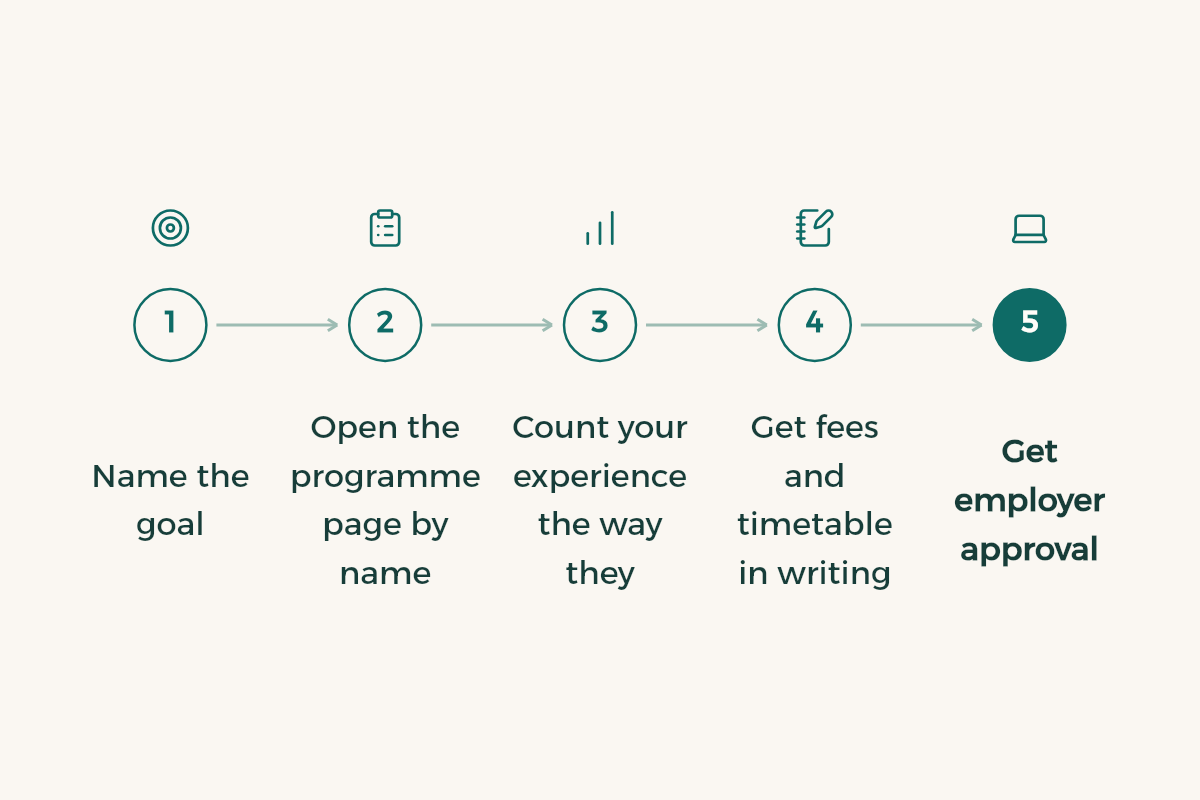
- Name the goal
Promotion, career change or research? If it is research, stop here and go academic.
- Open the programme page by name
On the college or Deanship site. Save it.
- Count your experience the way they count it
Some programmes only count years after graduation, and some want managerial years.
- Get fees and timetable in writing
The full amount, the class days and the number of semesters.
- Get employer approval
Before applying.
- Apply through the official portal
Inside the announced window, with clear scans of every document.
Write a short formal letter to the HR department at [employer] asking for approval to join [programme name] at [university].
The programme will build my skills in [skill] in the [department] team.
Classes are on [days and times] for [duration].
I would like to agree class and exam days in advance. The programme page and conditions are attached.
For the general rules of any master's inside the Kingdom, see masters in Saudi Arabia, and when the degree goes on your profile, use the CV guide for students.