By the tiswa editorial team, from the official sources listed at the end of this guide. How we write our guides
The cybersecurity major in Saudi Arabia has become one of the most sought-after tech majors, because every organisation now has systems and data to protect: banks, hospitals, government bodies and online stores. Specialists protect networks and systems, find weaknesses before attackers do, and respond to and investigate incidents. This guide explains the major from official sources: where it is taught, how long it takes, the courses, admission, job roles, and how to build your skills safely and legally.
Where cybersecurity is taught in Saudi Arabia
Saudi universities offer cybersecurity in more than one form. At King Saud University, the College of Applied Studies offers a Bachelor of Applied Computing with a cybersecurity track, and the Information Technology department in the College of Computer and Information Sciences lists cybersecurity among its fields. KFUPM offers a BS in Artificial Intelligence and Cybersecurity that combines the two. Other universities offer it as a standalone major or as a track within computer science. So do not stop at the programme name; read the study plan and count how many security courses it really has.
How many years is cybersecurity?
KSU's Bachelor of Applied Computing, cybersecurity track, takes four academic years with two levels per year and 131 credit hours. Students choose between courses with a summer internship or courses with cooperative training. KFUPM's BS in AI and Cybersecurity is four years after a required preparatory year, with 127 credit hours and summer training after the third year.
Cybersecurity courses
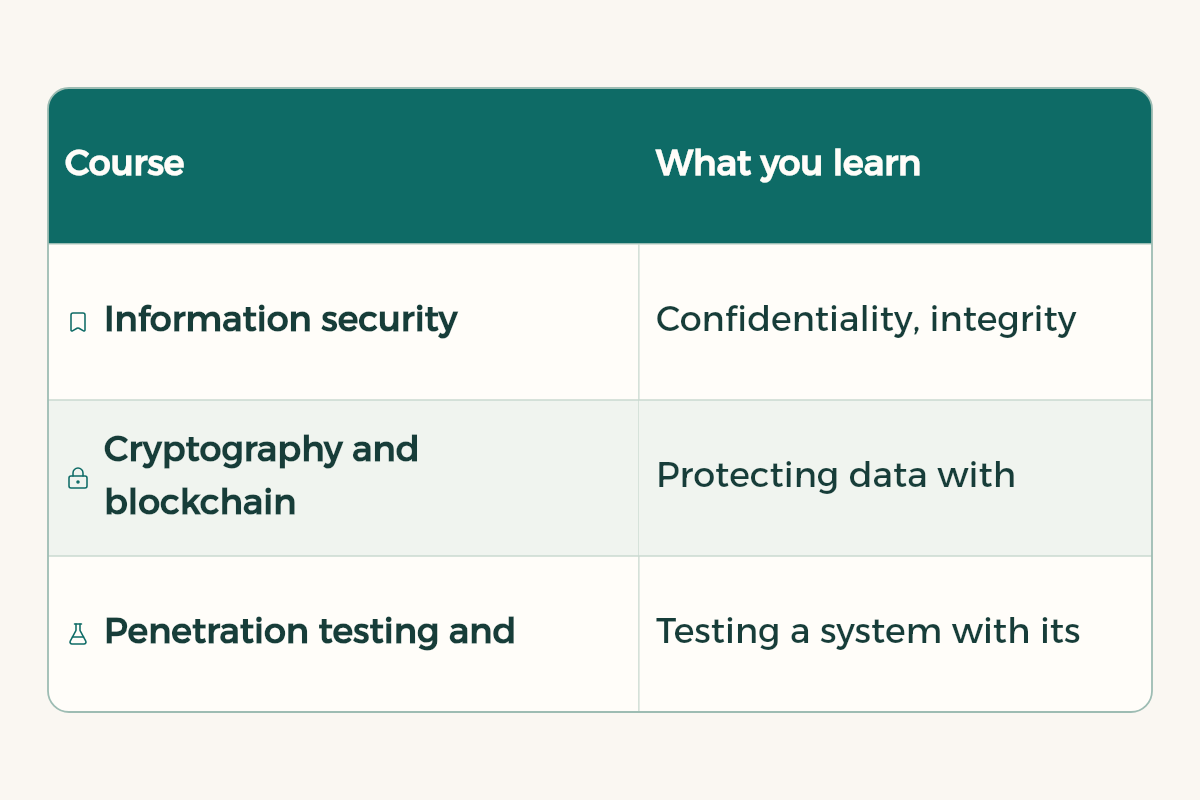
These examples come from the KFUPM plan and give a picture of courses that recur in most programmes:
| Course | What you learn |
|---|---|
| Information security | Confidentiality, integrity and availability, and common attacks |
| Cryptography and blockchain applications | Protecting data with encryption and building secure distributed systems |
| Penetration testing and ethical hacking | Testing a system with its owner's permission and finding weaknesses |
| Secure software development | Writing code free of known vulnerabilities |
| Data privacy | Protecting and managing personal data |
| Operating systems and databases | What you protect, since you cannot secure what you do not understand |
| Design and analysis of algorithms | Deep computational thinking |
| AI for cybersecurity | Using machine learning to detect attacks |
| Security in AI systems | How models are attacked and defended |
The KSU programme page lists skills graduates gain, including network monitoring, risk and vulnerability assessment, and forensic analysis of cyber incidents. Every programme needs a strong base in programming and networks, so if you are starting out, begin with how to learn programming from scratch.
Admission requirements
The KSU page for the Bachelor of Applied Computing, cybersecurity track, says scientific-stream secondary school graduates need a weighted score of 75%, made up of 40% Achievement Test, 30% Aptitude Test and 30% secondary school grade, and that admissions do not exceed the number proposed for the programme. The university's admissions office says both tests are required of all Saudi applicants. Each university has its own weights and requirements, and they change from year to year, so check the programme's own page before applying. To prepare for the tests, see the exams guides.
The Saudi Cybersecurity Workforce Framework
The National Cybersecurity Authority (NCA) developed the Saudi Cybersecurity Workforce Framework (SCyWF) as a foundational step towards a qualified national cybersecurity workforce. The framework organises cybersecurity work into categories, specialty areas and job roles, with the tasks, knowledge and skills each role needs, and it serves as a reference for hiring, training and workforce development. It covers roles specific to cybersecurity only, not general IT jobs with some security duties. As a student, read the roles in the framework and pick one or two to build your skills around from your second year.
Is the cybersecurity major right for you?
The major needs curiosity and patience more than excitement about hacking films. Most daily work is reading logs, analysing alerts, writing reports and applying controls, not fast duels with attackers. Ask yourself:
- Do you enjoy understanding how things work inside, such as networks and operating systems?
- Can you stay with one problem for hours without losing interest?
- Are you comfortable writing clearly? A good report is half the job.
- Are you ready to keep learning, since attacks and tools change quickly?
- Do you follow rules and ethics even when nobody is watching?
If most answers are yes, the major likely suits you. If you enjoy building software more than protecting it, compare it with the software engineering major.
Cybersecurity jobs
- Security operations centre (SOC) analyst: monitoring alerts and detecting attacks.
- Penetration tester: testing systems with formal permission and writing vulnerability reports.
- Incident responder and digital forensics analyst: investigating after attacks.
- Governance, risk and compliance specialist: policies, risk assessment and controls.
- Network or cloud security engineer: designing protection into infrastructure.
- Secure software developer or application security reviewer.
Summer or co-op training is a chance to step into a real SOC. Read the co-op training guide, and prepare a student CV that shows your projects and competitions.
How to practise safely and legally
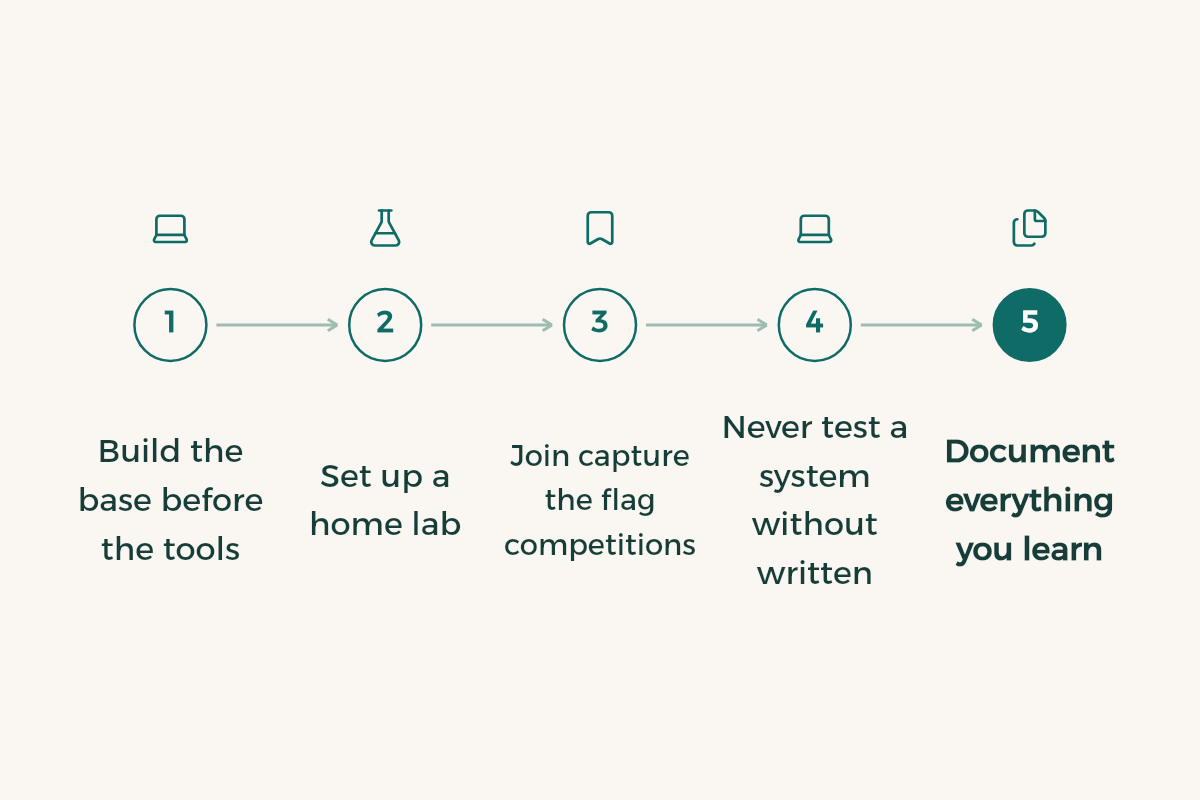
- Build the base before the tools
Networks, operating systems and programming first. Tools without fundamentals teach you nothing.
- Set up a home lab
Virtual machines on your own computer where you can practise freely without touching anyone else's systems.
- Join capture the flag competitions
CTF events train you to solve security challenges in a permitted setting.
- Never test a system without written permission
Probing other people's systems without authorisation breaks the law, even if your aim is to learn.
- Document everything you learn
Write notes and reports on every challenge you solve. They become your portfolio.
- Follow official sources
Read the NCA's controls and frameworks, because they are the language of the organisations you will work for.
I am a cybersecurity student studying [SQL injection]. Explain: how the vulnerability happens with a simple vulnerable code example, then how to write the same code safely, then how to spot it in a code review. Do not give me any steps to exploit it on a real system. At the end, ask me three questions to check I understood.
For more ways to use AI responsibly in security study, read AI for cybersecurity students. If you are comparing nearby majors, see the information technology major and the computer science major. Free development tools are in the GitHub Student Developer Pack.