By the tiswa editorial team, from the official sources listed at the end of this guide. How we write our guides
The data science major in Saudi Arabia combines three things: maths and statistics, programming, and understanding the field the data comes from. Every organisation now collects data about its customers and operations, but few know how to turn it into decisions. That is the data scientist's role: collecting, cleaning and analysing data, building models that predict and explain, then presenting the result so a decision maker understands it. This guide explains the major from official sources: where it is taught, how long it takes, the courses, admission, jobs, and how to prepare.
Where data science is taught in Saudi Arabia
KFUPM offers a BS in Data Science and Engineering, a full programme focused on data from collection to model. At King Saud University, the Information Technology department in the College of Computer and Information Sciences lists data science among its fields. Other universities offer it as a standalone major or as a track within computer science or statistics. Because names differ, open the study plan, check the balance between statistics and programming, and see whether there is a graduation project on real data.
How many years is data science?
KFUPM's BS in Data Science and Engineering is four years after a required preparatory year, with 129 credit hours. It includes summer training in the summer after the third year and a two-semester senior design project. Programmes at other universities are usually close to four years, but credit hours and tracks differ, so check the study plan before you decide.
Data science courses
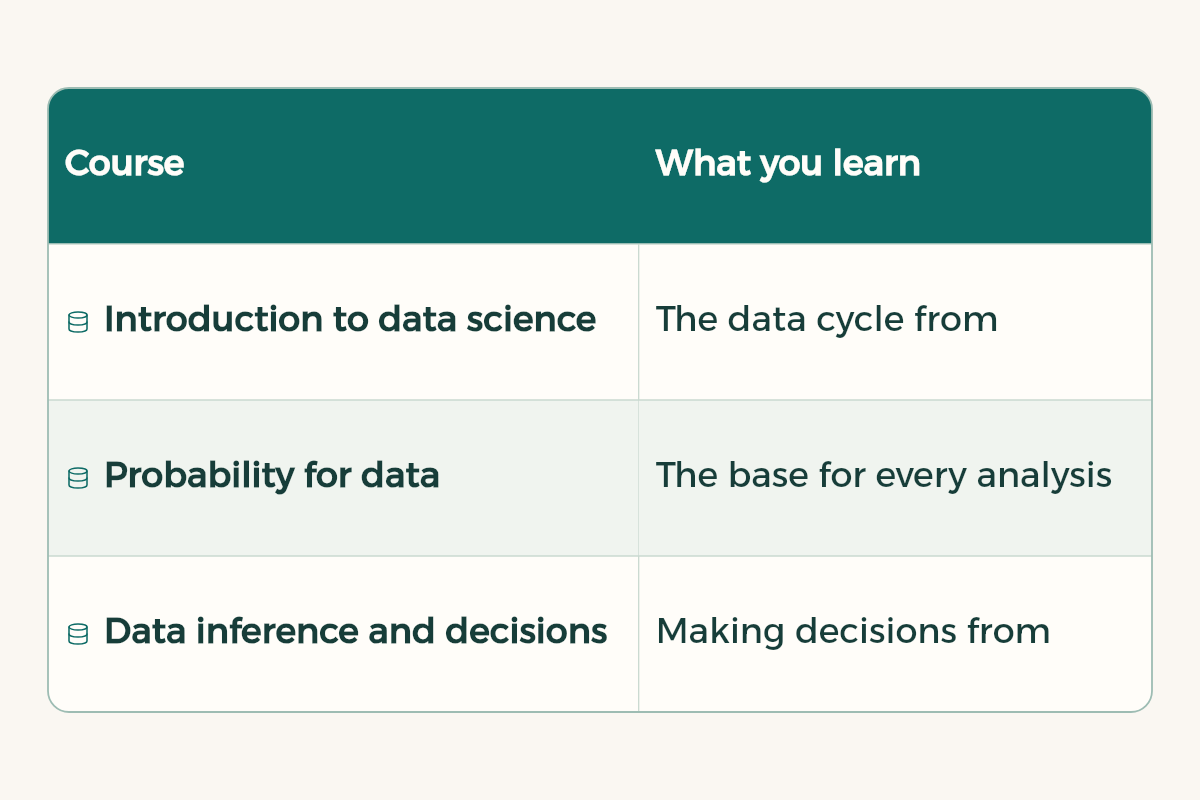
These examples come from the KFUPM plan and give a clear picture of the major:
| Course | What you learn |
|---|---|
| Introduction to data science | The data cycle from question to result |
| Probability for data science and statistical methods | The base for every analysis and model |
| Data inference and decisions | Making decisions from uncertain data |
| Matrix theory for data science | The linear algebra models rely on |
| Data engineering | Building pipelines that collect, move and prepare data |
| Fundamentals of database systems | Designing tables and queries |
| Mathematical modelling and optimisation | Framing a problem mathematically and finding the best solution |
| Machine learning and time series | Prediction and classification models, and forecasting from history |
| Big data analytics | Working with data too large for one machine |
| Human contexts and ethics of data | Privacy, fairness and the effect of decisions on people |
Notice the plan has a full course on data ethics. That matters, because data scientists handle sensitive information about people, and a flawed model can affect real decisions. If you are starting out, begin with how to learn programming from scratch, and sharpen your Excel for students skills, since it is the first analysis tool you will use.
Admission requirements
King Saud University's admissions office says the General Aptitude Test and the Achievement Test are required of all Saudi applicants, and that cut-offs are announced before admission opens. Each university has its own cut-offs and requirements, and they change from year to year, so check the admissions page of the university you want. To prepare for the tests, see the exams guides.
Is the data science major right for you?
Data science is not just pretty charts. Most of the time goes into cleaning data and understanding its errors. Ask yourself:
- Do you like numbers and statistics, and always ask why a result came out that way?
- Do you enjoy programming to solve a real problem, not only to build apps?
- Can you stay patient with incomplete, messy data until it is ready?
- Can you explain a complex result to someone who does not know statistics?
- Do you care about how decisions affect people, such as privacy and fairness?
If most answers are yes, the major likely suits you. If you prefer building intelligent models to analysis, compare it with the artificial intelligence major. If you prefer the business and management side, compare it with the information systems major.
Data science jobs
- Data scientist: builds models that predict, explain and support decisions.
- Data analyst: analyses data and builds dashboards and reports.
- Data engineer: builds data pipelines, databases and warehouses.
- Machine learning engineer: turns models into systems that run in products.
- Business intelligence analyst: links data to management goals and indicators.
- Researcher in statistics or AI for those who continue to graduate study.
Summer training is a chance to work on a real organisation's data. Read the summer training guide, and prepare a student CV that links to your project portfolio.
Common mistakes data science students make
- Starting with the model before understanding the data. Spend time exploring and plotting it first.
- Confusing correlation with causation, and concluding one thing caused another because they move together.
- Ignoring missing values and outliers, or deleting them without understanding why they exist.
- Crowded charts that do not deliver a clear message to the decision maker.
- Neglecting privacy when handling real people's data, even in course projects.
- Collecting many course certificates without one project that proves you can apply them.
Study and analytics portfolio tips
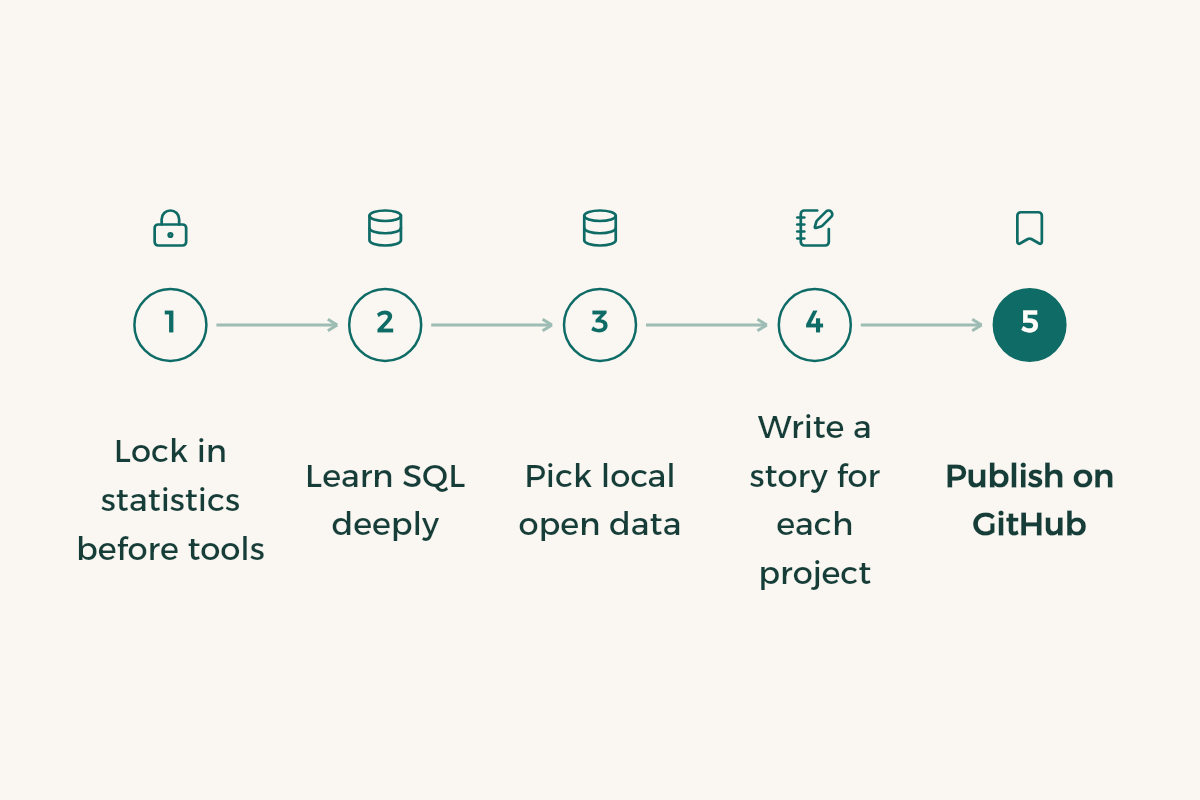
- Lock in statistics before tools
Understand mean, variance, correlation and statistical tests before you run any model.
- Learn SQL deeply
Most company data sits in databases, and SQL is a core skill for any analyst or data scientist.
- Pick local open data
Analyse open Saudi data and ask one clear question you can answer.
- Write a story for each project
The question, the data, the cleaning, the analysis, the result, and the decision you suggest.
- Publish on GitHub
A tidy analysis notebook with a clear write-up beats ten course certificates.
- Practise presenting
See presentation tips, because an analysis shows its value when you present it.
I am a data science student. I have a table of [monthly store sales] with these columns: [list the column names]. Suggest five useful analysis questions, and for each: the right chart, the cleaning steps before it, and the common mistakes in interpreting the result. Do not write the full code; I want to write it myself.
For more ways to use AI tools in your studies, read AI for computer science students. If you are comparing nearby majors, see the computer science major. Free development tools are in the GitHub Student Developer Pack.