By the tiswa editorial team, from the official sources listed at the end of this guide. How we write our guides
The nursing major in Saudi Arabia is one of the most popular choices for students in the health track, because it mixes science with daily work alongside patients. This guide covers how long the degree takes, what you study each year, the usual admission rules, what you need to be classified and registered by the Saudi Commission for Health Specialties (SCFHS), and a practical study plan from year one.
How many years is nursing?
Details vary by university, but the structure is similar. A documented example is the Bachelor of Science in Nursing at Imam Abdulrahman Bin Faisal University (IAU): five years in total, made up of one preparatory year, three years in the college and one internship year. The programme totals 136 credit hours. The internship is 52 weeks of hospital-based training that combines practical, managerial and theoretical work.
So you do not start the heavy nursing courses on day one. Year one builds English, biology, physics and computer skills, and it decides whether you enter the college at all. Read the preparatory year guide to get through it with a comfortable GPA.
Nursing courses year by year
This table summarises examples from the same programme's study plan, so you can see how the load builds up:
| Year | Example courses |
|---|---|
| 1 (preparatory) | General English 1 and 2, Introduction to the Nursing Profession, Biology, Physics, Computer Skills, Principles of Psychology, Arabic Language Skills |
| 2 | Anatomy, Physiology, Biochemistry, Microbiology and Parasitology, Health Assessment Skills, Fundamentals of Nursing, Infection Control |
| 3 | Pathology, Pharmacology 1 and 2, Medical Surgical Nursing 1 and 2, Psychiatric and Mental Health Nursing, Obstetrics and Gynecology Nursing, Nutrition, Epidemiology and Biostatistics, Geriatric Nursing |
| 4 | Pediatric Nursing, Research and Evidence-based Practice, Emergency Nursing, Nursing Management and Leadership, Critical Care Nursing, Community Health Nursing, Nursing Informatics |
| 5 | Hospital internship |

Electives include Wound Care, Palliative Care and Oncology Nursing. Year three is usually the heaviest, because pharmacology, medical-surgical nursing and clinical training all land at the same time.
Admission requirements
Admission usually happens in two steps: you join the university in the health track, then you are placed into a college after the prep year based on your GPA and the seats available. In our example programme the college asks for:
- Registration in the health track from the start.
- Passing every preparatory year course with a cumulative average of at least 300 out of 500.
- At least a C in the English courses, or a TOEFL score of 450.
Every university publishes its own rules and weighted percentages on its admission portal, so always check your own university before you apply. If English is your weak point, start early, because most nursing courses are taught in English. See how to improve your English for university.
Licensing: SCFHS classification and registration
A degree alone does not let you practise. SCFHS classifies health certificate holders, carries out the professional registration of health practitioners and sets the standards for practising health professions. Nursing has its own exam, the Saudi Nursing Licensure Examination (SNLE).
According to the SCFHS applicant guide, the SNLE has 200 multiple-choice questions in two parts of 100, with 120 minutes for each part, and the pass score is 500 on a scale of 200 to 800. The sections are weighted like this:
| Section | Weight |
|---|---|
| Fundamentals of Nursing | 20% |
| Adult Nursing | 40% |
| Maternal-Child Nursing | 30% |
| Management and Leadership in Nursing | 10% |
These sections line up closely with years three and four. Every course you study well in college is early preparation for the licence.
Jobs for nursing graduates
Once classified, nurses work across medical and surgical wards, emergency departments, intensive care, operating theatres, maternal and child care, primary care and home care. With experience come roles in nursing management, infection control, quality and clinical education. Nurses who want to specialise further go on to a master's degree or to the training programmes SCFHS oversees after the bachelor's.
A practical study plan for nursing students
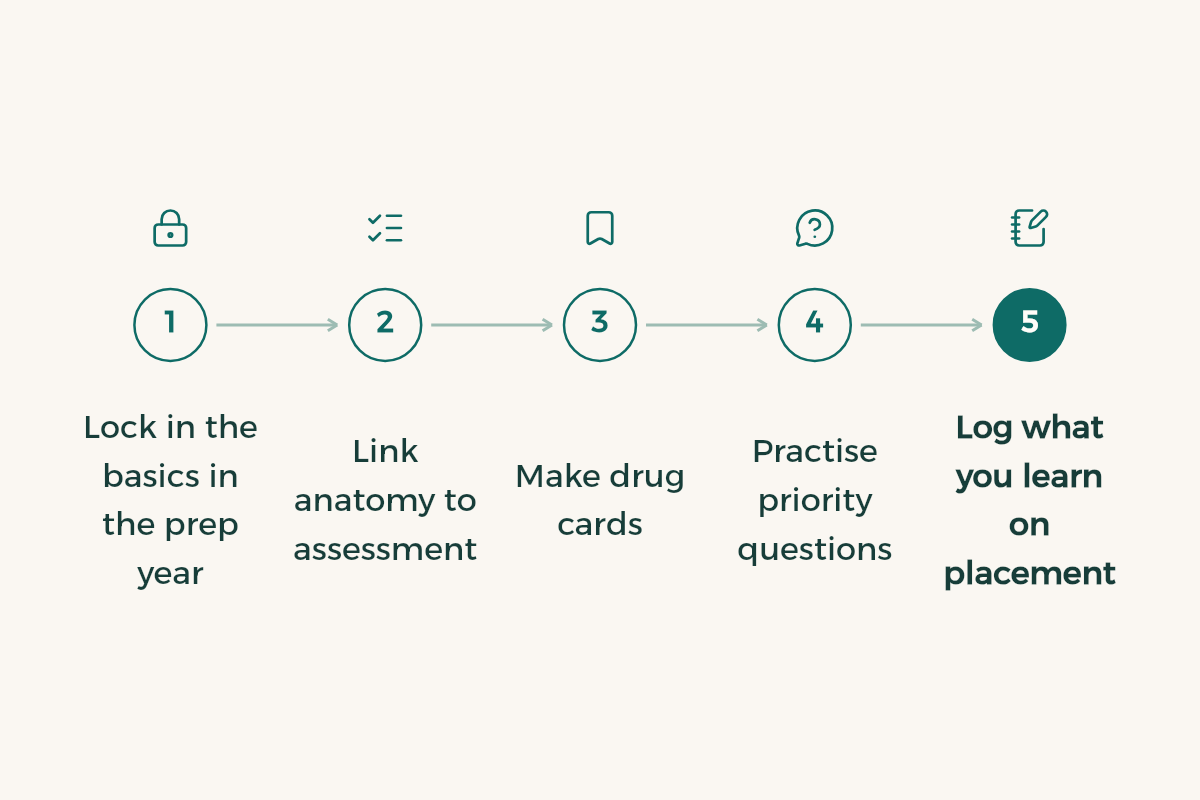
- Lock in the basics in the prep year
Biology and English decide whether you get into the college, so make them your priority and review them weekly, not just before exams.
- Link anatomy to assessment
For every body system you study in anatomy and physiology, practise assessing it in the skills lab the same week.
- Make drug cards
One card per drug: class, use, key side effects and what the nurse monitors. Review them with spaced repetition.
- Practise priority questions
"Which patient do you see first?" questions show up in college exams and in the SNLE. Do some every week.
- Log what you learn on placement
After each clinical day, write up one case you learned from, with nothing that identifies the patient, and review it before exams.
Prompt: a practice assessment case
One of the best ways to study in year two is to practise health assessment on made-up cases before clinical training. Copy this prompt and swap the body system in brackets for whatever you are studying this week:
You are a nursing tutor. Write me a short made-up patient case on [the respiratory system]: age, complaint, vital signs and exam findings. Do not name the diagnosis. Ask me: what are the subjective and objective data? What three findings worry you most? What do you report to the charge nurse first? After I answer, correct me calmly and tell me what I missed.
Nursing compared with nearby health majors
Many students compare nursing with medicine, respiratory therapy and emergency medical services. The core difference is the role: the doctor diagnoses and sets the treatment plan, while the nurse stays with the patient through the shift, delivers care, watches for changes and teaches the patient and family. Respiratory therapy focuses on the lungs and breathing equipment, and EMS focuses on care before the hospital. If you like continuity with patients and working in a large team, nursing is a close fit. For detailed comparisons read the respiratory therapy major and the emergency medical services major.
In practical terms, nursing is at least a year shorter than medicine in the documented example, and students start clinical training relatively early. That does not make it easier: the daily responsibility for patient safety is real, and the licence exam covers a wide range from adult care to mothers and children.
Is nursing right for you?
Nursing suits people who like working with others, can handle shifts and long hours on their feet, and pay attention to small details, because noticing a slight change in a patient can make a big difference. If you are torn between nursing and another health major, read how to choose a university major and the medicine major guide to compare length and the nature of the work, or browse all majors guides.