By the tiswa editorial team, from the official sources listed at the end of this guide. How we write our guides
The software engineering major in Saudi Arabia answers a question every tech team faces: how do you build a large program that dozens of developers work on and millions of people use, without it breaking with every update? Writing code is part of the job, but before it comes understanding requirements and designing the system, and after it comes testing, quality, maintenance and project management. This guide explains the major from official sources: length, courses, admission, how it differs from computer science, jobs and how to stand out.
How many years is software engineering?
At KFUPM, the BS in Software Engineering is four years after a required preparatory year, with 129 credit hours, and the programme is accredited by the Engineering Accreditation Commission of ABET. The bulletin describes it as broad-based, covering the main aspects of the discipline and preparing graduates for industry or graduate study. The plan includes summer training in the summer of the junior year. At King Saud University, software engineering is the newest department in the College of Computer and Information Sciences, and its first programme is the BS in Software Engineering.
Software engineering courses
The KFUPM plan combines two groups of courses:
| Group | Courses | What you learn |
|---|---|---|
| Computing foundation | Object-oriented programming, data structures and algorithms, algorithm design and analysis, databases, networks, information security, operating systems | The same base a computer science student takes |
| Requirements and design | Intro to software engineering, software requirements engineering, software design and construction | Turning a client's need into a specification and then a system design |
| Web and development | Web engineering and development | Building complete web applications |
| Quality | Software testing, software quality engineering | Making sure software works and stays maintainable |
| Management | Software project management | Planning, estimation, team and risk management |
| Graduation | Senior design project I and II, summer training | A real system built as a team, fully documented and tested |

Roughly a third of the courses are shared with computer science. The difference shows in the requirements, design, testing, quality and management courses, which prepare you to work in a team at a company.
The software life cycle you will live through
Most course projects and the senior project follow the same stages companies use, and each stage has a course in the plan:
- Requirements: you meet users and write down exactly what the system must do.
- Design: you split the system into parts and decide how they talk to each other.
- Construction: you write code with your team and merge changes regularly.
- Testing: you check that each part works, and that the parts work together.
- Release and maintenance: you deploy, fix bugs and add features without breaking what exists.
Software engineering vs computer science
Computer science goes deeper into theory, algorithms and research areas such as AI, while software engineering goes deeper into the process of building software as an organised engineering activity. Both produce developers; the difference is the focus. If you like asking "what is the smartest way to solve this?", computer science may fit you better. If you like asking "how do we build it, ship it and keep it running with a team?", software engineering may fit better. For details, read the computer science major.
Admission to software engineering
Admission for Saudi students at public universities rests on a weighted percentage combining the secondary school grade, the General Aptitude Test and the Achievement Test. The KSU admissions office says all Saudi applicants must take both tests, and that its academic excellence programmes in engineering and computer science require a weighted score of at least 90%. At most universities, the department is set after the first year by GPA and preference. Cut-offs change every year and are announced before admission opens.
Is software engineering right for you?
- You like coding, and you like seeing your software actually used even more.
- You enjoy organising, planning and breaking big work into tasks.
- You are comfortable with teamwork and talking with clients and teammates.
- You care about quality and detail, and code that "almost" works does not satisfy you.
- You want skills that tech companies, banks and government bodies hire for.
Software engineering jobs
- Software engineer or web and mobile app developer.
- Software test and quality assurance engineer.
- Requirements analyst or technical business analyst.
- DevOps or cloud engineer.
- Systems designer or software architect after years of experience.
- Software project manager or tech team lead.
The best way to prove your skills is a real GitHub project with documentation, tests and a clear commit history. Start with a LinkedIn profile for students, and read the co-op training guide.
Do software engineering graduates register with the Saudi Council of Engineers?
The Saudi Council of Engineers offers immediate professional accreditation to holders of a bachelor's in an engineering programme from a university or engineering college accredited by the Ministry of Education. Because software engineering is an engineering programme accredited by the Engineering Accreditation Commission at some universities, check your programme's status at your university and the SCE services before graduating. For most software development roles, hiring comes down to your skills, projects and experience.
How to stand out in software engineering
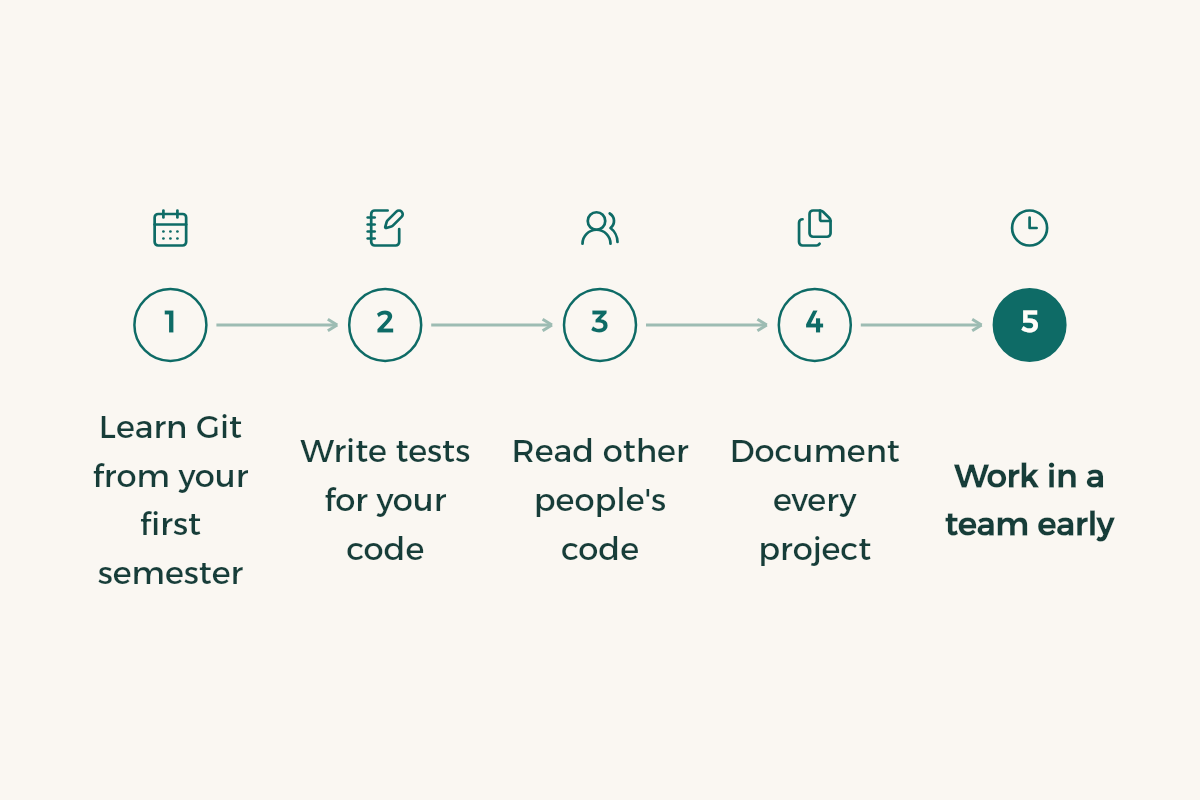
- Learn Git from your first semester
Every software team uses version control. Use it even for solo assignments.
- Write tests for your code
Make it a habit that every important function has a test. That is what separates a software engineer from a coder.
- Read other people's code
Open source projects show you how large programs are organised.
- Document every project
A clear README, a simple system diagram and run instructions. That is the first thing a reviewer sees.
- Work in a team early
Coding competitions and hackathons train you to coordinate and split tasks.
- Use free tools
Many developer tools are free for students; see the GitHub Student Developer Pack.
I am a software engineering student working on [an app for booking study rooms at my university]. Do not write the requirements for me. Ask me ten questions a requirements analyst would ask the client about users, permissions and edge cases. After I answer, help me review the user stories I write in the form "As a... I want... so that..." and tell me which ones are vague or untestable.
For more ways to use AI in coding and review without it writing for you, read AI for computer science students. For project ideas, see graduation project ideas. And if you are comparing a major that blends technology and management, see the information systems major.