By the tiswa editorial team, from the official sources listed at the end of this guide. How we write our guides
Your textbook is in English. Your co-op supervisor posts entries into an Arabic system, and the annual report you analyse for a class project was filed in Arabic first. That split is why a student can define accrued expenses perfectly and still freeze when asked for مصروفات مستحقة. Below are about 70 terms, ordered by when you need them rather than alphabetically.
Which accounting terms with examples should you learn first?
Six. Students who own these in the first two weeks of Principles of Accounting tend to coast; students who jump to ratios first end up memorising without understanding.
- Debit / credit (المدين والدائن)
Know which accounts increase on the debit side, or nothing later will stick.
- Journal entry (قيد اليومية)
The first line of every transaction you record.
- Accounting equation (المعادلة المحاسبية)
Assets = liabilities + equity. Test every entry against it.
- Accrual basis (أساس الاستحقاق)
Every adjusting entry rests on it, and so do most end-of-term mistakes.
- Trial balance (ميزان المراجعة)
Catches an unbalanced entry before you build the statements.
- Income statement / balance sheet
Asked about in every midterm.
Core entries in English and Arabic
| English | Arabic | Meaning |
|---|---|---|
| Asset | أصل | Something the business owns and expects future benefit from. |
| Liability | التزام | An amount the business owes another party. |
| Equity | حقوق الملكية | What is left for owners after liabilities. |
| Revenue | الإيرادات | Earnings from selling goods or services. |
| Expense | المصروفات | Costs used up to earn the period's revenue. |
| Accrual basis | أساس الاستحقاق | Record a transaction when it happens, whenever the cash moves. |
| Cash basis | الأساس النقدي | Record it only when cash is received or paid. |
| Journal entry | قيد يومية | A transaction recorded with equal debits and credits. |
| General ledger | دفتر الأستاذ العام | The book holding each account on its own page. |
| Trial balance | ميزان المراجعة | A list of balances that exposes unbalanced entries. |

One example covers the whole table. A café in Al Khobar pays six months of rent up front. Debit prepaid rent (an asset), credit cash. A month later, move one sixth to rent expense. That second step is what your textbook calls an adjusting entry.
What are the accounting terms in Arabic for financial statements?
Companies listed in Saudi Arabia must use IFRS as endorsed by the Saudi Organization for Chartered and Professional Accountants (SOCPA), which reviews each standard on technical, Sharia and legal grounds before endorsing it.1 So in published Saudi reports you will see قائمة المركز المالي far more often than الميزانية العمومية.
| English | Arabic | Note |
|---|---|---|
| Statement of financial position (balance sheet) | قائمة المركز المالي | Assets, liabilities and equity at one date. |
| Income statement | قائمة الدخل | Revenue, expenses and net profit over a period. |
| Cash flow statement | قائمة التدفقات النقدية | Cash in and out, split into operating, investing and financing. |
| Cost of goods sold (COGS) | تكلفة البضاعة المباعة | What the goods sold cost. |
| Gross profit | مجمل الربح | Revenue minus COGS. |
| Net profit | صافي الربح | What is left after every expense. |
| Retained earnings | الأرباح المبقاة | Accumulated profit not paid out. |
| Working capital | رأس المال العامل | Current assets minus current liabilities. |
| Current ratio | نسبة التداول | Current assets divided by current liabilities. |
| Going concern | فرض الاستمرارية | The assumption the business continues. |
Smaller companies use the IFRS for SMEs standard endorsed in Saudi Arabia, and the Foundation notes it has been translated into Arabic.1 If you want one trustworthy Arabic reference, start there rather than with a forum PDF.
Adjustments, controls and audit
| English | Arabic | Meaning |
|---|---|---|
| Depreciation | الإهلاك | Spreading a physical asset's cost over its useful life. |
| Amortization | الإطفاء | The same idea for an intangible, such as purchased software. |
| Accounts receivable | الذمم المدينة | What customers owe you. |
| Accounts payable | الذمم الدائنة | What you owe suppliers. |
| Accrued expenses | المصروفات المستحقة | Incurred but not yet paid. |
| Prepaid expenses | المصروفات المدفوعة مقدماً | Paid for a period still to come. |
| Provision | مخصص | A liability of uncertain timing or amount. |
| Goodwill | الشهرة | What an acquirer pays above net assets. |
Saudi usage translates audit as مراجعة; even SOCPA's Arabic name is الهيئة السعودية للمراجعين والمحاسبين. You will meet تدقيق in books from other Arab countries, and it means the same. Materiality is الأهمية النسبية, internal control is الرقابة الداخلية, and a bank reconciliation is مطابقة كشف البنك.
Finance and capital market terms
| English | Arabic | Meaning |
|---|---|---|
| Present value (PV) | القيمة الحالية | What a future amount is worth today. |
| Net present value (NPV) | صافي القيمة الحالية | PV of expected cash flows minus the investment. |
| Internal rate of return (IRR) | معدل العائد الداخلي | The rate at which NPV is zero. |
| Discount rate | معدل الخصم | The rate used to bring future cash back to today. |
| Opportunity cost | تكلفة الفرصة البديلة | The best option you gave up. |
| Liquidity | السيولة | How fast an asset turns into cash without a big loss. |
| Leverage | الرافعة المالية | Financing with debt to lift returns. |
| Cost of capital | تكلفة رأس المال | The minimum return funders expect. |
| Dividend | توزيعات الأرباح | Profit paid to shareholders. |
| Debt instrument | أداة دين | A tradeable instrument that creates or acknowledges debt. |
| Prospectus | نشرة الإصدار | The document required to offer securities. |
Writing a paper on Saudi stocks? Take definitions from the Capital Market Authority's glossary, not a general dictionary. It separates the Main Market from the Parallel Market by the offering rules each follows, and defines a substantial shareholder as a person holding 5% or more of a class of the issuer's shares.2
Islamic finance and zakat
Here the trap runs the other way. These words are Arabic to begin with, and students explain Murabaha as a loan. It is a sale.
- Murabaha (المرابحة): a sale at cost plus a disclosed, agreed profit.
- Ijara (الإجارة): leasing an asset for a known rent over a known period.
- Musharaka (المشاركة): both sides bring capital and share profit and loss by agreement.
- Mudaraba (المضاربة): one side brings the money, the other the work.
- Zakat (الزكاة): IFRS does not cover it, so SOCPA issues its own pronouncements on it.1
What are the common accounting terms translation mistakes from Arabic to English?
| Word | Wrong | Right |
|---|---|---|
| Provision | احتياطي | مخصص. A reserve (احتياطي) sits in equity. |
| Credit | ائتمان | In an entry it is الدائن; ائتمان is the banking sense. |
| Revenue vs income | both دخل | Revenue is إيراد; income usually means profit. |
| Allowance for doubtful accounts | bad debt expense | مخصص الديون المشكوك في تحصيلها, a contra-asset. |
| Depreciation | استهلاك | Saudi textbooks mostly use الإهلاك; استهلاك is used elsewhere. |
And one mix-up that has nothing to do with language: receivable versus payable. Receivable is money coming to you. Payable is money leaving.
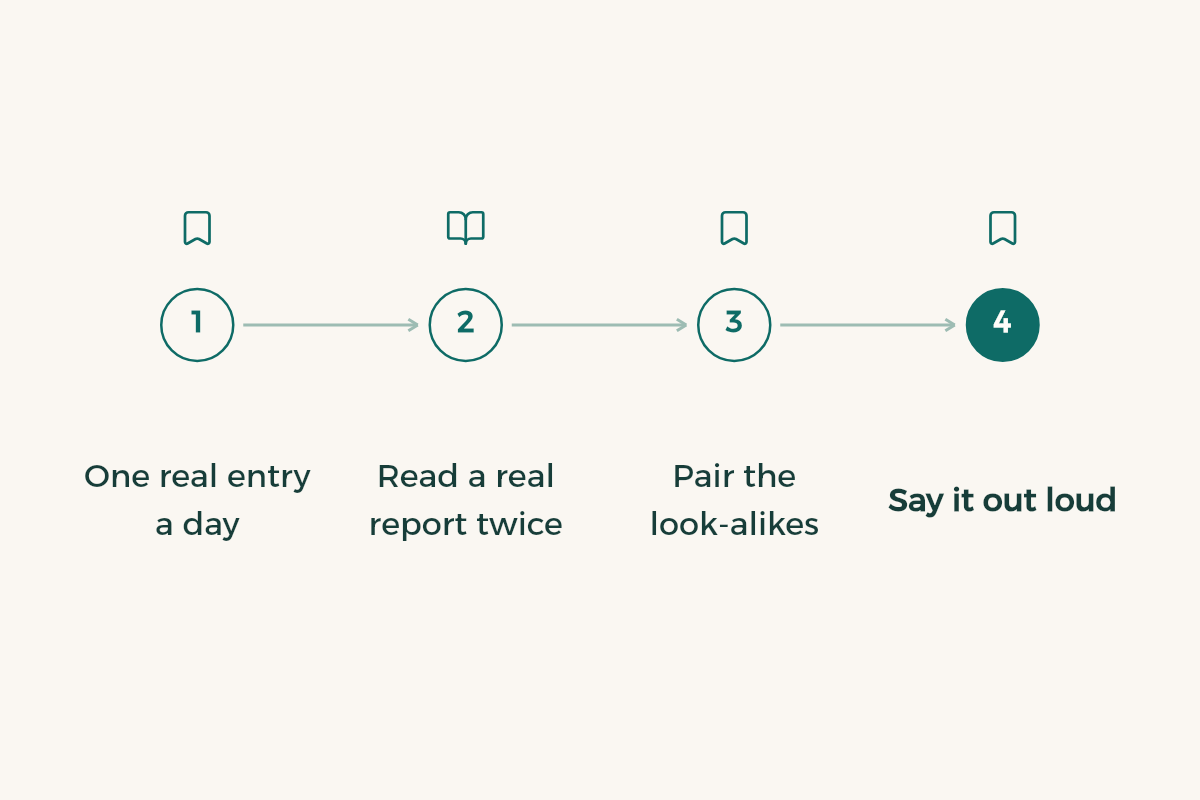
How do you learn accounting terms and meaning fast?
- One real entry a day
Record something from your own week, say a textbook purchase, with its debit and credit in English.
- Read a real report twice
Open a Saudi listed company's annual report in both languages and match the line items.
- Pair the look-alikes
Put depreciation and amortization on one card and quiz yourself before bed.
- Say it out loud
Explain an income statement to a classmate in two minutes without notes.
Give me five transactions for a small coffee shop in Jeddah. Ask me to record each with its debit and credit in English, then build a trial balance. Do not show the answer before I reply, and correct every wrong term or number.
Still choosing? Read the accounting major guide and the finance major guide. For management and marketing words there is the business and marketing glossary, and for personal money the zakat on savings guide and the Sah sukuk guide.