By the tiswa editorial team, from the official sources listed at the end of this guide. How we write our guides
A new student opened the degree plan at an engineering college and found nine courses in the first semester and eight in the second. He could not see why he was studying physics before he had seen a bridge or a dam. The scene is an example, but it repeats: the first-year table looks far from the profession, and it is actually the shortest route to it once you know how to read it.
What are the first-year civil engineering courses?
Plans differ between universities, and some begin with a shared preparatory year for all engineering before the branches split. So we do not give you an official list. What you usually find falls into four groups: maths, basic sciences, drawing and computing, and an introduction to the profession. Course names, numbers and credit hours sit in your own college plan, so get them from the official website or your academic adviser.
| Group | Example course (illustrative) | What it builds later |
|---|---|---|
| Mathematics | Calculus, differential equations | Every equation in statics and structures |
| Basic sciences | Mechanics-based physics, general chemistry | Understanding forces, and the properties of concrete and soil |
| Drawing and computing | Engineering drawing, intro to programming | Reading drawings and automating calculations |
| Profession intro | Introduction to civil engineering | Knowing the branches and choosing your path |
| Communication | English, technical report writing | Lab reports and co-op training |
The table is a way to organise your thinking, and your official plan governs registration.
How do you read a civil engineering degree plan?
Start with prerequisites. The plan lists next to each course what you must pass before it, and failing one course can delay a whole chain. If statics needs mechanics-based physics, and that needs calculus, then failing calculus holds back three courses, not one. The same method is explained in more detail in the guide to reading your degree plan, and the course specification guide shows how to read each course’s aims and outcomes.
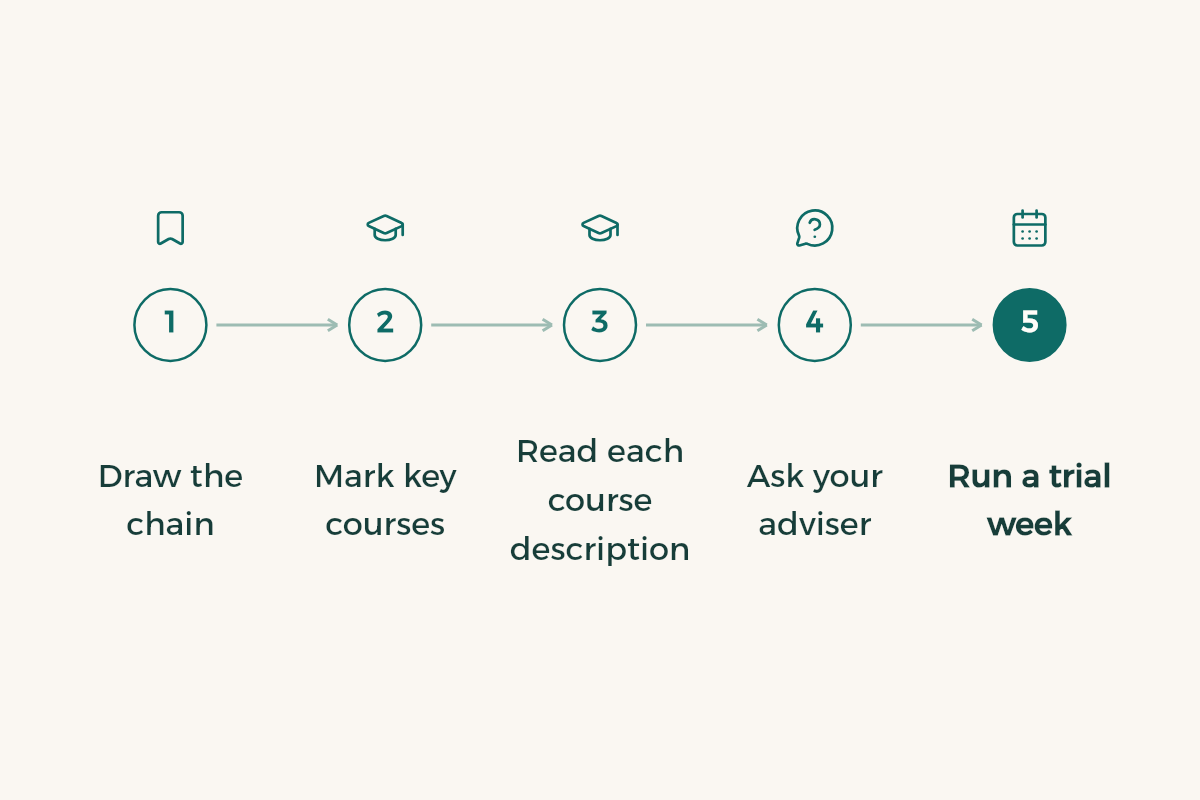
- Draw the chain on paper
Write the course names and link each to its prerequisite with an arrow. A course with several arrows leaving it is a key course.
- Mark the key courses
Usually calculus and physics. Give them fixed weekly time before the other subjects.
- Read each course description
Look in the course specification for textbooks, assessment method and test weights, and note them beside the course.
- Ask your adviser about load
How many credit hours suit your first semester? One direct question beats a guess.
- Run a trial week
Put lectures and study blocks into one timetable and test it for two weeks before changing it.
How do you prepare for first-year civil engineering courses before term starts?
You do not need to read a whole textbook ahead of the instructor. You need sound basic maths and one experience of turning a physics problem into a drawing. Here is one exercise specific to civil engineering: take a shelf fixed to a wall and holding books, draw it as a straight line, then draw arrows for the weights and for the reaction at the fixing. Ask yourself which way it would move if it were free. That is a free-body diagram, and it is the first thing you will write in statics.
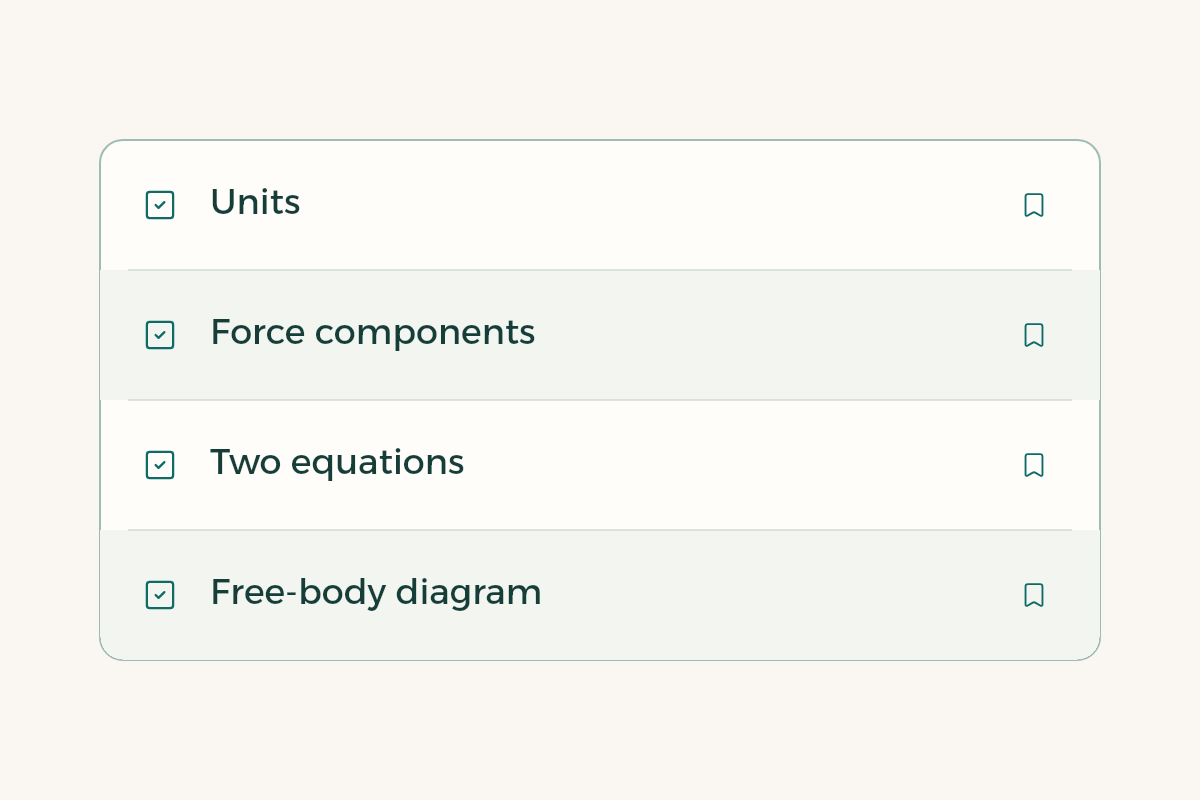
Practise three skills before the term: converting units (metres to centimetres, kilograms to newtons), splitting a force into two components with sine and cosine, and solving two equations in two unknowns. All three show up in almost every test, and they need no more than two hours a week. To see where these calculations end up in work, browse the civil engineering student software guide.
Is the maths in civil engineering hard for a new student?
It is hard for those who treat it as a separate subject and manageable for those who tie it to an application. The difference between two students is often habit, not intelligence: one solves ten problems every Tuesday and the other waits for the night before the test. Engineering accreditation bodies such as ABET require graduates to have a foundation in maths and basic science, which is why you will not find an engineering plan that skips them.2 The Saudi Council of Engineers is the body worth knowing from now, since you will need to register with it after graduating.1
For the studying itself, use the group study guide, because statics problems are understood faster when one of you explains them at a whiteboard. And if you want to manage your grade point average from semester one, the GPA calculation guide shows how each course weight counts.
How do year-one courses differ from the department courses after them?
Year-one courses are often shared with other engineering branches, while department courses come after: mechanics of materials, surveying, soil engineering and structural design. The American Society of Civil Engineers describes the branches of the profession on its site, and in each branch you can see where the maths you study now comes in.3 Do not worry about choosing a branch early, because that decision comes after you have seen the first courses.
If you are still deciding on your degree, go back to the civil engineering major guide, compare it using how to choose a major, and keep the engineering glossary open for the terms your instructors will use in week one.
Remember that reading the plan does not end at registration. Revisit it every semester: what have you finished, what remains, has a new prerequisite appeared? And to connect study with the working future, look at the civil engineering co-op skills guide to see what you need to start building now.
A common mistake is to register for everything the portal allows without looking at the load. The system may let you take fifteen credit hours when your first semester really calls for fewer. If you do fail a key course, do not postpone it: retake it in the first available term, and ask the deanship of admission and registration how retakes work and how they affect your GPA. Check the test schedule in your learning system, such as Blackboard, in week one, not two days before the test.