By the tiswa editorial team, from the official sources listed at the end of this guide. How we write our guides
A course specification and a course report are two linked documents. The specification tells students what they will learn and sets out the teaching, assessment and content that will deliver it. The course report is written at the end of the term to measure what was actually achieved, and what should change next time. This guide explains the logic of each document and gives you steps to complete both without losing any part.
What does a specification contain?
Published course specification forms from Saudi universities share a general shape: course information, then the description and aim, then the outcomes with their teaching and assessment, then the topics, assessment activities, resources and facilities, and finally quality review and approval.2 Section names and numbering differ, so the form approved at your university is the one you complete, not any other.
Most of the quality content sits in the outcomes, teaching and assessment section. Outcomes are its core, so read the guide to writing learning outcomes before you complete it.
Outcomes are usually grouped under numbered domains, such as knowledge and understanding, skills, and values with autonomy and responsibility. Older files may use a different grouping, so check which domains your university's form uses.
What does a course report contain?
The course report is written at the end of the course. The instructor completes it and gives it to the program coordinator. Its usual sections cover the course information and number of students, how the course was delivered compared with the plan and why it differed, results for each learning outcome, resources and facilities, administrative problems that disrupted the term, student and instructor evaluation, and an improvement plan.
Who writes what, and when?
In most universities the course coordinator or the department prepares the specification with the instructors before the course is first taught, and the department council approves it. The course report is different. The instructor completes it at the end of each term, for each section or campus location where the course is taught. The program coordinator then combines the reports into one program-level report. An instructor who teaches two sections writes two reports.
How do you move from the specification to the report?
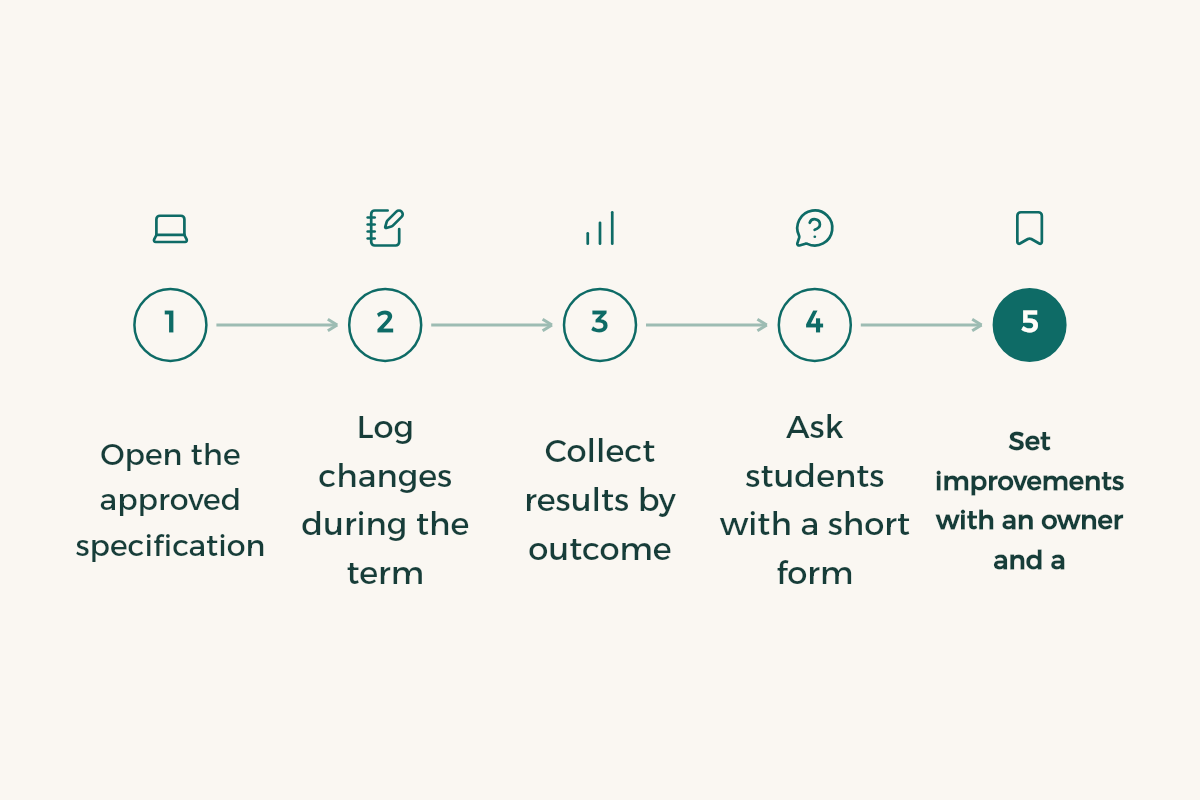
- Open the approved specification
Before the term starts, save or print the approved version. The report compares what happened with what was promised, so do not write it from memory.
- Log changes during the term
Keep a short note for every change: a topic moved, a task dropped, a lecture turned into a lab session. This note is the basis of the delivery section.
- Collect results by outcome
Link each assessment to the outcome it measures, then total performance by outcome. If an outcome is measured by two tests, combine the results from both.
- Ask students with a short form
Four or five questions are enough: were the tasks clear, was the time right, what helped you most? Record the answers before you comment on them.
- Set improvements with an owner and a date
Each improvement needs a verb you can follow up, an owner and a date. For example: move the project report to week eight so the workload is spread across the term.
- Submit the report with evidence
Attach the exam blueprint, the anonymised grade summary and sample student work. A report backed by evidence stands up better in review.
How does the specification connect to the report?
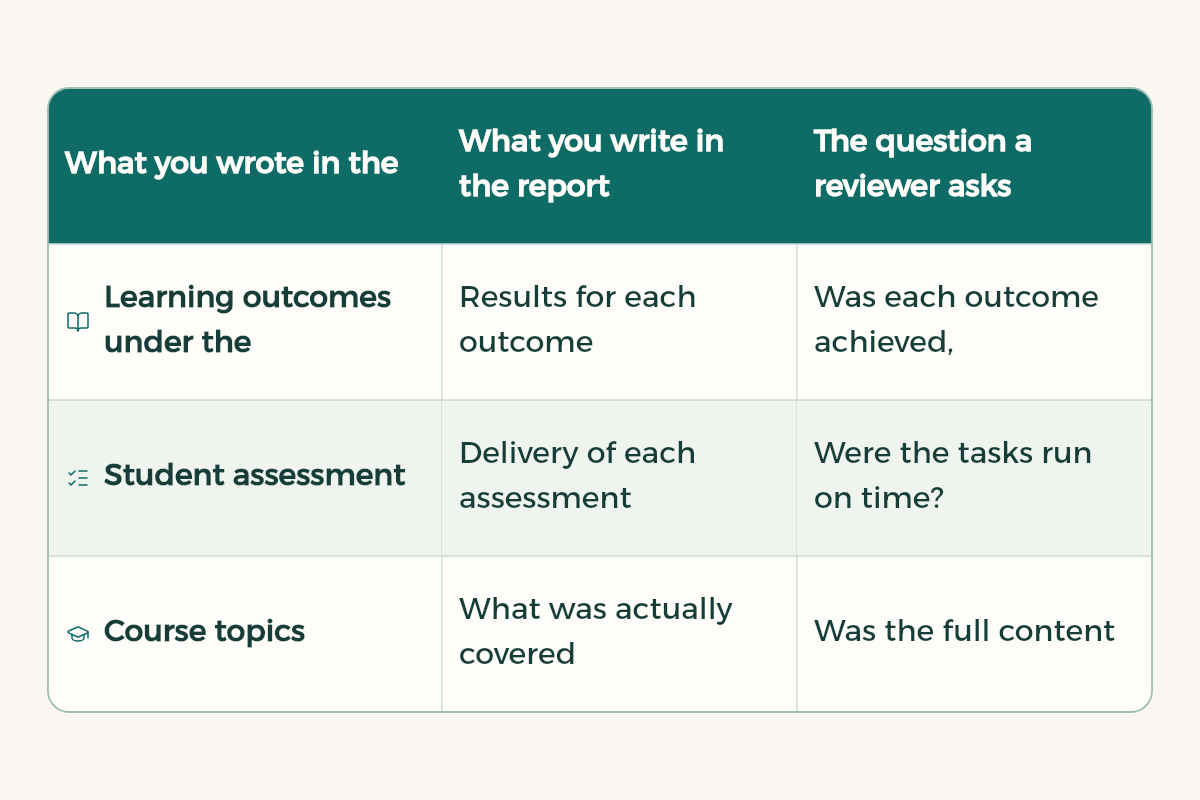
The table below shows how each part of the specification connects to the report, so you know where each piece of information belongs and what a reviewer will check:
| What you wrote in the specification | What you write in the report | The question a reviewer asks |
|---|---|---|
| Learning outcomes under the domains | Results for each outcome | Was each outcome achieved, and where did results fall short? |
| Student assessment activities and timing | Delivery of each assessment | Were the tasks run on time? |
| Course topics | What was actually covered | Was the full content delivered? |
| Learning resources and facilities | Whether they were adequate | Did students need a resource that was not available? |
| Teaching strategies | What worked and what did not | Which method needs changing next term? |
What mistakes weaken both documents?
- Copying a specification from another course without changing it, so the file does not match the course it describes.
- Writing the report weeks after the term ends, when details have faded and causes sound generic.
- Reading results only through the grade average, without looking at the outcomes they were meant to measure.
- An improvement plan with no owner and no date, so the same problems return next term.
- Changing content or assessment during the term without recording it.
How do you draft the report with a prompt?
I am the instructor of [course name], and the term has ended. Here are the approved learning outcomes, grouped under their domains, and the assessment tasks:
[paste them here]
Here are the results for each assessment, with the number of students who completed the course:
[paste the totals]
Here are my notes from the term:
[paste the notes]
Draft the delivery section, then the results grouped by learning outcome, then a three-point improvement plan. Do not invent numbers that are not in what I pasted, and list any information that is missing.
What comes after the report?
The report is not the end of the course. It is the starting point for the next specification. Adjust the learning outcomes and assessment based on what you found. If participation was weak, the active learning strategies guide has ideas. If there was not enough time inside the lecture for practice, read about the flipped classroom. More guides for teaching staff are in the faculty section.