By the tiswa editorial team, from the official sources listed at the end of this guide. How we write our guides
Academic integrity and preventing cheating are linked responsibilities, and neither works alone. A student who knows the rule and understands its purpose is less likely to cheat, and a well-designed assessment is hard to cheat on in the first place. This guide sets out a practical framework for lecturers: a written policy, assessment design, settings for online exams, and fair steps when there is a concern.
What counts as cheating in your course?
The first practical step is to state in the course specification what counts as cheating and what does not. Ambiguity causes most disputes. A student who never learned that working together on an individual task was banned will honestly believe they did nothing wrong. Include three elements:
- Specific examples from your own course: copying from a classmate, using written notes in a closed-book test, and submitting someone else's work under your name.
- What is explicitly allowed, such as approved sources and the citation style the department requires.
- The procedure used when a concern arises, and the student's right to respond under the university's regulations.
When a quality review looks at your course, the first thing it asks for is a written policy that everyone knows and applies. For the wording of accreditation requirements, read the academic accreditation policies published by the Education and Training Evaluation Commission yourself.1 Write the policy once, clearly, and do not rewrite it from scratch every term.
How do you design assessment that is hard to cheat on?
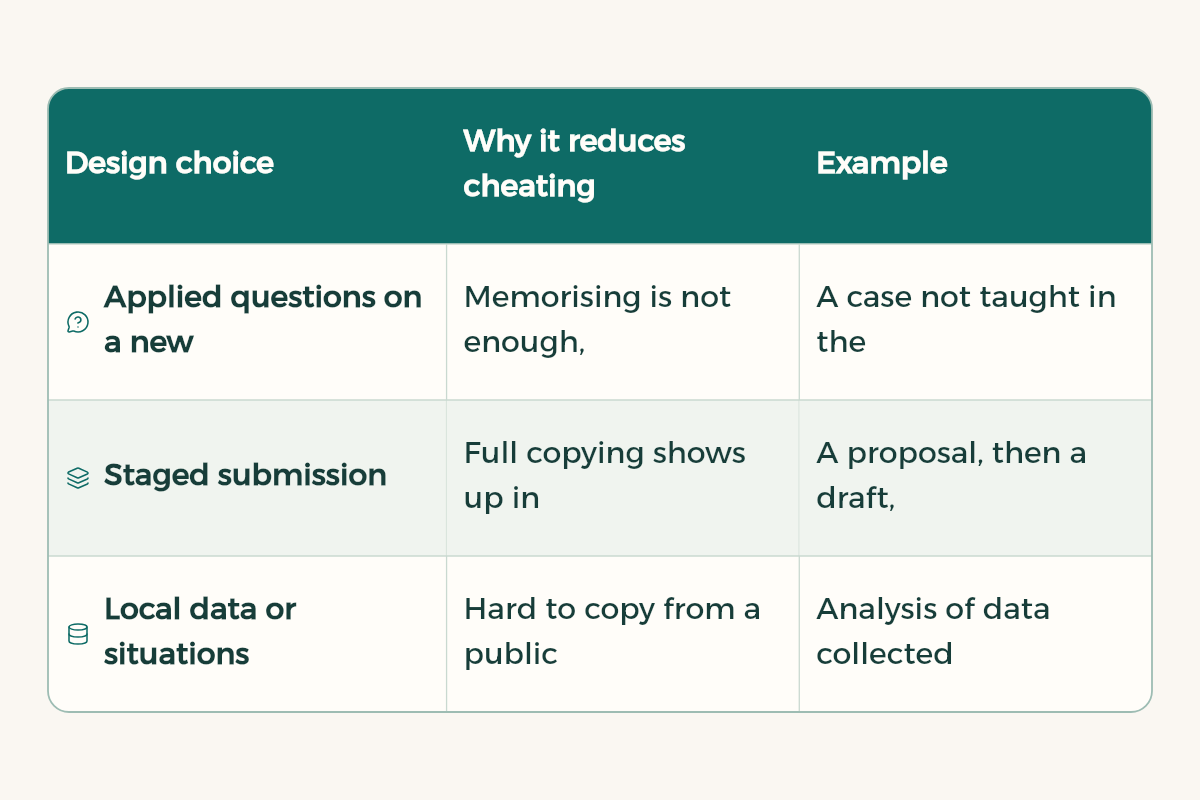
Most cheating happens in assessments that repeat the same questions year after year, or that ask only for memorised recall. Good design reduces the need for policing in the first place:
| Design choice | Why it reduces cheating | Example |
|---|---|---|
| Applied questions on a new case | Memorising is not enough, and the answer needs understanding | A case not taught in the same wording, asking for the concept to be applied |
| Staged submission | Full copying shows up in the early stages | A proposal, then a draft, then a final version |
| Local data or situations | Hard to copy from a public source | Analysis of data collected in class |
| Changing questions each term | Old questions do not circulate among students | Changing numbers, contexts and question order |
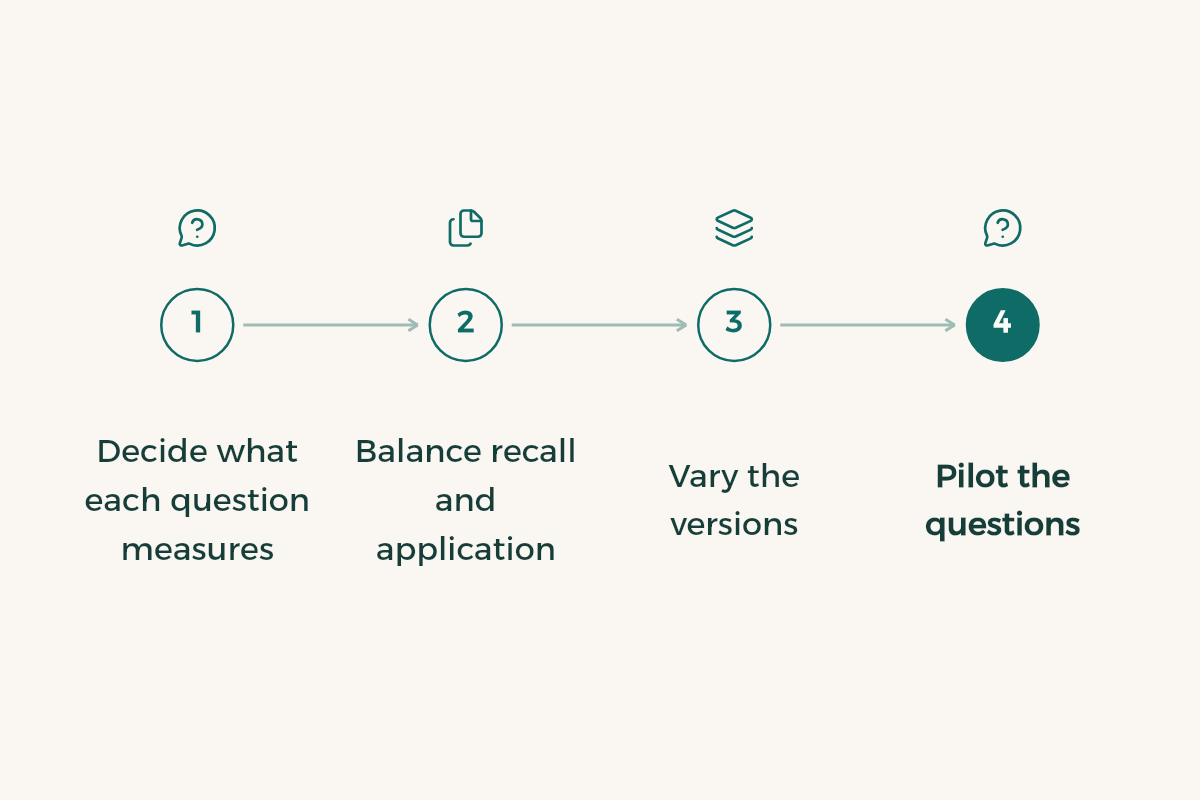
- Decide what each question measures
Write the learning outcome beside each question. If you cannot find one, the question may not deserve its place.
- Balance recall and application
Make a reasonable share of the exam ask for application and analysis, since those are harder to copy.
- Vary the versions
If you teach more than one section, change the order of questions or the numbers, keeping the difficulty the same.
- Pilot the questions
Try the exam on a colleague or a small group, and check that the right answer cannot be guessed easily.
Online exams: which settings cut the chances of cheating?
An online exam needs different thinking from a hall exam, because the student may be somewhere else with other resources. No setting stops cheating completely, but these steps clearly reduce the chances:
- Set a clear time limit that fits the number of questions, so the student has no spare time to search for answers.
- Randomise the order of questions and options where your system allows it, since identical versions make collaboration easier.
- State the exam rules before it starts: what materials are allowed, what happens if the screen is left, and what happens if the connection drops.
- Include open or applied questions in part of the exam, because they reveal understanding more than direct multiple choice.
- Keep a record of attempts and timings, so you can review any doubtful case on evidence rather than impression.
To prepare the exam itself, the Blackboard Grade Center guide explains how grades are calculated after marking. For the questions, writing multiple choice exams shows how to write plausible and fair distractors.
Can an AI detector prove that a student cheated?
No. Detection tools make mistakes, and a percentage from a tool is not evidence on its own. Treat the result as a prompt to look at the work itself: does it match what the student explained in class, can they name their sources, and is there a trail of drafts that shows how it grew?
What helps more is writing the permitted levels of AI use as concrete sentences: what is allowed for generating ideas, what is allowed for wording, and what is banned outright. The general line "use AI responsibly" settles nothing. We covered this in AI in university teaching and in detecting AI use in student work.
What is the best AI writing detector for teachers?
There is no single best one, and a tool that works well on one course can miss work in another. Test two or three tools on past submissions you already know were written by hand, and see how often they flag them. Record the results, and use the tool only as a prompt for a closer reading of the work.
How should you redesign an assignment for different course types?
No single design fits every course. The shared idea is that the assignment asks for something hard to copy: a local context, visible stages of work, or a short oral explanation.
| Course type | Easy-to-copy assignment | An alternative that shows learning |
|---|---|---|
| Theory course | A general essay on a well-known topic | A case analysis from the student's own city or university, with set sources |
| Quantitative course | Problems printed in the textbook | Problems with different numbers for each student, and one step explained aloud |
| Programming | A complete program submitted once | Staged submission with version history and a question about part of the code |
| Group project | A final report only | Short meeting notes, peer assessment and a brief presentation |
These designs do not stop cheating completely, but they make real work the easiest path. Start with one assignment next term and compare the quality of work with the term before. Link each assignment to clear criteria from the rubric guide, so students know the grade rewards thinking and stages, not only the final form.
Integrity is not the lecturer's job alone. If the department agrees on one way to word instructions, reviews exams before they are published, and shares examples of new questions across sections, cheating becomes harder and less tempting. Ask the head of department or the quality coordinator to put these practices on the meeting agenda.
What do you do when doubt arises after submission?
The first step is documentation. Keep the evidence as it is, and record the date and the circumstances. Do not make a public accusation or write it in a group message. Then speak with the student calmly, show them the evidence and listen to their answer. The decision follows your university's regulations, usually through a committee or a unit responsible for integrity.
Do not mix up a doubt about cheating with an appeal against a grade. The Jouf University regulation, for example, lets a student appeal a final grade within 15 days of the result being approved. If the department rejects the appeal, it goes to the college council, whose decision is final.2 Cheating has its own procedure, set by your university, so ask about it before you act.