By the tiswa editorial team, from the official sources listed at the end of this guide. How we write our guides
A report arrives with a number in bold, and the temptation is to read it as a verdict. It is not one. The score reflects how a text looks to a model trained on other texts, so it changes with length, format and register, and it says nothing about who typed the words. Treat it as a reason to look, never as the reason to act.
How reliable is an AI writing detector?
Most detectors compare patterns in a text with patterns they associate with machine-generated writing, then return a likelihood. A Stanford team published a study in Patterns in 2023 that tested several popular detectors on essays by native and non-native English writers. The detectors labelled many non-native essays as machine-written, and classified native-speaker essays far more accurately.1 OpenAI, which released a public classifier, switched it off in 2023 because its accuracy was low.2
Short texts and reference lists give weak signals. A student who writes in a formal, tidy register may look machine-made even if no tool touched the work. And a student who used an editing tool for phrasing produces a mixed result that no single number can settle.
Which AI writing detector evidence settles the question?
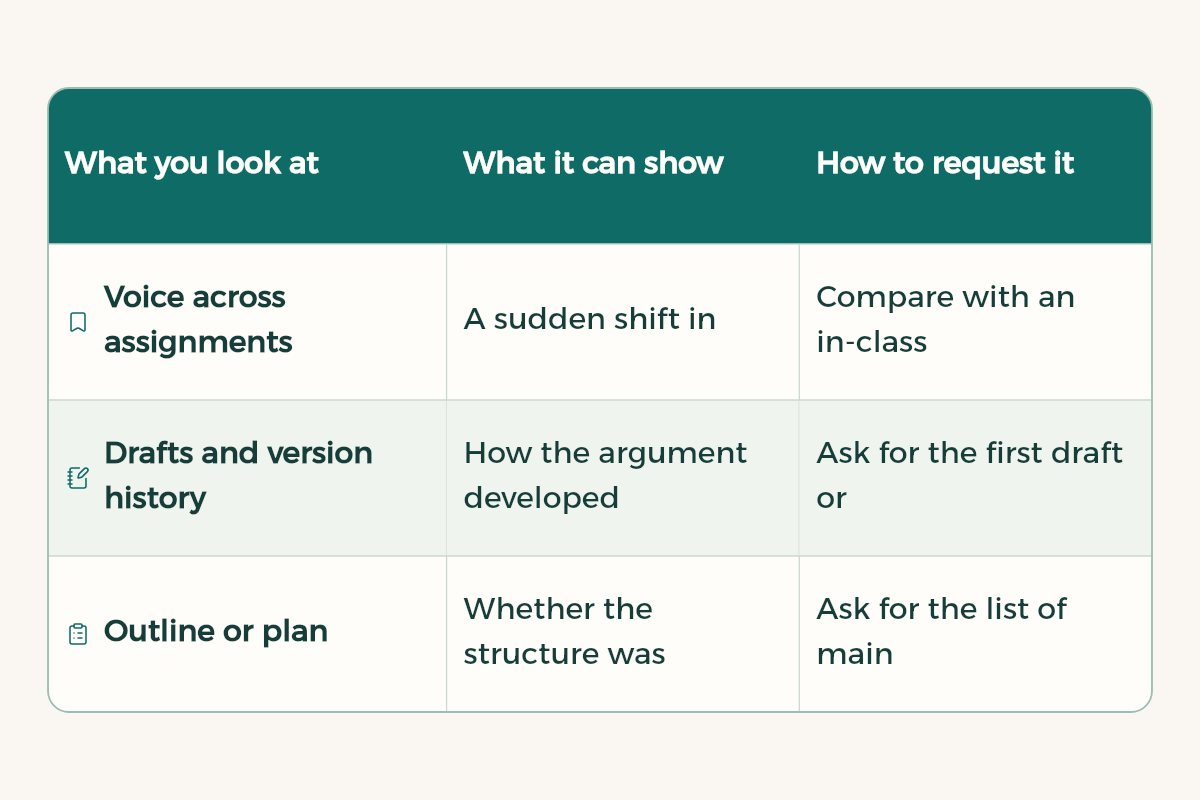
The evidence that settles things almost always exists before the deadline: drafts, version history in the file, the outline, and a comparison with earlier work you saw the student produce in class. Do not hunt for one suspicious sentence, since that is how reviews go wrong. Look for a change that repeats across several submissions.
| What you look at | What it can show | How to request it |
|---|---|---|
| Voice across assignments | A sudden shift in vocabulary and sentence rhythm | Compare with an in-class exercise or an earlier short task |
| Drafts and version history | How the argument developed and where it was corrected | Ask for the first draft or earlier saved versions |
| Outline or plan | Whether the structure was planned before drafting | Ask for the list of main points well before the due date |
| Sources | Whether the student read what they cite | Ask what one named source adds to the argument |
How do you review without accusing anyone?
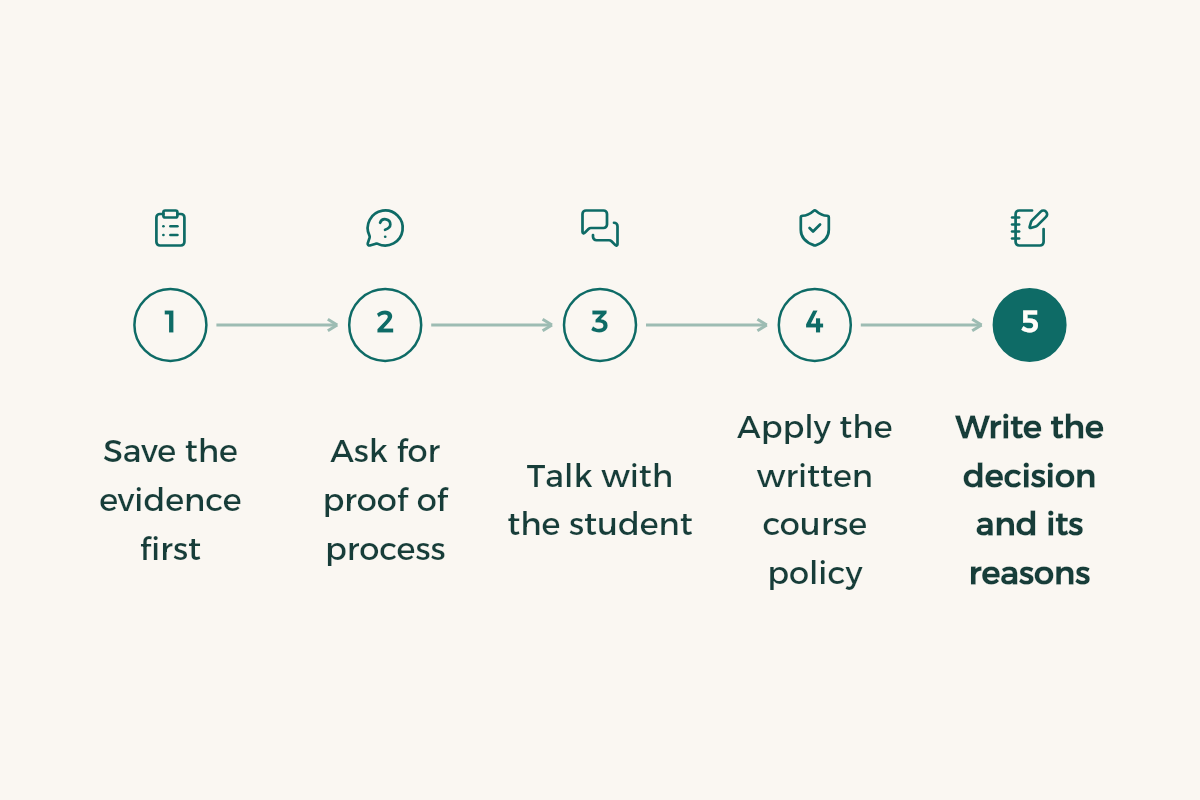
- Save the evidence first
Keep the submission, the tool output and the submission time together in one file. Write no accusation in an email or a comment until the review is finished.
- Ask for proof of process
Drafts, an outline or research notes, with a clear deadline for handing them in.
- Talk with the student
About the idea and the writing choices, using the questions in the section below.
- Apply the written course policy
If the permitted level appears in the course specification, compare the work with it. If nothing is written down, do not penalise a rule nobody announced.
- Write the decision and its reasons
Give the student the right to respond and to appeal under your faculty and university procedures.
If your faculty has an academic integrity committee, send the file there instead of deciding alone. A decision that passed through a committee is harder to overturn, and it protects you as much as the student.
Which questions reveal understanding in ten minutes?
A short conversation measures understanding directly. The student who wrote the work usually explains the choices easily, even when they stumble at the start. The student who did not often struggles with details of the text they handed in. Keep the tone calm and ask about the work, not about the software.
I am a lecturer in [subject]. The assignment is [describe the task], and the main points it should cover were: [list the points].
Write eight open questions for a ten-minute conversation with the student about their writing decisions, why they chose their sources, and how they would apply the main idea to a new case.
Do not write questions that can be answered with one word, and do not ask about specific tools.
Write the answers in a short note. Do not expect the student to recite anything word for word, because understanding shows in how they explain a choice.
How should you design the task so learning shows?
The strongest protection against wholesale copying is the task itself. A prompt about a popular topic can be imitated in a minute. A prompt tied to a class discussion, to data collected in the room, or to the student's own placement is much harder to finish with a tool alone. A clear rubric that rewards stages rather than only the final text makes the same point to students:
- Anchor the prompt to a discussion from the previous session.
- Stage it: a proposal, then a draft, then a final version with your short comment.
- Add a two-minute oral segment where the student defends one decision.
- Ask for a brief reflection on what was hard and what changed their view.
Write down why each assessment decision was made. Your course coordinator or a quality reviewer will ask for that reasoning, and a note written at the time is far more persuasive than one reconstructed later.
What do you do if doubt remains?
If doubt remains, use your university's formal procedure rather than an accusation. The academic integrity guide explains how clear procedures protect the student and the lecturer alike. If you want to review the course policy itself, the guide to AI in university teaching covers how to set the allowed level.
Two mistakes come up again and again. The first treats a strong student as a suspect because a score went up. The second punishes a rule that was never published. The advice above also does not fit a very short task, where no indicator tells you much.