By the tiswa editorial team, from the official sources listed at the end of this guide. How we write our guides
Open the old course file, copy the outcomes, and within two weeks you will find that half of them cannot be checked against anything. The fault is in the wording, not in your teaching. A good outcome makes the activity and the assessment easier to design, and it makes the committee reviewing the course far easier to satisfy.
Is an outcome the same as an aim?
An aim describes the purpose of the course, such as "introduce students to the principles of financial accounting". An outcome describes what the student does at the end, such as "prepares an income statement from a given trial balance". The aim appears once at the top of the specification. The outcomes sit beneath it, and each one should be something you could watch.
Constructive alignment rests on the idea that the verb in an outcome should reappear in the teaching and in the assessment.1 Graham Gibbs puts the practical point in the title of one of his essays: you cannot design learning activities until you are clear about your outcomes.2
How do you write learning outcomes for a course?
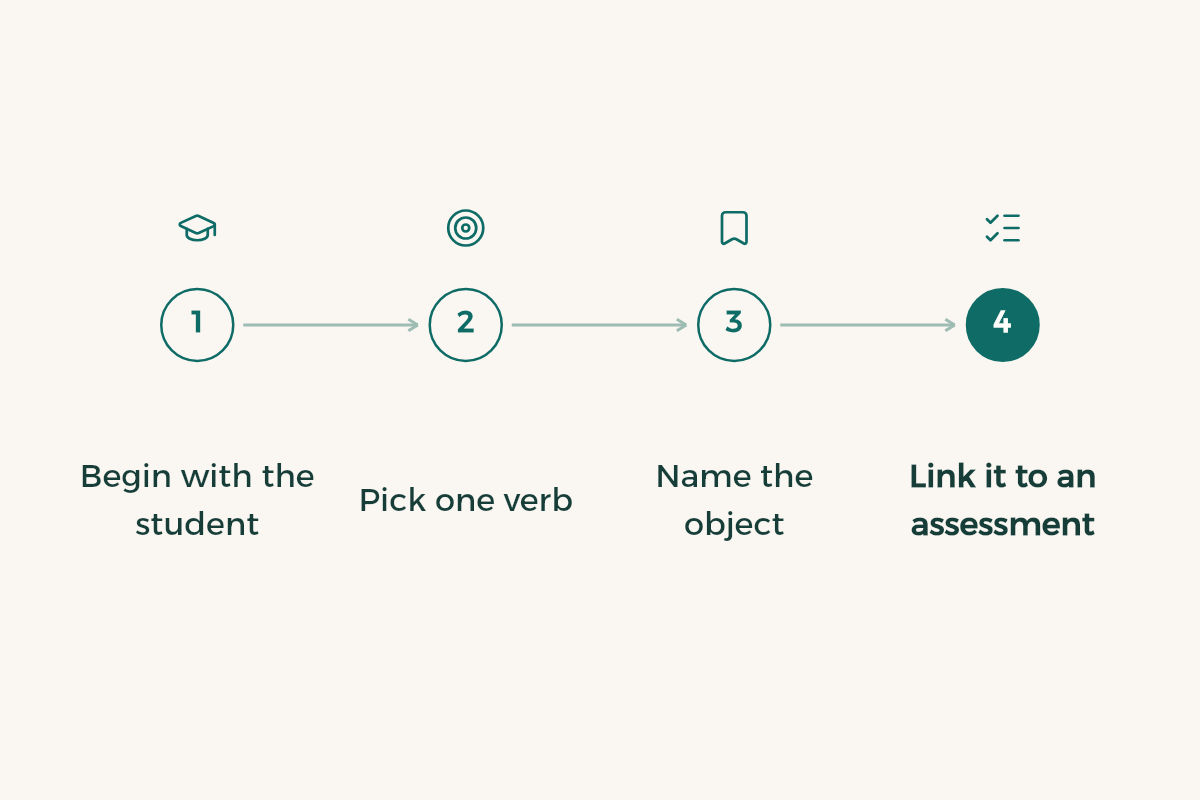
- Begin with the student
Complete the sentence "The student can..." with an action you could see. "Understands", "appreciates" and "knows" do not give you anything to observe.
- Pick one verb
An outcome with three verbs needs three different tests, and the meaning gets lost. Choose the sharpest verb, and add a second only if it belongs to the first.
- Name the object
After the verb comes the content: "solves second-degree equations", not "solves mathematical problems" in general.
- Link it to an assessment
Ask which question in the exam or project will show this outcome. If you cannot name one, either the outcome or the assessment is missing.
What are examples of learning outcomes?
Weak verbs describe something inside the head: understand, appreciate, believe. Stronger verbs describe something you can see: classify, calculate, design, compare, critique. Pick from the table by the level of the course. An introductory course mostly needs verbs of recall and explanation, and an advanced one needs verbs of analysis and design.
| Course level | Verbs that fit | Example outcome |
|---|---|---|
| Introductory | Define, classify, identify | Classifies lease contracts by type and governing rule |
| Intermediate | Calculate, apply, solve | Calculates liquidity ratios from a set of financial statements |
| Advanced | Compare, analyse, critique | Compares two inventory valuation methods and justifies the better one for a named firm |

Notice that every verb in that table can be tested. If you write "appreciates", you will struggle to set an exam question that shows it, which tells you the verb needs replacing.
What belongs in the alignment matrix?
The alignment matrix puts each outcome on its own row, then names the activity that trains it and the assessment that measures it. It does not need fancy formatting. It needs every row to be complete. A row without an assessment is an outcome you never check, and a row without an activity is an outcome you demand but never practise.
- Activity: a lecture segment, problems worked in class, a group project or an oral presentation.
- Assessment: a midterm, a staged assignment or a final exam question that targets it.
- Timing: the week in the course timetable when each outcome is assessed.
What mistakes keep recurring?
The most common one is ten outcomes for a three-credit course, which forces you to assess each of them in one exam question and leaves little time for anything else. The second is copying outcomes from another course without checking that anyone teaches them. The third is writing in aim language, so that an outcome becomes "is familiar with the topic".
Some courses do not fit this pattern, especially practical training where the outcome is a whole procedure carried out to a standard. There, write the outcome as a short ordered sequence of observable steps, and keep the same rule for assessment. Check the test items that measure those outcomes in the multiple choice guide.
Committees rarely reject an outcome because the topic is wrong. They reject it because nobody can say how it is measured. Before the specification goes to the department, ask a colleague to read each outcome and name the exam question that would test it. Where the colleague hesitates, the outcome needs another verb, not another paragraph of explanation. This review takes an afternoon and saves weeks of revision later.
What do you do once the outcomes are written?
Read them aloud to your students in the first session and ask them to say back what each one asks them to do. Whatever they explain is what they will try to do, so if the reading differs from your intention, rewrite the sentence before it goes into the file. Then use the rubric guide to set levels of performance that show how well each outcome was met.