By the tiswa editorial team, from the official sources listed at the end of this guide. How we write our guides
How to publish in peer-reviewed journals is one of the most useful skills a faculty member can build. Publication matters for promotion files, research grants and your standing in the field. Yet many researchers spend months on good work and then send it to a poor match, or to a doubtful outlet that charges fees and offers little review. This guide helps you choose a journal, check its quality, avoid predatory publishers, and start from official sources.
Start with the question: where does my paper fit?
Before you search for a journal, define three things: the specific field of your paper, the type of contribution (an empirical study, a systematic review, a case study or an analysis), and the readers you want to reach. A journal that publishes systematic reviews may not accept a small experimental study, while a regional journal may reach local readers better than a general international one. A good choice starts from this fit, not from the prestige of a name.
How to check the quality of a journal
A peer-reviewed journal means that submitted papers are assessed by experts in the field before acceptance. But the label alone is not enough. Ask who indexes the journal, and whether it appears in databases recognised in your discipline. Start with the databases your university library provides, some of which are available through the Saudi Digital Library.
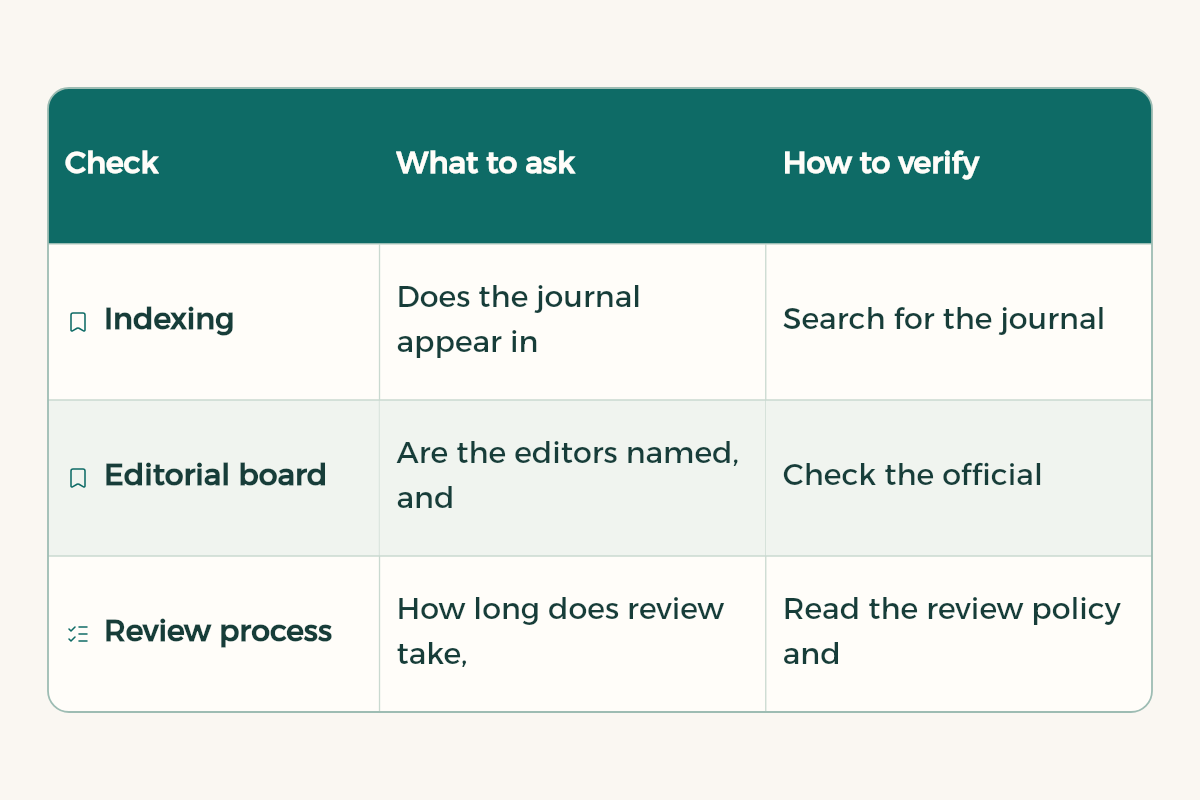
| Check | What to ask | How to verify |
|---|---|---|
| Indexing | Does the journal appear in an indexing database for your field? | Search for the journal inside that database, not only on the journal's own site |
| Editorial board | Are the editors named, and do they belong to real institutions? | Check the official editorial board pages and their university affiliations |
| Review process | How long does review take, and does the journal publish its review criteria? | Read the review policy and the response times the journal states |
| Fees | Are fees stated clearly before acceptance? | Read the fee policy and ask for the terms in writing before you submit |
| Publisher | Is the journal linked to a known publisher, society or university? | Look up the publisher, its contact details and its postal address |
Signs of a predatory journal
A predatory journal accepts articles for payment without enough scientific review, and often overpromises speed and reach. These signs should make you cautious:
- Invitations to publish sent from a general address, with phrases such as "we welcome your article immediately".
- No clear information about the publisher, the address, or the editorial board.
- A title close to a well-known journal, or a claim of indexing you cannot confirm in the database itself.
- Fees that are not stated, or appear only after acceptance, or pressure to submit within a day or two.
- Calls for papers on topics that have nothing to do with the journal's stated scope.
Steps before you submit
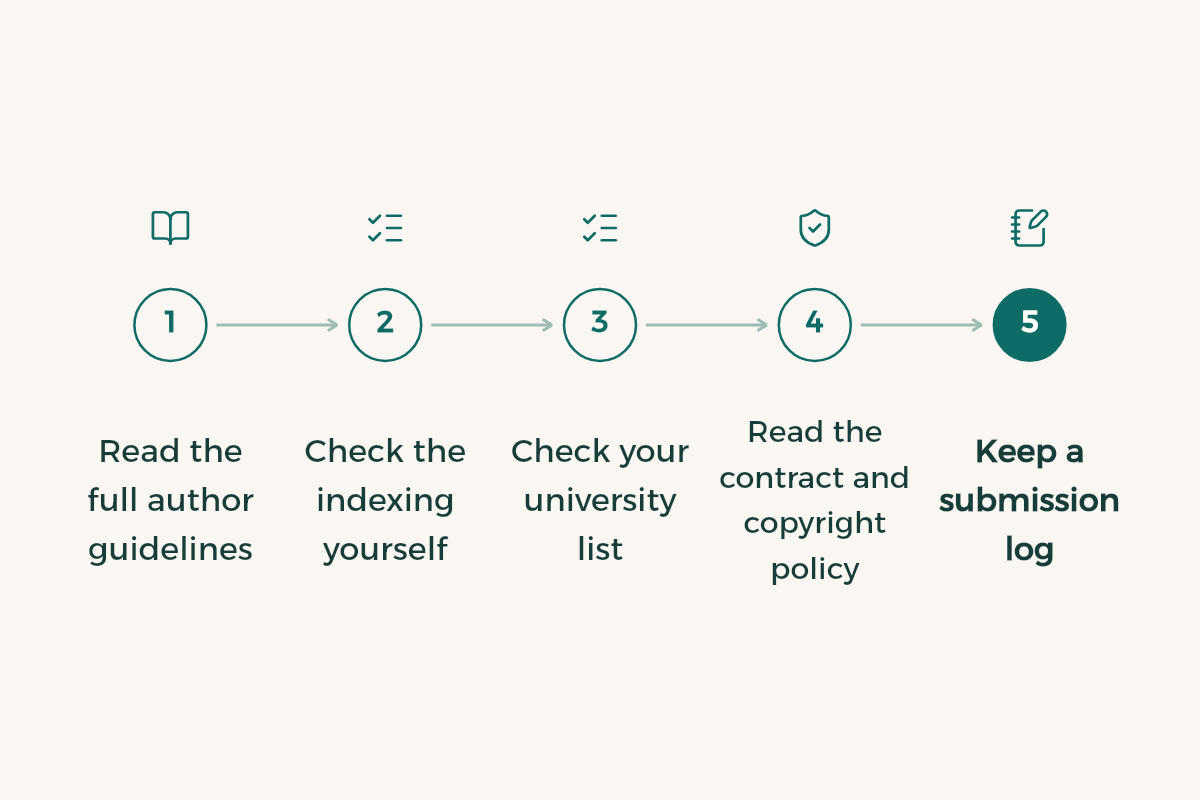
- Read the full author guidelines
Note the length, the citation style, the abstract format and how to submit. Many papers are returned for formal reasons before anyone reads them.
- Check the indexing yourself
Search for the journal in the databases your university uses, and save a screenshot or a link to the result. Do not rely on what the journal says about itself.
- Check your university list
Many Saudi universities publish lists or guides of the journals they recognise for promotion and research rewards. Ask your research deanship or the responsible office for the approved guide.
- Read the contract and copyright policy
Confirm your rights to reuse the paper after publication, and whether you can deposit it in your university repository. If a clause is unclear, ask for it in writing.
- Keep a submission log
Record the journal name, the submission date and the status, and keep official emails. The log also helps your promotion file.
Where to find official research resources
The Saudi Digital Library's official portal has a login for university members, and offers Arabic and foreign knowledge sources, Saudi scientific journals, a repository of Saudi master's and doctoral theses, and access to publisher platforms. The library page of Northern Border University says its students reach the library through their Blackboard account. Start by signing in through your university account, and ask your university library which resources suit your field, because the tools available can differ between universities.
For questions about internal publishing procedures and research support, start with the graduate studies or research deanship of your university. An example of an official page that explains how research output links to academic promotion is the scientific council page at King Saud University.
Publishing also depends on how well the paper is written. If you are preparing a manuscript, read the research paper guide and use the APA citation guide to keep references consistent. If you want to think about how AI tools fit into academic writing, see AI in university teaching.
Common publishing mistakes
- Sending the same paper to several journals at once without telling the editors.
- Publishing preliminary results and then republishing them in a different form without saying so, which journals treat seriously.
- Choosing a journal for its name alone, without checking whether the topic fits.
- Relying on an acceptance email without checking the indexing and the publisher.
Responding to reviewers
Answering reviewers is a skill of its own. Write your response in a table with three columns: the reviewer's comment, what you did, and where you changed the text. If you do not accept a comment, explain your reasons respectfully rather than ignoring it. Many papers improve a great deal in the second round, and editors notice authors who respond clearly.
A tracker for submitted papers
When you have several papers at different stages, time goes on remembering where each one stands. A simple table is enough:
| Paper | Journal | Date sent | Status | Next step |
|---|---|---|---|---|
| Short title | Journal name and indexing | Today's date | Under review, revisions requested or accepted | What you will do and when |
Update the table with each message from the journal, and keep a copy of every letter with it. The same record later goes into your academic promotion file with no extra effort, and shows you which journals take a long time to review before you send to them again.
If your paper comes from a project that involves graduate students, the learning outcomes guide helps you set clear roles for students and researchers from the start.