By the tiswa editorial team, from the official sources listed at the end of this guide. How we write our guides
These group study tips start from one fact: a study group can be the best session of your week or the worst. In a good group, a classmate explains the part you missed, you catch your mistakes before the exam, and you show up because others are counting on you. In a bad one, you sit together for three hours, talk about everything except the course, and go home with your day gone.
The difference is not the people; it is the organisation. Learning-support centres at universities such as Western University in Canada, the University of Northern British Columbia and SUNY New Paltz publish study group guides, and they agree on simple rules: a small group, regular meetings, a clear agenda and shared roles. This guide turns those rules into practical steps with a ready session plan.
When does group study help?
University guides present group study as a supplement to studying alone, not a replacement. You need to understand the material on your own first; the group then tests your understanding and fills gaps. It is especially useful for:
- Courses with problems that can be solved several ways, where each member sees a different route.
- Revision before exams, when you quiz one another.
- Hard topics that one of you understands better than the rest.
- Students who procrastinate, because the group's meeting time forces a start.
It helps less when you are reading the material for the first time, when you need focused solo memorising, or when the group is big and disorganised.
How to form a study group that works
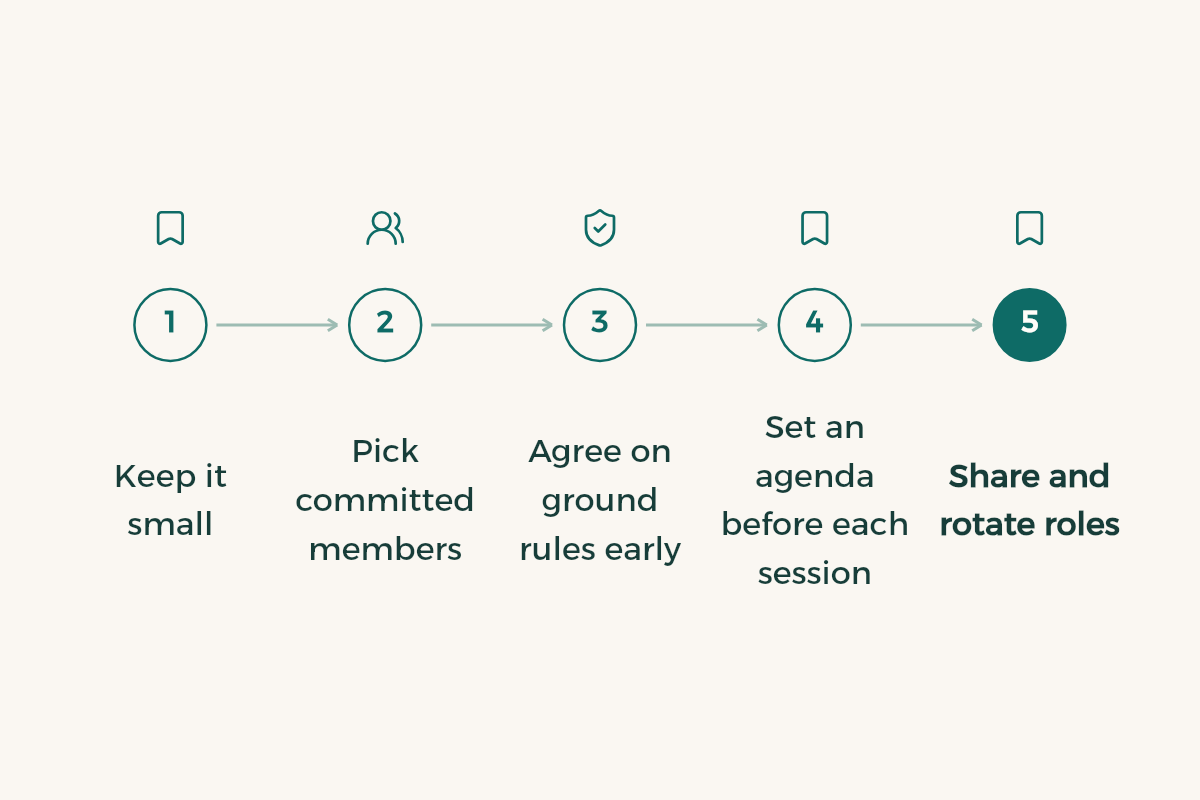
- Keep it small
University guides suggest no more than five or six students. UNBC's guide suggests a maximum of six, with a mix of perspectives.
- Pick committed members
Friendship alone is not the test. Choose classmates who come prepared, even if they are not your closest friends.
- Agree on ground rules early
Douglas College's guide notes that successful groups set clear guidelines early: attendance, preparation and phones.
- Set an agenda before each session
New Paltz recommends agreeing on a loose agenda before each meeting so everyone arrives prepared. For example: "chapter 4, problems 1 to 10".
- Share and rotate roles
Western's guide suggests assigning roles and rotating who leads, including a timekeeper who brings the discussion back to the course.
- Keep sessions short and frequent
A UAH guide notes that most knowledge sharing happens within the first 30 to 60 minutes of working together. Short regular sessions beat one long one.
A one-hour group study session plan
| Time | Activity | Led by |
|---|---|---|
| First 5 minutes | Go over the agenda and goal | Session leader |
| 10 minutes | Each member names one part they did not understand | Everyone |
| 20 minutes | Teach back: each member explains a topic to the others | In turns |
| 15 minutes | Quick quiz: questions members wrote for each other | Question keeper |
| Last 10 minutes | Sum up and agree the next session's agenda | Session leader |
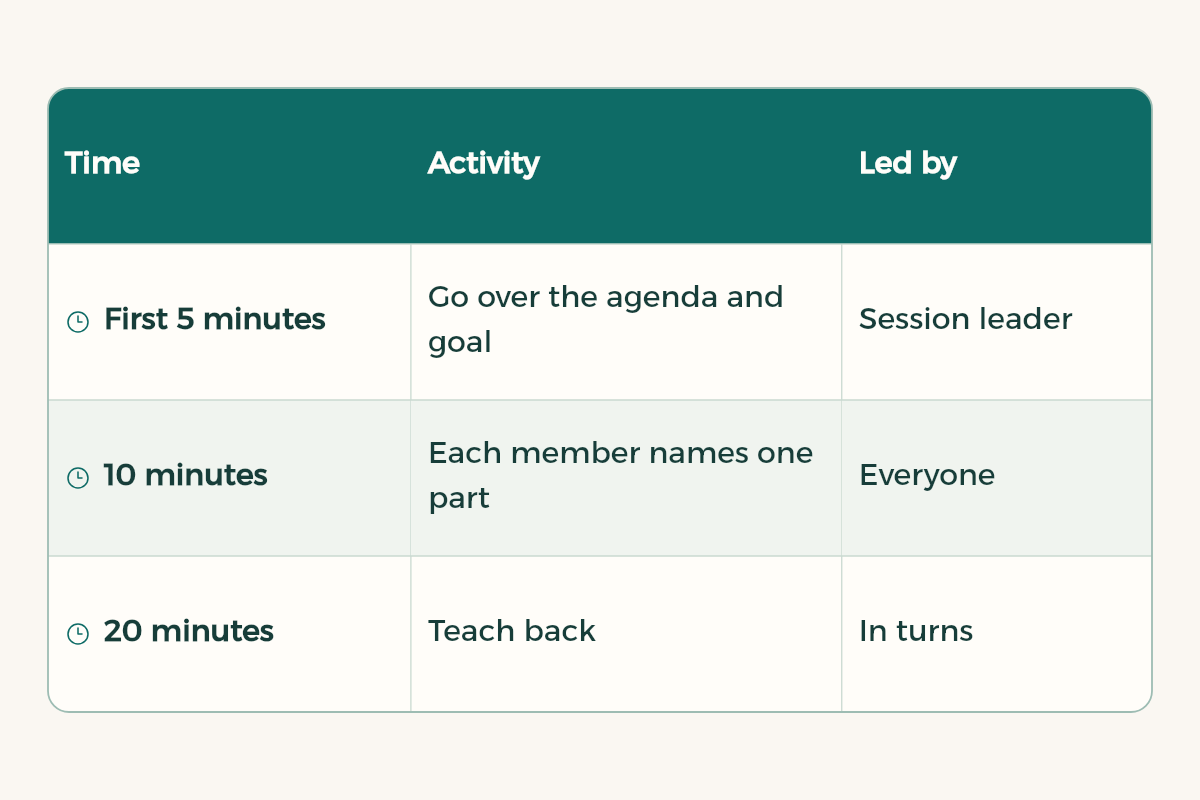
Most of the time goes to explaining and testing, not reading. That is what makes a group session different from studying alone.
Activities that make a group worthwhile
- Teach back: Western's guide describes members taking turns to explain concepts. It is a group version of the Feynman technique.
- Swap questions: each member writes five questions on the chapter, then you swap and answer without books.
- Board problems: one member solves while the others follow each step and ask "why?".
- Compare notes: each member checks their summary against a classmate's to find missing points.
- Mock exam: sit a past paper together under time, then go through the mistakes.
Mistakes that turn group study into chat
- A big group: the more people, the more side talk and the less time each member gets.
- No agenda: "let us meet and study" usually ends as a chat about campus and lecturers.
- Copying answers: New Paltz warns against using the group to copy homework or hand out answers without discussion.
- One person always explaining: everyone benefits except them. Rotate the roles.
- Phones on the table: agree to put them away during the session and use the short break for them.
Group study online
If meeting in the library is hard, the same rules work on a video call. Share your screen for problems, use a shared document for questions and run a timer for sessions. Western's guide also suggests scheduling tools to coordinate times. Shared Pomodoro sessions work well here: everyone studies for 25 minutes in silence with cameras on, then you talk during the break.
A prompt to prepare session questions
We are a study group of [number] students taking [course name].
Our next session covers: [topic or chapter].
These are our shared notes:
[paste notes]

Using only these notes, write:
- 10 discussion questions that need an explanation, not a one-word answer
- 5 quick quiz questions for us to test each other, with answers in a separate section
- two topics we can split between us for teach-back
Do not add information that is not in the notes.
How do you know your group is working?
At the end of each session ask three questions: did I understand something I did not before? Did I find a mistake in my understanding? Do I know exactly what to study before next time? If the answer is "no" for three sessions in a row, the group needs a change in size, structure or members. It is fine to switch groups; the goal is your understanding and your grade, not politeness.
Group study works best alongside organised solo study. Read our study plan template to plan your week, the guide on how to study effectively, and browse our study guides.