By the tiswa editorial team, from the official sources listed at the end of this guide. How we write our guides
The Feynman technique is one of the simplest study methods and one of the best at revealing real understanding. You pick a topic and explain it in plain words, as if to someone who knows nothing about it. The moment you stumble, or reach for a complex term because you cannot simplify it, you have found exactly the part you have not understood yet.
The technique is named after Richard Feynman, the American physicist and Nobel Prize winner in physics, who was known for explaining complex ideas simply. Learning centres at universities such as Bucknell and California State University, San Bernardino publish guides to it and describe it as learning by teaching: you learn a topic by teaching it.
This guide covers the four steps, a full worked example, a template you can fill in for any topic, and a prompt that makes AI play the student who asks you awkward questions.
Why the Feynman technique works
Many students confuse recognising information with understanding it. You read the explanation in the book and think "clear", but that clarity came from the book, not from you. When you close the book and explain it yourself, the comfort disappears and the real gaps show. Bucknell's guide describes the technique as showing where you understand a concept well and pinpointing your problem areas: where you get stuck or fall back on complex language.
It is close to the retrieval practice that the Cornell Learning Strategies Center recommends: pulling information out of memory yourself rather than rereading it. Feynman adds a second condition: the explanation has to be simple and connected, not a list of memorised facts.
The steps of the Feynman technique
- Choose a topic and write it at the top
Bucknell's guide suggests starting with the hardest or most important concepts in the course. Write the title at the top of a blank page.
- Explain it in simple words
Write or say out loud an explanation as if teaching a first-year student or a younger sibling. Short sentences, everyday examples, and no jargon unless you explain it.
- Find the gaps and go back to the source
Mark every place you got stuck or used a term you could not simplify. Go back to the book or lecture for those parts only, until you understand them.
- Simplify and explain again
Rewrite the explanation from the start in simpler language, adding an analogy or example. The CSUSB guide suggests repeating the process until you can explain it clearly and confidently.

Worked example: explaining supply and demand
Say you are studying introductory economics. Your first attempt might read:
"Price is set at the equilibrium point where the supply and demand curves intersect, and any change in the determinants shifts a curve."
That sentence is correct but nearly copied from the book. What are "determinants"? Why does a curve shift? If you cannot say, that is a gap. After going back to the lecture, the explanation might become:
"Imagine a new coffee shop near campus. If a cup is very cheap, lots of students buy, but the shop makes no profit, so it raises the price. If it is very expensive, nobody buys, so it lowers the price. The price settles where the amount students want to buy matches the amount the shop wants to sell. When exam week comes and more students want coffee at every price, the price the market settles at goes up."
The second version is longer, but it shows you understand the idea, and now you can attach the technical terms with confidence. That is exactly what exams want, especially in "explain" and "justify" questions.
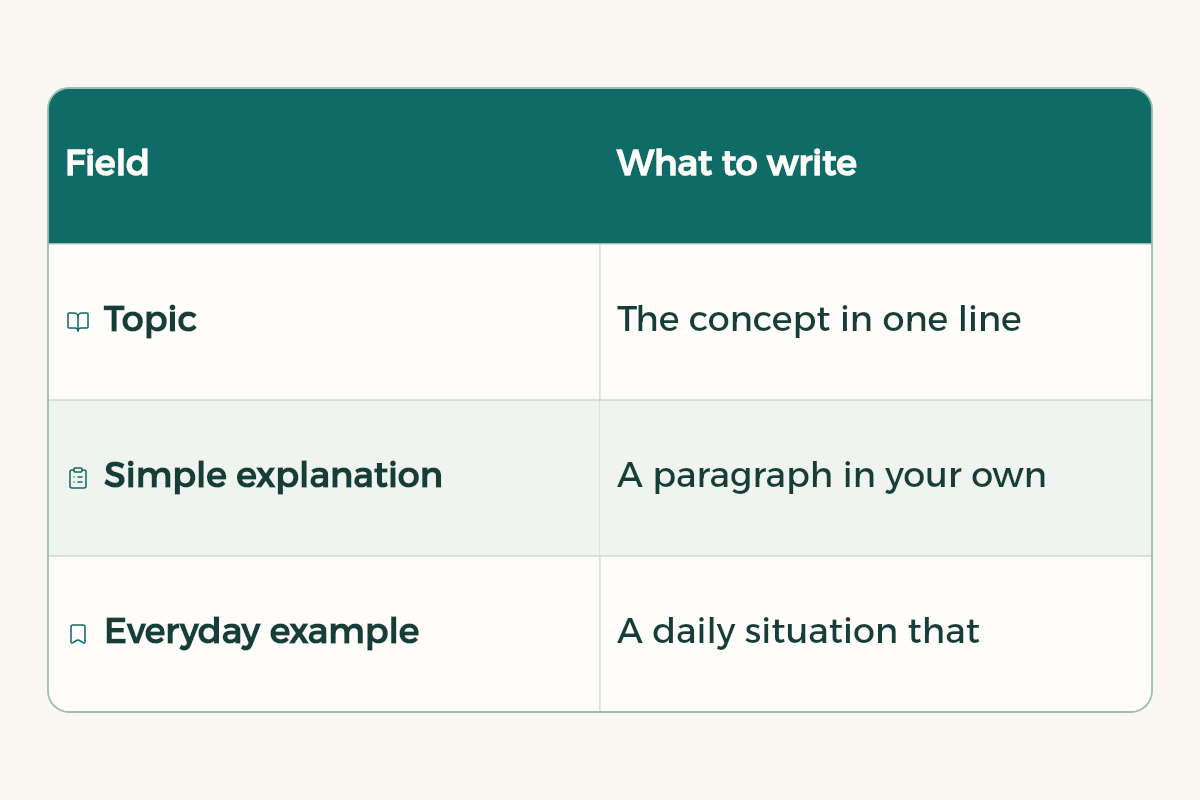
A ready Feynman template
Copy this template into your notebook or notes app and fill it in for each hard topic:
| Field | What to write |
|---|---|
| Topic | The concept in one line |
| Simple explanation | A paragraph in your own words, as if for a first-year student |
| Everyday example | A daily situation that shows the idea |
| Where did I get stuck? | The parts you could not explain and the terms you could not simplify |
| After review | Your corrected explanation of the hard parts |
| Likely exam question | One question you expect on this topic, with its answer |
Prompt: let AI play the student
One of the hardest parts is finding someone to explain to. AI can help, as long as you make it ask rather than explain:
I want to use the Feynman technique on [topic] in [course name].
Act as a first-year student who knows nothing about this topic.
I will explain the topic to you in my next message.
After my explanation:
1. Ask me 3 questions about any unclear part or any term I did not explain.
2. Tell me if my explanation has a factual error, without giving me the full correct explanation; just point to where the error is.
3. Never explain the topic yourself. I want to reach the understanding on my own.
Once it points to an error, go back to your textbook or lecture to fix it, not to the assistant's answer. Your main source is still what your lecturer taught.
When to use the Feynman technique
- For concepts that need understanding, not just memorising: causes, mechanisms, relationships, theories.
- A few days before an exam, to catch the topics you think you understand but do not.
- In group study: each member explains one topic to the others. See our guide to group study.
- Less useful for facts that just need memorising, such as numbers and names. There, Anki is a better fit.
Common mistakes
- Explaining only in your head: it lets you skip the hard parts without noticing.
- Copying sentences from the book: the goal is your words, not the author's words rearranged.
- Oversimplifying: simple does not mean dropping what matters. If your simple version contradicts the lecture, it is wrong, not simplified.
- Stopping after one round: the value is in repeating until the explanation is clear, as the university guides advise.
The Feynman technique works best alongside active recall and spaced repetition and mind maps. Browse all our study guides.