
By the tiswa editorial team, from the official sources listed at the end of this guide. How we write our guides
Two requests reached an HR officer at a telecom company on the same morning. The first was headed “Request” and said: “Please accept me for training, thank you.” The second was headed “Co-op request: information systems student, Princess Nourah University, from January” and ran five lines. The reader needed no question about the second and answered it that day. The difference between them was not intelligence. It was order.
What parts does a co-op training request letter need?
Professional writing guides advise opening with the main point, giving background and detail, and closing by restating the request.1 That holds in Arabic as in English. These six parts are the order that works for most requests.
| Part | What you write | Illustrative example |
|---|---|---|
| Greeting | A greeting and the reader’s name if you know it | Peace be upon you, Ms Noura Almutairi |
| Introduction | Your name, discipline, university and level | I am Sara, an information systems student in my seventh level |
| Why them | One sentence showing you know their work | I follow your customer-data analysis projects |
| Two skills | Two skills you defend with evidence | SQL and Power BI dashboards built in my database course |
| The ask | Duration, start date and what you will accept | A co-op placement for one semester starting in January |
| Attachments | Your CV, college letter and transcript | CV as a PDF and the college’s training letter |
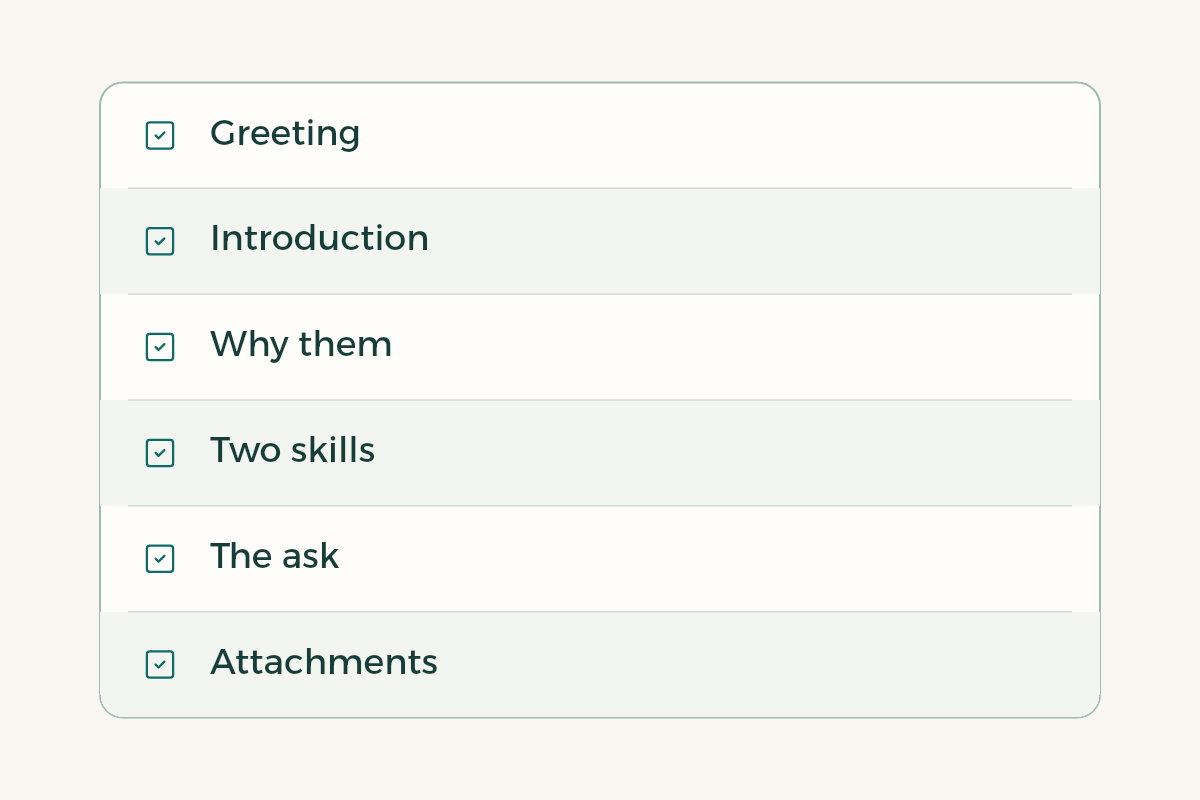
The table’s examples are illustrative of how to write, not text to copy. Replace them with your own details.
How do you write a co-op training request letter step by step?
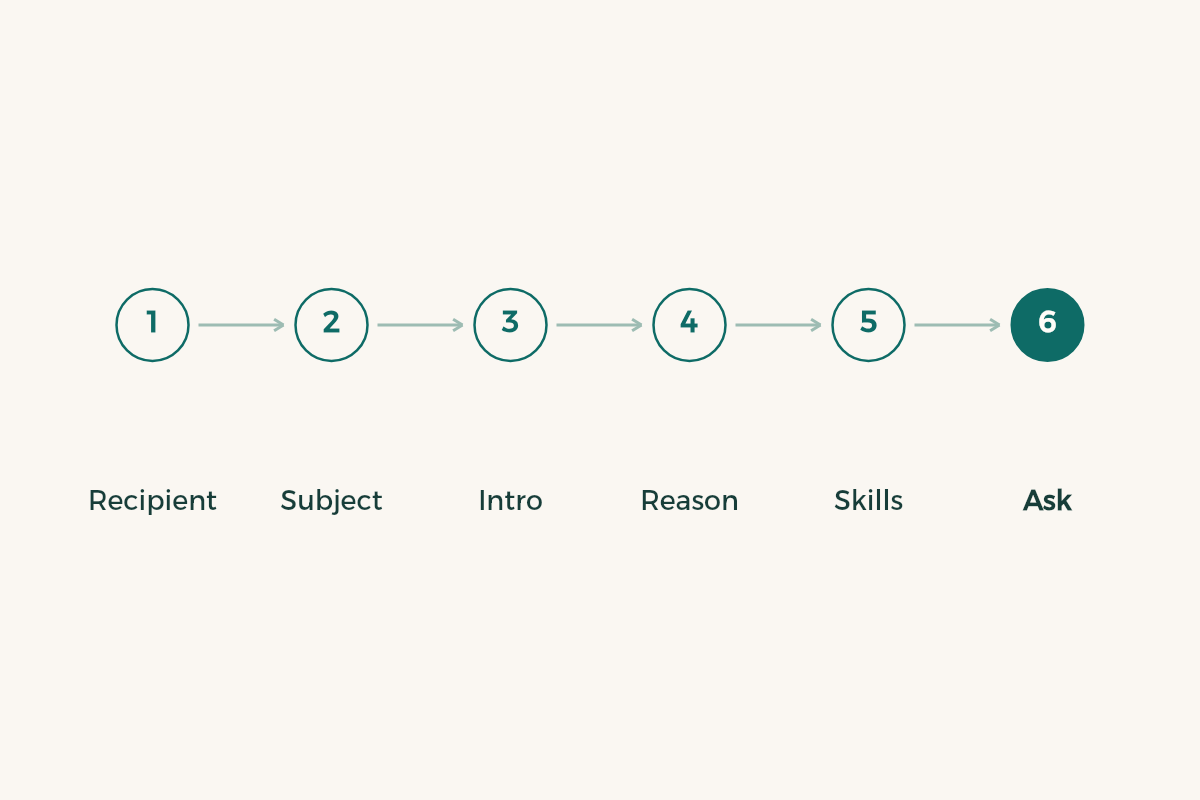
- Find the recipient
Look for the name of the HR officer or department head on the organisation’s page or on LinkedIn. A note to a person is read more than one to “Dear Sirs”.
- Write a subject that works unopened
“Co-op request: electrical engineering student, King Saud University, from January”. It says who you are, what you want and when.
- Open with one line of introduction
Name, discipline, university, level. Skip the long blessing and the praise of the company.
- Give your reason for choosing them
A sentence about a project, product or sector you saw yourself, not a phrase that fits any employer.
- Offer two skills
Tie each to evidence: a course, a project, a tool you used. Leave out what you do not command.
- Close with a specific ask
“I would like a one-semester co-op placement starting in January; my CV and college letter are attached.” Then thanks, in one line.
Write in plain formal language. Avoid slang in an official note, and avoid heavy phrases of homage that push the reader away from you. A clear line beats them.
Should the request be in the email body or an attached file?
Write it in the body and attach the CV and official letter. The reader opens the body first and does not open every attachment. Guides recommend simple email layout: no indents, a blank line between paragraphs, and a closing greeting with your name under it.2 You do not need the letterhead, address and date of a paper letter.
If the organisation asks for a paper letter or a file, follow the format it names. Employers set their own forms, and what they state beats any guide. In the Professional Experience programme at the Human Resources Development Fund, registration asks you to attach a statement from your institution,3 so get your college’s statement early whatever you send.
What mistakes are common in a co-op request letter?
The first is the empty subject line, such as “Request” or “CV”. The second is one note pasted to ten employers with the name unchanged, so it arrives addressed to another company. The third is length: three short paragraphs are enough, because nobody reads a full page in a crowded inbox. The fourth is skills with nothing behind them, like “I master artificial intelligence” with no example. The fifth is an unsuitable sender address, such as a nickname or a random number in the sender name.
There is a quieter mistake: sending at the wrong time. Co-op semesters are usually filled months before they start, and your college’s training coordinator knows when organisations take requests. Ask before you write, because the door may be shut or not yet open, and a late note sits in an inbox nobody reviews.
What is the difference between a co-op training letter and a request letter?
A co-op training letter is normally the official document your college or its training office issues to the organisation, confirming that you are an enrolled student and that the university allows the placement. The request letter is what you write to persuade the reader to accept you. You need both: the first opens the door and the second convinces the person behind it. The wording and details of the official letter differ between universities, so ask your training coordinator how to request it and when it is issued, and do not rely on a classmate’s letter from another university.
If your college issues the letter in the name of one organisation, do not reuse it for another. Ask for a fresh copy for each place you write to. Issuing can take days, so plan for it before the date you want to send, not after.
What if nobody replies to your request?
Wait a week, then send a two-line follow-up: “Peace be upon you. I am following up on my request sent on the 15th, and I attach my CV again. Thank you for your time.” Do not rewrite the note and do not apologise for bothering them. If nothing comes after a second follow-up, move to another organisation and do not read silence as a verdict on you. Many inboxes go unopened because the owner is away or the choice is already made.
Improve your odds beyond the note: a LinkedIn profile that matches your CV, a one-page CV, and facts you can defend in a phone call. Read the guide to co-op training for the path, the student CV guide to prepare the attachment, and the cover letter guide if an organisation wants a longer letter. If the organisation is in health, go to nursing co-op training.