By the tiswa editorial team, from the official sources listed at the end of this guide. How we write our guides
A cover letter for students is a short letter sent with your CV explaining why you want this specific opportunity and why you fit it. Many students skip it or send the same letter everywhere, which is your opening: a tailored, four-paragraph letter sets you apart from dozens of applicants with the same GPA and the same major. This guide gives you the structure, a ready template, and a way to tailor it in twenty minutes.
When do you need one?
- When the post asks for it. Not sending one usually means you are filtered out.
- When you apply by email; the email body itself becomes a short cover letter.
- For co-op and summer placements, where the company compares students with no experience and the letter shows motivation and understanding of their work.
- When moving from your major into a nearby field, since the CV alone does not explain why.
If the platform has no place for a letter, as with some online forms, do not force it; put your strongest line into the objective section of your CV.
The structure: four paragraphs, no more
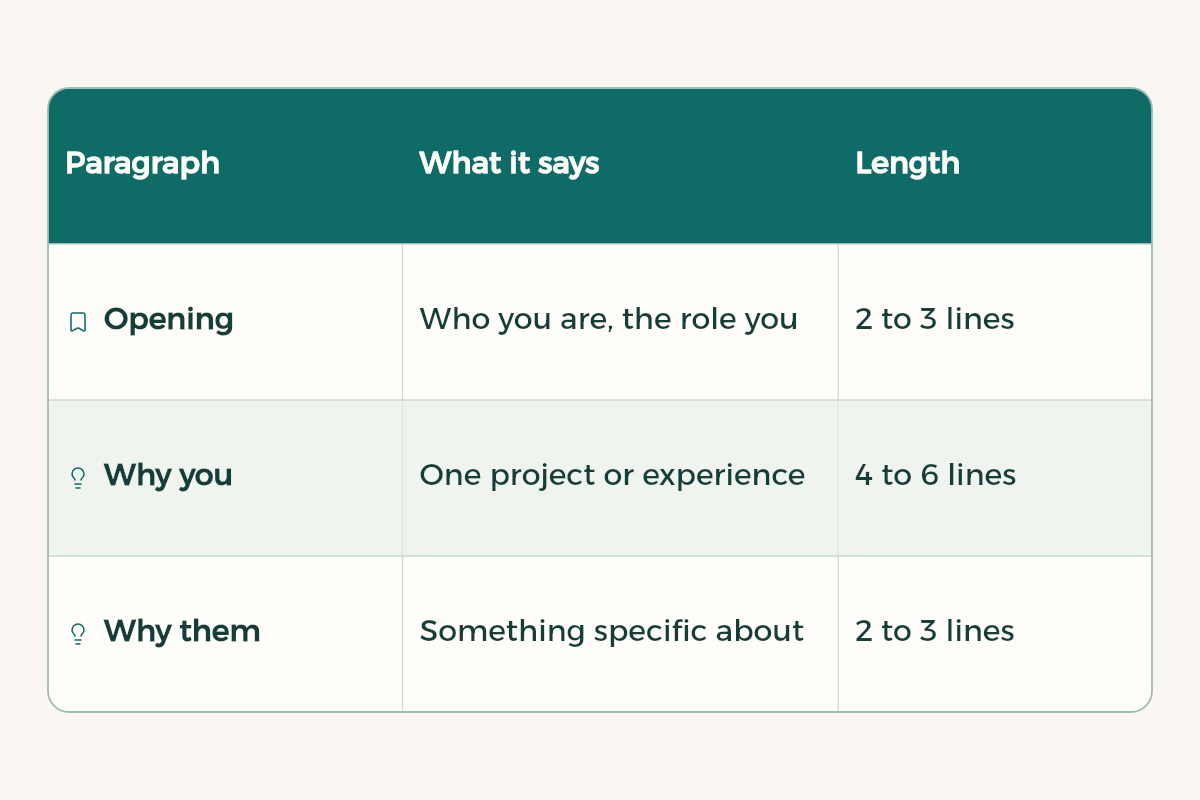
| Paragraph | What it says | Length |
|---|---|---|
| Opening | Who you are, the role you are applying for, and one line that hooks the reader | 2 to 3 lines |
| Why you | One project or experience that proves a skill the post asks for, with numbers | 4 to 6 lines |
| Why them | Something specific about the company or team, proving you looked them up | 2 to 3 lines |
| Close | A clear ask for an interview, your availability, and thanks | 2 lines |
Keep the whole letter to one page, ideally 250 to 350 words. Recruiters read dozens of applications, and long letters get skimmed.
A ready cover letter template
Copy it and replace the brackets. Delete any line that does not apply to you.
[Full name]
[City] | [Mobile] | [Email] | [LinkedIn URL]

Dear [Company] hiring team,

I am applying for the [role as written in the post]. I am a [major] student at [university], graduating in [term], and the post's focus on [specific task or requirement] caught my attention.

In [project/course/volunteer role], I [what you did, past tense], which [number or clear result]. Along the way I learned [skill the post asks for], which is what I want to build on in [team].

I have been following [something specific: a product, project or news item], and I want to start my career somewhere that [quality linked to it].

I would welcome an interview to discuss how I can contribute, and I can start on [date]. My CV is attached.

Kind regards,
[Name]
Writing it in 20 minutes
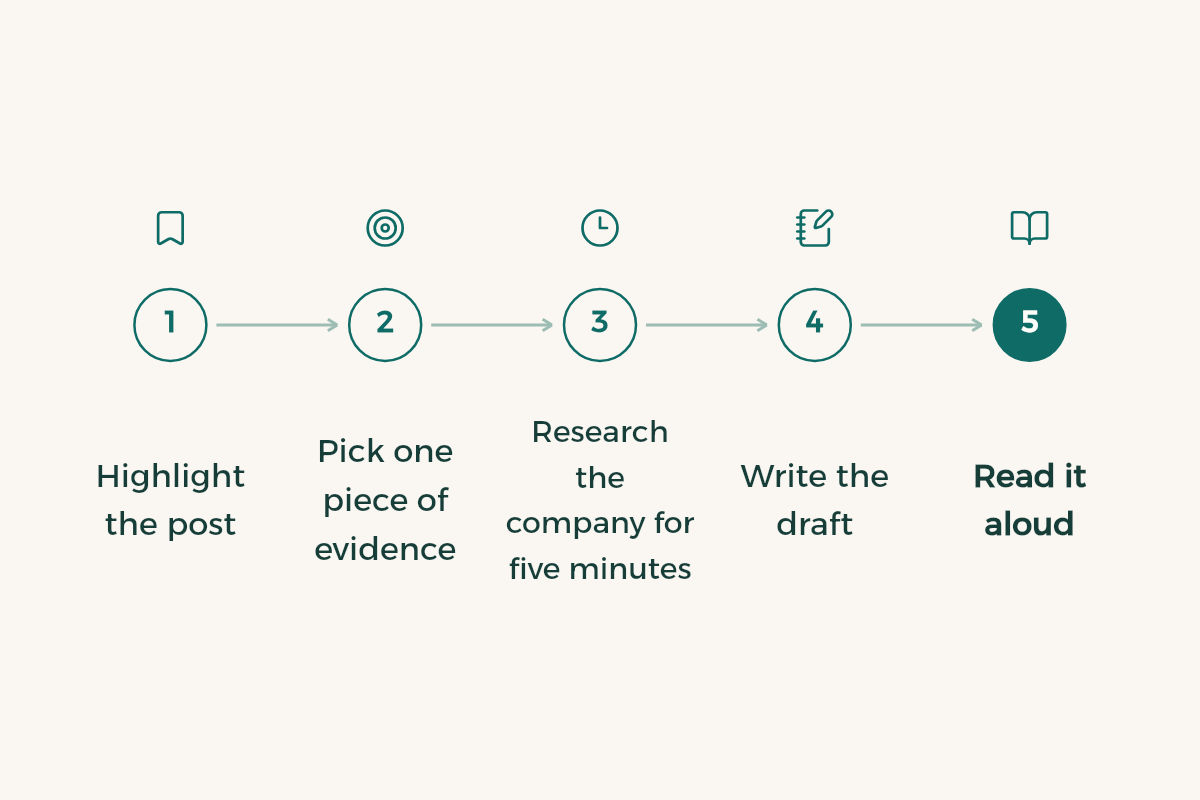
- Highlight the post
Read the job post and mark three skills or tasks that repeat. Those are the words the reader is looking for.
- Pick one piece of evidence
From projects, volunteering or part-time work, choose one experience that proves the strongest of the three. Detail on one beats a list of five.
- Research the company for five minutes
Their website, recent news and LinkedIn page. Find one real thing to mention in the why-them paragraph.
- Write the draft
Fill the template above without polishing, then delete every sentence that would work for any other company.
- Read it aloud
Long, stiff sentences show up when spoken. Shorten them.
- Save as a clearly named PDF
For example Sara-Alharbi-Cover-Letter.pdf, formatted to match your CV.
Tailor it with AI without sounding automated
AI tools save time, but a letter written by a tool from scratch reads generic and is easy to spot. Give it your own material and ask it to arrange, not invent:
Here is the job post: [paste post]
Here is my draft cover letter: [paste draft]
Revise the draft without adding any experience or number that is not already in it. I want you to:
1. Tie the why-me paragraph to the most important requirement in the post.
2. Remove generic phrases that would fit any company.
3. Keep it between 250 and 300 words.
4. List the sentences you changed and why.
Arabic or English?
Write in the language of the post. Large and international companies usually post in English and expect an English letter; some public and semi-public bodies accept Arabic. Keep both versions of the same letter ready, and proofread the English carefully, since spelling mistakes stand out more there.
Mistakes that get a letter ignored
- Repeating your CV as prose. The letter explains and connects; it does not relist.
- Opening with "I am writing to apply for the advertised position". Start with the role and who you are.
- The wrong company name, the classic mistake when reusing an old letter. Check it twice.
- Talking only about what you want: experience, learning, salary. Always tie it to what you bring them.
- Exaggeration. Every sentence can become a question in the interview.
- More than a page, or fonts and layout that differ from your CV.
Applying by email
Make the subject line clear: the role, then your name, for example "Summer marketing intern: Sara Alharbi". The email body is a five-line version of the letter, with the CV and letter attached as two PDFs. If a week passes with no reply, send a short follow-up in the same thread without re-attaching.
The employer will probably open your profile after reading the letter, so make your LinkedIn profile tell the same story.