By the tiswa editorial team, from the official sources listed at the end of this guide. How we write our guides
Bridging programs in Saudi Arabia let a diploma holder continue to a bachelor's in the same or a closely related field without starting from year one. The undergraduate study and examinations regulation calls this the "academic upgrade programme (bridging)" and defines it as a programme designed to complete study from diploma to bachelor's. This guide covers what the regulation says, the conditions that recur across universities, how applicants are ranked, and a full official example from King Khalid University.
What the unified regulation says
The regulation allows a university council to approve bridging programmes under controls set by the Council of University Affairs, and also to admit a bachelor's holder to a second bachelor's. It also covers exit points: some bachelor's programmes award a diploma if a student completes a set part of the plan and stops. So the road between diploma and bachelor's now runs both ways: up by bridging, and down at an exit point.
The regulation does not set each programme's detailed conditions. Each university sets and announces them when admission opens, so the required GPA, accepted majors, tests and fees all differ. Always start from the bridging guide on the admission and registration deanship's site of the university you want, or from its page on tiswa.
An official example: King Khalid University
King Khalid University published a guide for its paid bridging programmes, which let diploma holders complete a bachelor's in the same field. These are its main conditions, shown as an example of what universities usually ask, not a rule for all:
- Saudi nationality or a valid residence permit.
- An intermediate or advanced diploma or equivalent, from inside or outside the Kingdom, issued by an officially accredited body. Graduates of private institutes licensed by the Technical and Vocational Training Corporation must also pass the corporation's comprehensive exam.
- A diploma GPA of at least 3.00 out of 5 or equivalent.
- The diploma major must be a continuation of the bachelor's major or one of its tracks.
- Medically fit for the major, and not dismissed from the university, any other university or the Technical and Vocational Training Corporation.
- At least 60 in the department's comprehensive admission test.
- An English proficiency test for programmes taught in English.
- Not currently enrolled at the university, and applying online in the announced window.
- A nomination is cancelled if fees are not paid on time.
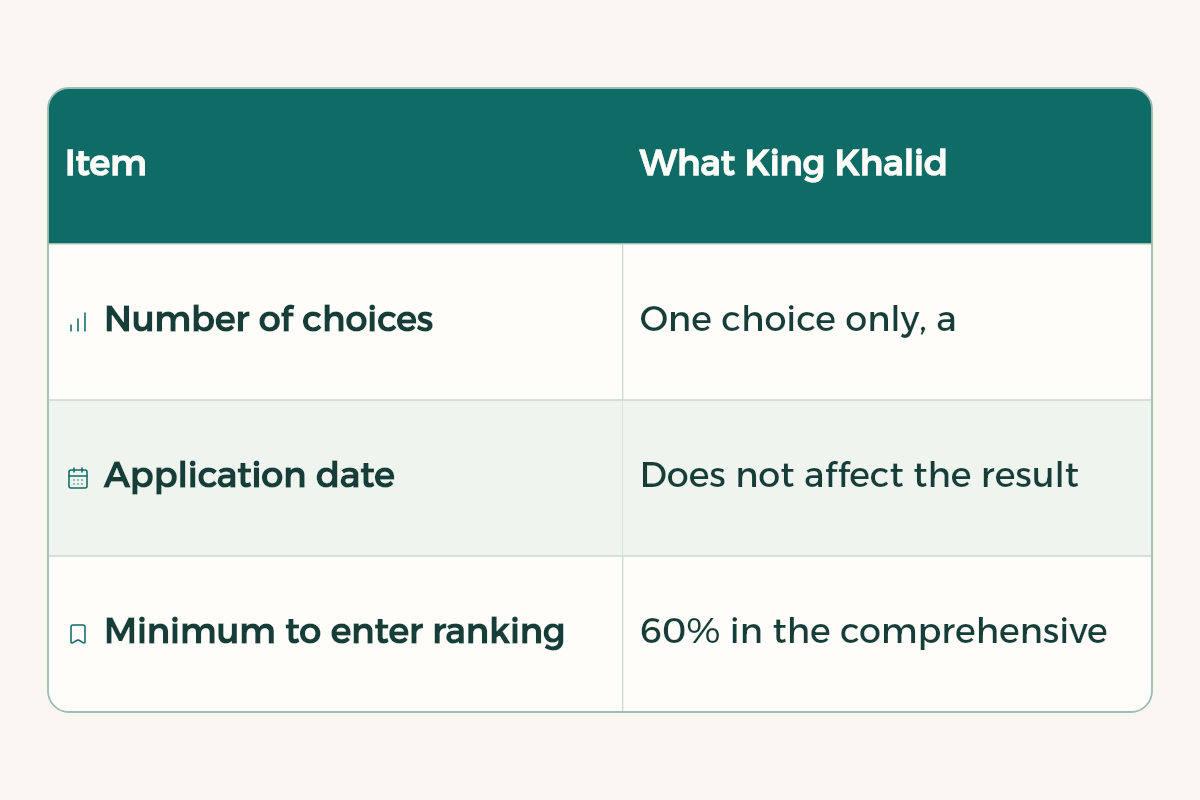
| Item | What King Khalid University's guide says |
|---|---|
| Number of choices | One choice only, a continuation of the applicant's major |
| Application date | Does not affect the result |
| Minimum to enter ranking | 60% in the comprehensive admission test |
| Composite score | 50% GPA and 50% comprehensive test |
| Admission method | Automatic, by seats and composite score |
A worked example with those weights: a diploma GPA of 4.20 out of 5 is 84%, and a test score of 76. Composite = (84 × 0.5) + (76 × 0.5) = 42 + 38 = 80%. The test weighs as much as your GPA, so preparing for it deserves real time.
How much time does bridging save?
This is the main benefit. In King Khalid University's guide, an admitted student with a two to two-and-a-half-year diploma is automatically exempted from all courses in levels one to three and from university requirements, and studies the remaining levels of the plan. Longer diplomas earn more exemption. Rules differ between universities, but the idea is the same: you do not repeat what you have shown you already studied.
The unified regulation generally allows exemption from courses studied before, based on similar content and the college council's decision. For details, see how to transfer universities; its course equivalency rules are close to those for bridging.
Is bridging right for you?
Bridging fits if your diploma major is close to the bachelor's you want and you are ready to return to a full study system with a GPA, warnings and exams. It suits people working with a diploma who want a higher qualification, and recent diploma graduates who did not get direct bachelor's admission. If you want a completely different major, bridging may not fit; compare general admission, covered in the unified admission guide, with other options for diploma holders.
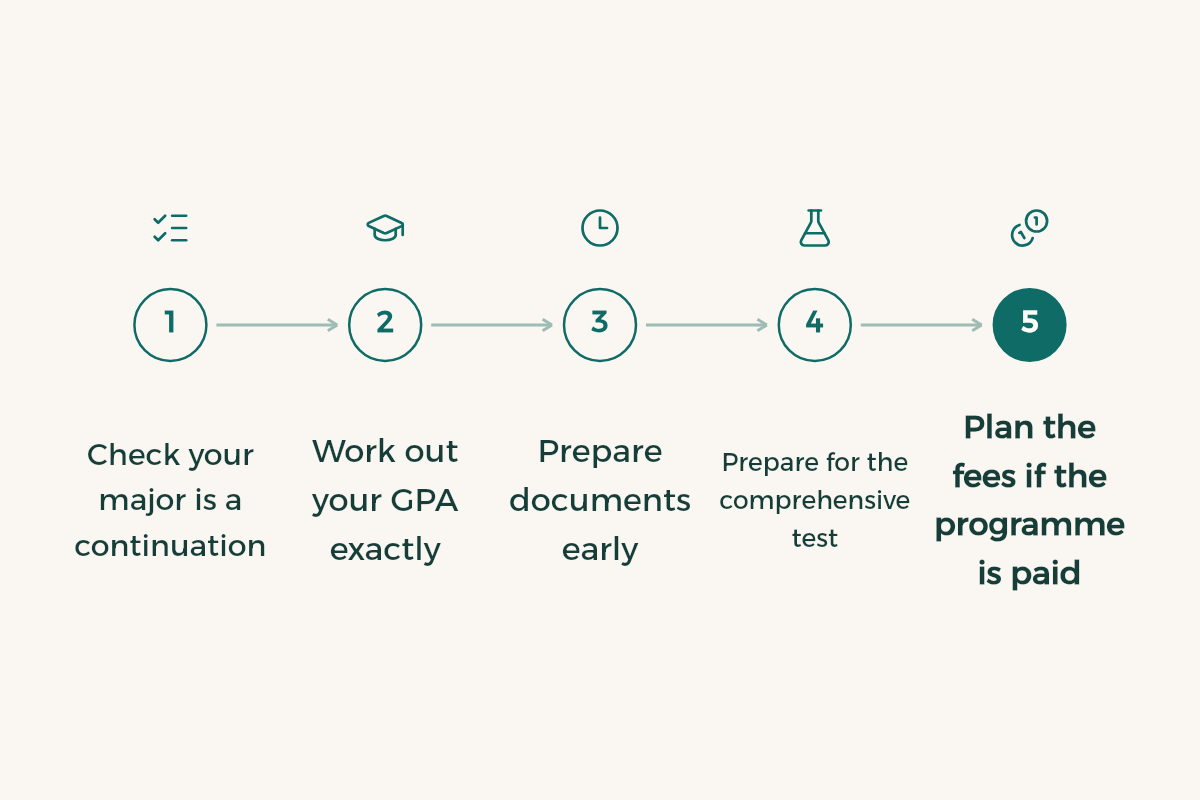
Practical steps before applying
- Check your major is a continuation
Read each programme's list of accepted majors; this condition rules out the most applicants.
- Work out your GPA exactly
If your GPA is out of 4, convert it the way the university does. See how to calculate GPA.
- Prepare documents early
In the example: ID, graduation certificate and transcript, a valid English test for English-taught programmes, and a professional licence and medical check for health majors.
- Prepare for the comprehensive test
Get the published test references from the guide and review your core diploma courses.
- Plan the fees if the programme is paid
In the example, not paying on time cancels the nomination, so plan the amount before results.
I hold a diploma in [major] from [institution], with a GPA of [GPA] out of [5 or 4].
I want to apply for bridging to a bachelor\'s in [major] at [university], and the comprehensive test is in [number] weeks.
The published test references: [paste them].
1) Split the references over the remaining weeks.
2) Suggest a review method for each topic, with practice questions.
3) Work out my composite score at 50% GPA and 50% test, for different test scores.
After you are admitted
You will usually be treated like any bachelor's student under every rule: GPA, academic probation, drop and add, withdrawal. Read the credit hours system and academic probation explained before your first semester. If you work, balance work and study from the start, and ask your employer about approval if it is needed.
Every other university rule is in university rules.