
By the tiswa editorial team, from the official sources listed at the end of this guide. How we write our guides
A patient monitor fails in the intensive care unit, and the hospital’s clinical engineering team is called. The first thing the engineer asks on arrival is: where is the patient now, and has a replacement monitor been fitted? Only then do they open the device. That order is what a placement supervisor looks for in a student, and it does not show in the phrase “I love medical devices.” It shows in small pieces of proof you collect from your studies before you apply.
Which skills do biomedical engineering co-op placements look for?
Work in hospital clinical engineering departments and at device distributors spreads across preventive and corrective maintenance, electrical safety checks, managing the equipment register and helping with pre-purchase evaluation. Supervision differs by site, and the host decides what a student may touch and what they only watch. The Saudi Food and Drug Authority regulates medical devices in the Kingdom, so read its page to understand who licenses and who monitors.1 The World Health Organization defines a medical device broadly, including instruments, software and implants, which is a useful way to see how wide your future work is.2
| Skill | Evidence from your studies (example) | What to revise |
|---|---|---|
| Biological signal processing | Filter a published teaching ECG trace and show it before and after | Signals and systems |
| Electrical safety | A check list for a lab instrument that cites the leakage limits from your course | Medical instrumentation |
| Documentation | A project notebook with dates, versions and backups | Capstone or project course |
| Measurement and calibration | A calibration report for a pressure sensor from the university lab | Measurement lab |
| Talking to clinicians | A half-page explanation of how a device works for a non-engineer | Technology and society |
The rows are examples. Use published teaching data or data from your own lab, and never use real patient data.
How do you collect evidence from university projects?
- List your courses
Write down every course with a project or lab. This is your stock.
- Match one project to each skill
One project can serve two skills. Do not invent skills to fit your projects.
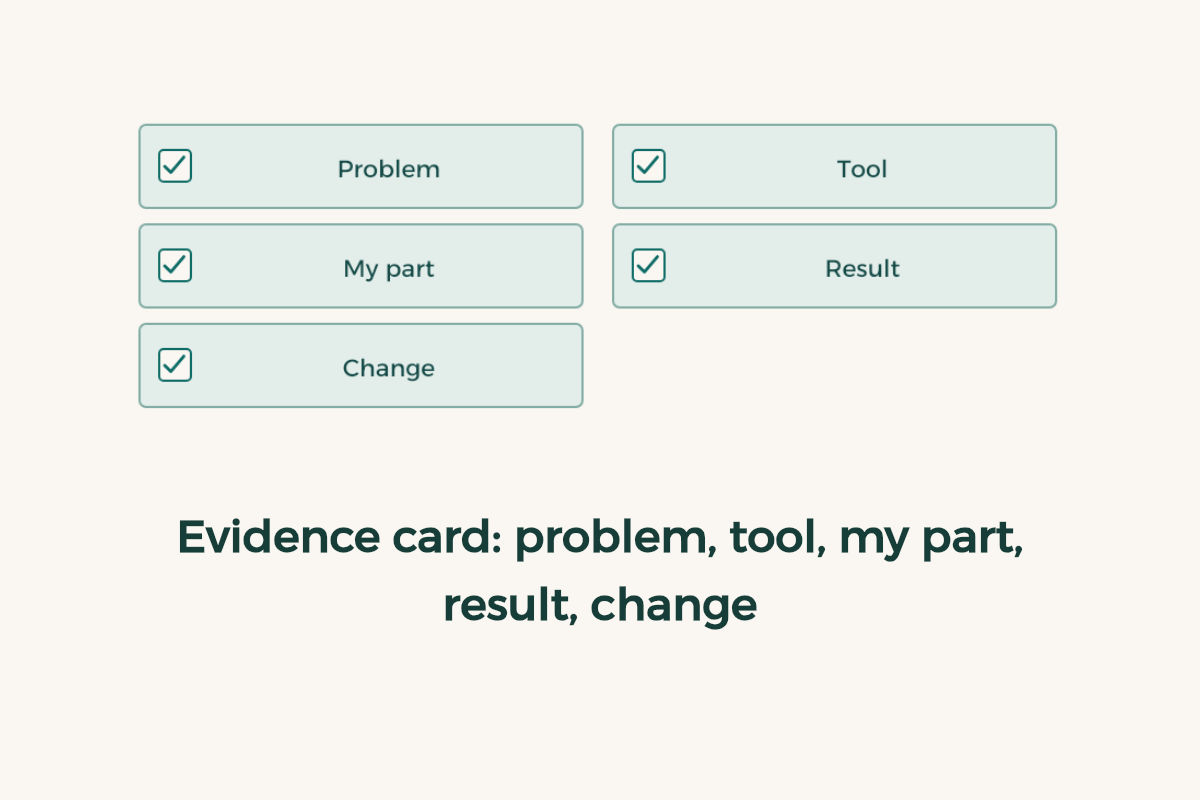
- Write a five-line card
The problem, the tool, what you did yourself, the result, and what you would change.
- Save files that prove it
A plot, a schematic, code or a lab report, as a PDF or a private link.
- Strip personal data
Remove any real name or identifier, and state that the data is for teaching.
- Show it to a lecturer
Two minutes of their time will reveal exaggeration you cannot see yourself.
The same card works for your CV and the interview; for wording see the guide to a CV for students, and for projects you must explain to a panel see explaining your project in an interview.
Where do you find a biomedical engineering internship in Saudi Arabia?
Start with the training unit at your college, which knows which sites your department accepts. Then look at hospital websites, medical equipment distributors and official pages that announce student places, and do not expect any one announcement to be complete. A hospital may train an intern inside its clinical engineering department, and a distributor may train one in installation and technical support. Each teaches something different: the first shows a device serving a patient, the second shows it from the manufacturer’s side. Choose what you lack and write down the choice and the reason.
For professional registration after graduation, the Saudi Council of Engineers classifies and accredits engineers, so read its services early to see what graduates are asked for.3 The training itself is governed by your college’s conditions.
Can I do an internship in Saudi Arabia with no work experience?
Yes. Co-op and internship places are meant for learners, so present projects and courses where a work history would go. Be clear about how coop training differs from an internship: coop sits inside your degree plan under conditions your college writes, while an internship may sit outside it. Ask the training office which one your department counts before you apply to either.
When the evidence is gathered, print your six cards and ask one question of each: if the supervisor asked about the hardest step in this project, what would I say? A card you cannot answer for with confidence needs another read before it goes into your application. Set aside an hour a week for this review, starting a month before applications open, because late preparation shows in the answers.
Which mistakes weaken a biomedical engineering application?
The first is listing device names the student has never inspected. The second is ignoring electrical safety as a dull course. The third is showing a project without saying what the student did. The fourth is mixing up preventive and corrective maintenance: the first is scheduled before a fault, the second comes after. The fifth is using real patient data in a portfolio, which is an ethical and legal problem before it is a professional one. The sixth is applying before asking the college about approved sites, then training somewhere that does not count.
Prepare for the interview with the guide to job interview questions, follow up using the steps in following up on an internship application, and if you hold two offers compare them with the guide to comparing training offers.