By the tiswa editorial team, from the official sources listed at the end of this guide. How we write our guides
The Tamheer program, now officially the Graduate Development product, is the shortest route to a first real job for many Saudi graduates. You train full time inside an organisation, the Human Resources Development Fund (HRDF) pays you a monthly allowance, and the employer gets to know you before deciding to hire. This guide follows the official HRDF product page and its FAQ; check it before you apply, since rules can change.
What is Tamheer?
A product from HRDF for diploma, bachelor and higher graduates. You apply to training opportunities posted by organisations straight from your HRDF account, with no office visits. Training is on the job at the organisation's premises and full time; remote or part-time training is not accepted.
Who is eligible
As listed on the HRDF page:
- Saudi nationality, registered on the HRDF website.
- A diploma of at least one academic year (two semesters) from an accredited institute or college, or a bachelor's or higher from a Saudi university or a foreign one recognised by the Ministry of Education, with an equivalency decision for foreign degrees.
- No more than one calendar year of previous experience in the public or private sector.
- Aged 30 or under.
- Not currently employed in the public or private sector.
- Training balance not used up (two opportunities totalling 6 months), and not excluded from the product or on the HRDF banned list.
There are no required majors and no regional limits; availability depends on the organisations in your city. If you held a job before, you can still apply as long as your experience is a year or less.
The Tamheer allowance: how much, when, and how it is calculated
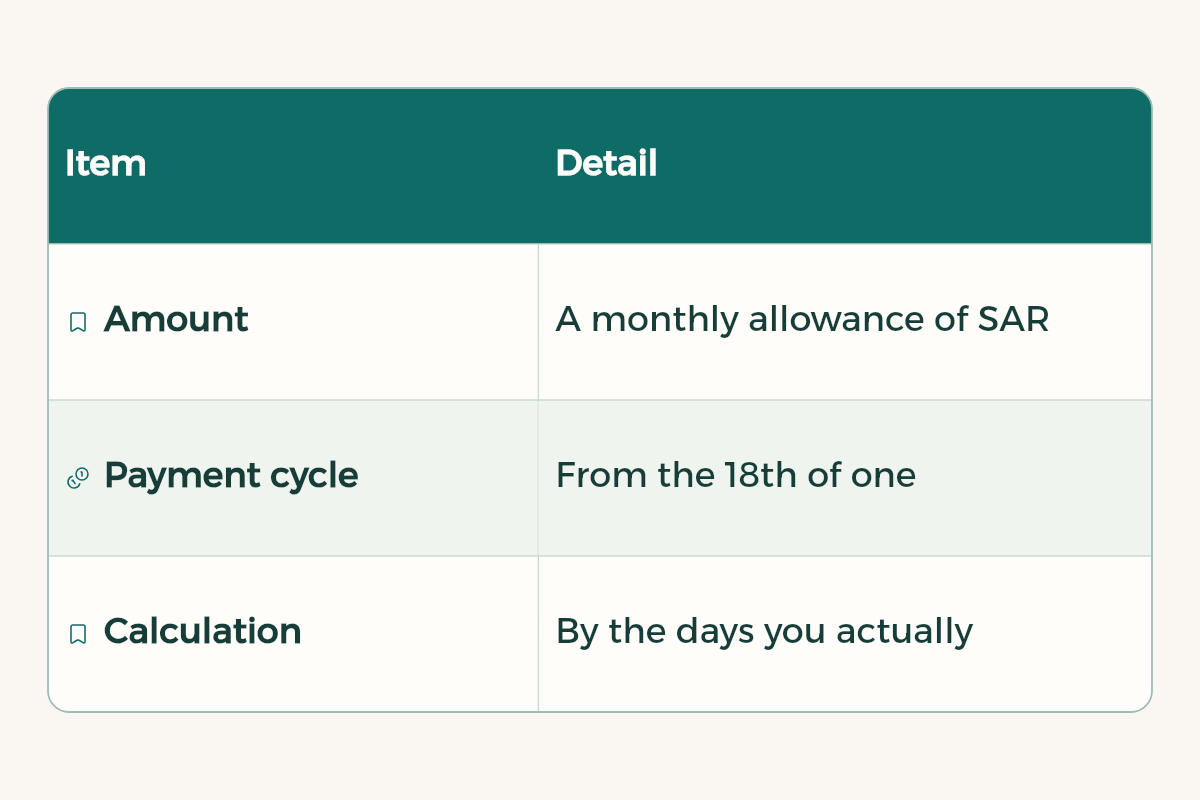
| Item | Detail |
|---|---|
| Amount | A monthly allowance of SAR 3,000 for trainees who meet the payment requirements |
| Payment cycle | From the 18th of one calendar month to the 17th of the next |
| Calculation | By the days you actually attended in the cycle; starting mid-cycle means a pro-rated amount |
| Payment date | Between the 10th and 15th of each calendar month, on working days |
| Bank account | An IBAN in your name at a bank operating in Saudi Arabia and licensed by the central bank, verified instantly |
There is no pay for overtime, and neither the organisation nor anyone representing it may ask for part of your allowance. If that happens, raise a ticket on the HRDF website: handing over part of the allowance is a breach that can get you suspended too.
How to register and apply
- Update your records first
Your education data is pulled from Jadarat and the Muahal platform, so make sure your latest qualification is there.
- Log in to HRDF
Under e-services choose individual login and sign in with Nafath.
- Register for on-the-job training
From the programmes menu pick on-the-job training, register, accept the terms, and choose diploma graduate or bachelor graduate.
- Add your IBAN
Click your name at the top, then Profile, then Bank information. No valid IBAN, no allowance.
- Apply to opportunities
Browse the listed opportunities and apply; track each application, offer and interview from your applied opportunities page.
- Do not start before the official date
Attendance starts once the organisation sets your start date in the system and HRDF notifies you. Days before that do not count and cannot be claimed.

Duration and hours
The organisation sets the duration, between 3 and 6 months. Training is full time and on site, up to 48 hours a week or 8 hours a day, cut in Ramadan to 36 hours a week or 6 a day, with a weekly rest of at least 24 consecutive hours if the organisation works 6 days. Official holidays for both Eids, National Day and Founding Day do not affect your attendance rate. An opportunity cannot be paused, extended or postponed, and its details cannot change after it is published.
Why an allowance is not paid: three reasons
- Absence above 10% in the payment cycle.
- No valid IBAN in your name.
- Your trainer did not record your attendance during the attendance window, the 13th to the 17th of each calendar month.
The last one is the riskiest because it is not directly in your hands. Remind your supervisor before the 17th, and raise an HRDF ticket if they do not respond. Two months after the end of a cycle's attendance window you can no longer claim that cycle for any reason, and wrong attendance entries are not corrected afterwards.
What gets you excluded
- Being registered with GOSI on any day of the training, which means taking a formal job while on Tamheer.
- Absence above 10% in two months, consecutive or not.
- False information, misconduct, or not doing your training tasks.
- Disclosing confidential information; the organisation may ask you to sign a confidentiality document.
Excluded trainees cannot use the product again, so read the terms when you register.
Withdrawing: when it costs you balance
| When you withdraw | What happens |
|---|---|
| Before a start date is set | Nothing is deducted from your balance |
| Within 14 days of starting | No deduction and no allowance; a second withdrawal means exclusion |
| After 14 days | You are paid for days attended, and your balance loses the time trained plus one month |
HRDF accepts or rejects a withdrawal within 3 working days. If you receive the job-search support programme, there is no waiting period to join Tamheer, but returning to that support afterwards is not automatic and needs a new application.
Turning Tamheer into a job
Organisations pick Tamheer trainees knowing they might hire them, so treat the months as a long interview. Ask your supervisor in week one what success looks like, log your results weekly with numbers, and ask for feedback halfway through. Before the end, ask plainly about openings. Your training certificate is issued from the on-the-job training dashboard once you complete a month or more without exclusion; add it straight to your CV and your LinkedIn profile.
Hello,
I am [name], a [major] graduate from [university] with a GPA of [GPA]. I read your [role] opportunity on Tamheer, and I believe [specific project or skill] fits the [task from the post] work.
I can start on [date], and my CV is attached.
Thank you for your time,
[name] | [mobile]
Before the interview, go through job interview questions for students and prepare STAR answers.