

By the tiswa editorial team, from the official sources listed at the end of this guide. How we write our guides
A student with a disability who arrives at university usually needs simple things that are hard to get: to know who to ask, when to submit a request, and whether an answer will come before the exam. A student affairs office does not need a new system to start. It needs a clear route and people who know it. This guide is for staff in student affairs and support units, and it separates what the official ministry page lists from what each university has to build for itself.
Which accommodations does the ministry list?
The Ministry of Education page on students with disabilities in higher education lists arrangements under three headings. The physical setting includes good lighting, classrooms arranged so students can move, suitable seating, and alternative spaces such as a quiet room free of distractions, or individual testing.1 Presentation covers slides with images and video for students with learning difficulties or hearing impairments, permission to record lectures, extra time to view some material, and a note-taker for students who find writing hard.1
| Need | Arrangement listed | What the office does |
|---|---|---|
| Hearing impairment | Sign language interpreter, and visual presentation of material | Ask the student for a preference before term, and book the interpreter early |
| Learning difficulties | Pictures and video in lessons, task lists and timers | Agree with the lecturer on a format the student can use |
| Difficulty writing | A note-taker who records the answer | Name who will write, and confirm they follow the student words only |
| Visual impairment | Braille questions, and questions read aloud | Check the braille copy is ready before the exam date |

Who receives the request inside the university?
King Saud University assigns its educational and academic support services unit the task of following the academic side of a student, and of providing the tools that raise their attainment. Faculty members receive academic accommodation forms by disability type each term.2 In practice, the lecturer should not wait for the student to explain. The form should reach them from the responsible unit before they need it.
Exams have a separate route on the women campus at the same university. The academic advising and testing unit takes the exam after the lecturer hands it over, and sits the student either with a writer by hand or electronically, depending on what the student chooses and needs.2 The principle is that the student chooses the method, rather than having it chosen for her.
How do you start without a dedicated unit?
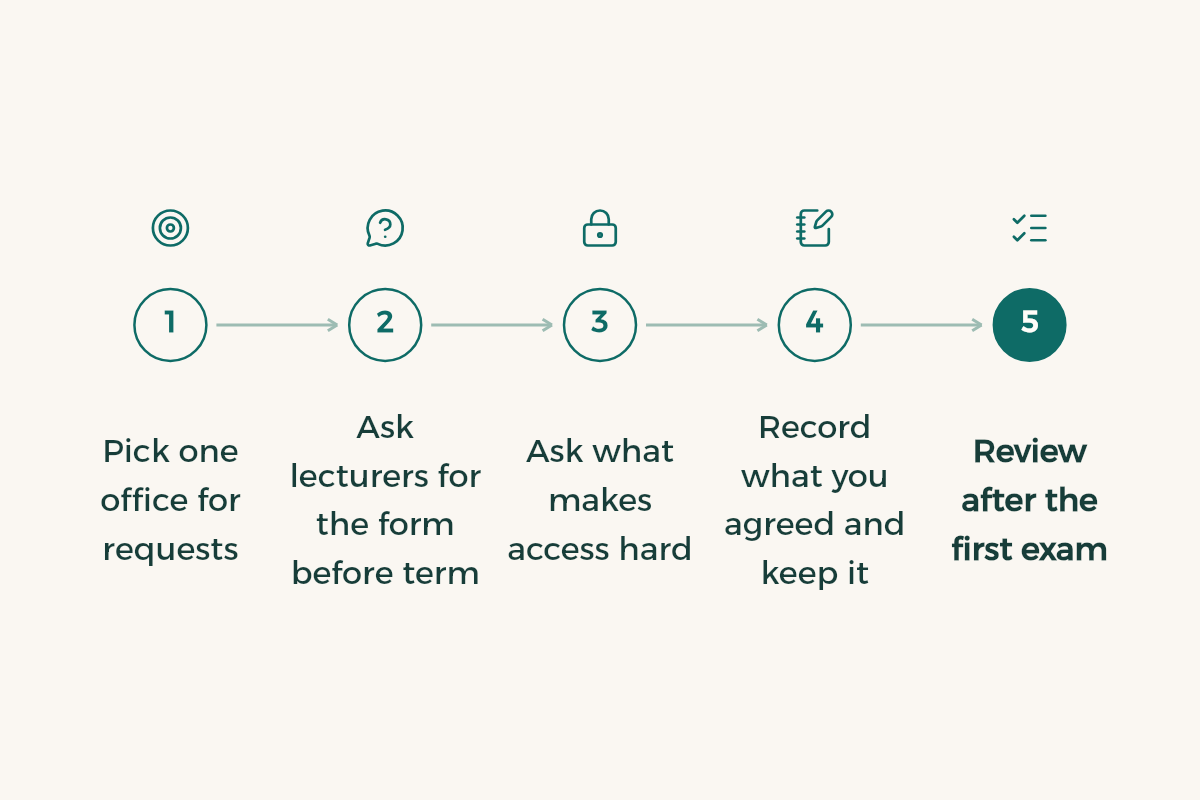
- Pick one office for requests
Student affairs or the advising office will do. Publish its name, location and contact channel. A student who does not know where to go waits, and then loses the first exam.
- Ask lecturers for the form before term starts
Not after the first exam. A form that arrives late does no good, however well designed it is.
- Ask what makes access hard
The useful question is: what makes it hard for you to read the material or show what you know? Do not ask for more of the diagnosis than you need to set the arrangement.
- Record what you agreed and keep it confidential
A written note of the arrangement, seen only by people who need it. The student should not have to explain the case again next term.
- Review after the first exam
The first exam shows the gap. If the copy was late or the invigilator did not know the arrangement, the fault is in the process, not in the student.
Most students do not want classmates to know their arrangements. Route the process through the responsible office, not through the lecturer in front of the class.
Which tools help students with disabilities at university?
Start with the listed arrangements: visual material, recorded lectures, note-takers and interpreters cover much of what students ask for.1 Beyond that, assistive software and devices depend on what your university provides and what the student already owns. Write down which items the university will supply and which the student will bring, so nobody discovers the gap in the exam hall.
Which mistakes empty the support of value?
- Announcing arrangements in a handbook nobody reads, then having the student ask about them in the middle of an exam.
- Treating every request as a copy of the last one, which hides the difference between a sight problem and a problem with managing time.
- Asking for proof and then not keeping it confidential, so the file becomes a source of embarrassment.
- Separating the arrangement from psychological and social support, so the student fights on one front and gets no help on the other.
Not every arrangement suits every student. A student who needs a writer may not be comfortable with anyone writing for them, and a student who asks for extra time may need a quiet room more than time. Ask before you decide on their behalf.
Do activities and volunteering need special planning?
Yes. A student whose building, transport or meeting place keeps them out will lose the belonging that activities are meant to build. Before you publish an event, ask about the entrance, the room and who will meet the student on arrival. In volunteering, offer tasks that suit different abilities, as the student volunteering guide explains.
Knowing about support also lowers the chance a student leaves. Read the student retention guide for the signals that come before a student leaves, and remember that a delayed small arrangement can be one of them.
If a student needs devices or study software, the student deals page is a place to start looking at what is available, though the decision on equipment stays with the university and the student.
Is an arrangement enough to keep a student enrolled?
No. An arrangement removes one barrier, but it does not guarantee an adviser who follows the student, classmates who know them, or a course load that suits their abilities. Tie the student file to academic advising, have the adviser follow them through the term, and treat the arrangement as part of a study plan rather than a separate form. The academic advising guide covers the questions an adviser should settle with the student.


