

By the tiswa editorial team, from the official sources listed at the end of this guide. How we write our guides
Most students do not leave a university overnight. A term GPA slips, re-registration gets delayed, and the name drops off the attendance list a little later. The gap between institutions that keep students and those that lose them is whether they notice that slide early, and who acts when they do. This guide is for staff in student affairs, admissions and advising, and it concentrates on what your existing data can tell you now.
When does withdrawal actually start?
Rarely with a decision. It usually starts with a postponement: a course has to be repeated, a term carries a lighter load, or an advising appointment is cancelled and never rebooked. A student who says they will leave next term may have started drifting months before.
That is why one check in week four beats a dozen motivational messages in the middle of term. If you can only run one check, run it at the start of the core courses, because that is where weak starts show up first.
| Signal | What it usually means | Suggested step |
|---|---|---|
| Falling term GPA | The student needs support in one course, not in the whole university | Review that course with the lecturer and arrange a help session |
| Repeated absence from one course | Could be the difficulty of the course or an outside pressure | Adviser contact before the absences pile up |
| No registration for the next term | Either a temporary break or a real exit | Direct call, and find out the reason before opening a file |
| Repeated course withdrawal requests | The student is looking for a way out of accumulated pressure | Meeting to review the study load and the options |

What are the course and university withdrawal rules?
Rules differ between universities, and you cannot advise a student well without checking your own. At Umm Al-Qura University, for example, a student may withdraw from up to two courses in a semester. Withdrawal is not allowed in the summer semester or in first-year and preparatory programmes, and the course is recorded as withdrawn with excuse, not as a failing grade.1
The same regulation covers return. A student who leaves the university may apply to re-enrol within two semesters after the withdrawal semester, and only once. A student who has received three consecutive academic warnings cannot re-enrol. Students planning to leave often do not know this, and it matters to them more than almost anything else you tell them.1
Who follows the student before they decide?
Do not rely on a single person in academic affairs. Assign a named adviser to each flagged student, book a time in the term, and ask that every meeting is written down. An adviser who meets a student once a year knows the name. One who follows them every term knows the story.
In many colleges the work is split between advising, admissions, registration and student affairs. Agree on one office that receives the signals and one person who calls the student first. Delay between offices is usually what loses the student, far more often than a lack of care.
Which steps work before it is too late?
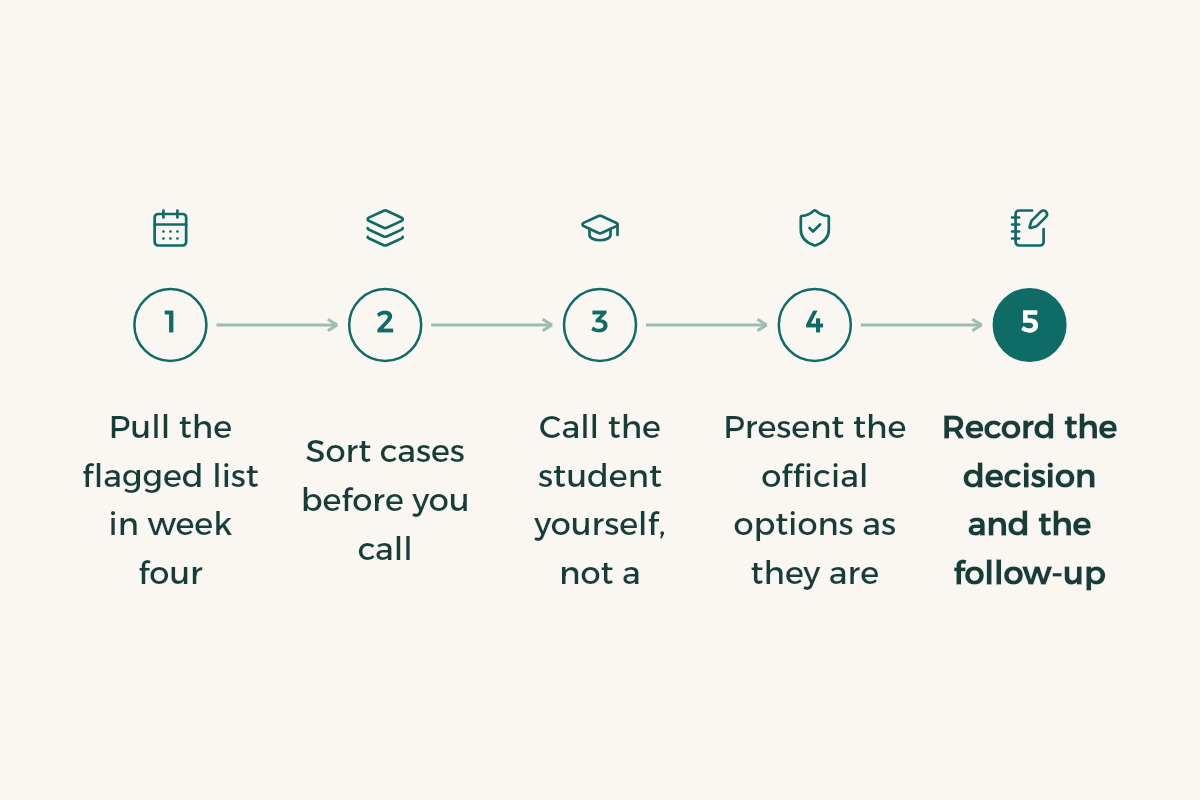
- Pull the flagged list in week four
Use grades, absences and registration status. Do not wait for term end, because the decision is usually forming in the middle.
- Sort cases before you call
One student needs help with a course, another needs financial or personal support, a third wants to change major. Each goes to a different office.
- Call the student yourself, not a template
One clear sentence is enough: we want to understand what makes studying hard for you, and agree on one step this week.
- Present the official options as they are
Withdrawal from a course, a reduced load, or a deferral for an accepted reason. Make sure the student knows what each does to their GPA and when they can return.
- Record the decision and the follow-up date
Without a written record, the same case reappears next term as if it were new.
- Compare the numbers with the previous term
Did withdrawals fall in the course you followed? That answers whether the step is worth repeating.
Take a student who got a weak grade in a core course after several absences, and did not register the next term. If the adviser makes a short call in week five, the student may find that one course needs a help session, not that they must leave. If the file waits until term end, the decision becomes a statistic read after the window has closed.
Can retention actually be measured?
We looked for a national first-year retention figure and did not find an official one that breaks out first-year students. So calculate it yourself: the share of a cohort that started term one and registered for term two, and the share from each cohort that reached graduation.
Accreditation asks for the same thing from another angle. The National Commission for Academic Accreditation and Assessment expects institutions to measure satisfaction with guidance and support services and to use the results to improve.2 Keep the data by college and cohort, and the same file serves both purposes.3
What do university students need from an adviser?
A named person who knows their record and answers within a week. Students who have to explain their situation to three offices usually stop asking. Give the adviser the grade history and the absence flags before the first meeting, so the conversation starts with a plan rather than a form.
Mistakes that weaken retention work
- A general motivational message to every student, which the ones who need it skip and the ones who do not read.
- Watching GPA alone. Repeated absence from one course is an early signal that a final grade will not show until it is too late.
- Opening a student file after they have stopped attending, so the call becomes an explanation rather than help.
- Launching a new programme every year without knowing which one kept anyone enrolled.
Some cases will not be saved by any step. A student who must work to support family, or who finds the major is wrong for them, may make the right choice by pausing. The aim is that a student leaves knowing their options, not that they lose a term because nobody asked.
What should the college do next term?
Start with the courses students drop most often. If one course in a college produces most withdrawal requests, the problem may be the sequence of courses or how the course is taught, not the students. Discuss the numbers with the college before you take them to a planning committee.
If you are trying to see whether activities help students stay, read the student engagement guide. Belonging and advising work together, and neither replaces the other.
If a student needs help choosing courses and planning the term, the clearest reference is the academic advising guide, which lists the questions to settle before the new term starts.
Is money the reason students leave?
Often it is a direct cause, and the student may not know which options exist. Ask your team to know which grants, stipends and support your university offers, and to introduce the student to the office that handles them. For discounts outside campus, the student deals page gathers offers in one place.
When do these steps fail?
A student who ignores three separate contacts needs another route, such as a parent where regulations allow it, or the student affairs office directly. Do not try to force continuation on a student who has decided to change path. A process that serves the university alone will not keep anyone.


