By the tiswa editorial team, from the official sources listed at the end of this guide. How we write our guides
Orientation week is one chance to introduce a new student to the university before teaching starts. During it, the student learns where to go, whom to ask and how ordinary days work. If the week fails, the student spends the first month looking for a room or an officer who can answer, and then stops asking. It deserves as much planning time as the semester timetable itself.
How do I prepare for freshman year of college?
Before you choose events, decide what a student should leave with at the end of the week. These four outcomes suit most universities:
- The student knows where to go, whom to ask and how daily life works.
- The student understands the academic system: the study plan, registration and advising.
- The student has met two or three classmates and knows which clubs suit them.
- The student knows where to turn for financial, academic or emotional help.
What are the best tips for freshman year of college?
First-year students need a few clear pieces of advice, and they lose them when too many arrive on one day. The best way to deliver them is through a second-year student, not a long lecture. Brief the student speakers in a short session before the week, and ask them to explain how they revised, how they used advising and where they went wrong.
Remember that on day one the worry is usually the place rather than the content: where the lecture hall is, where the prayer room is, where the card is issued. Mark the routes clearly and staff the entrances with people who greet everyone the same way.
What does a day-by-day schedule look like?
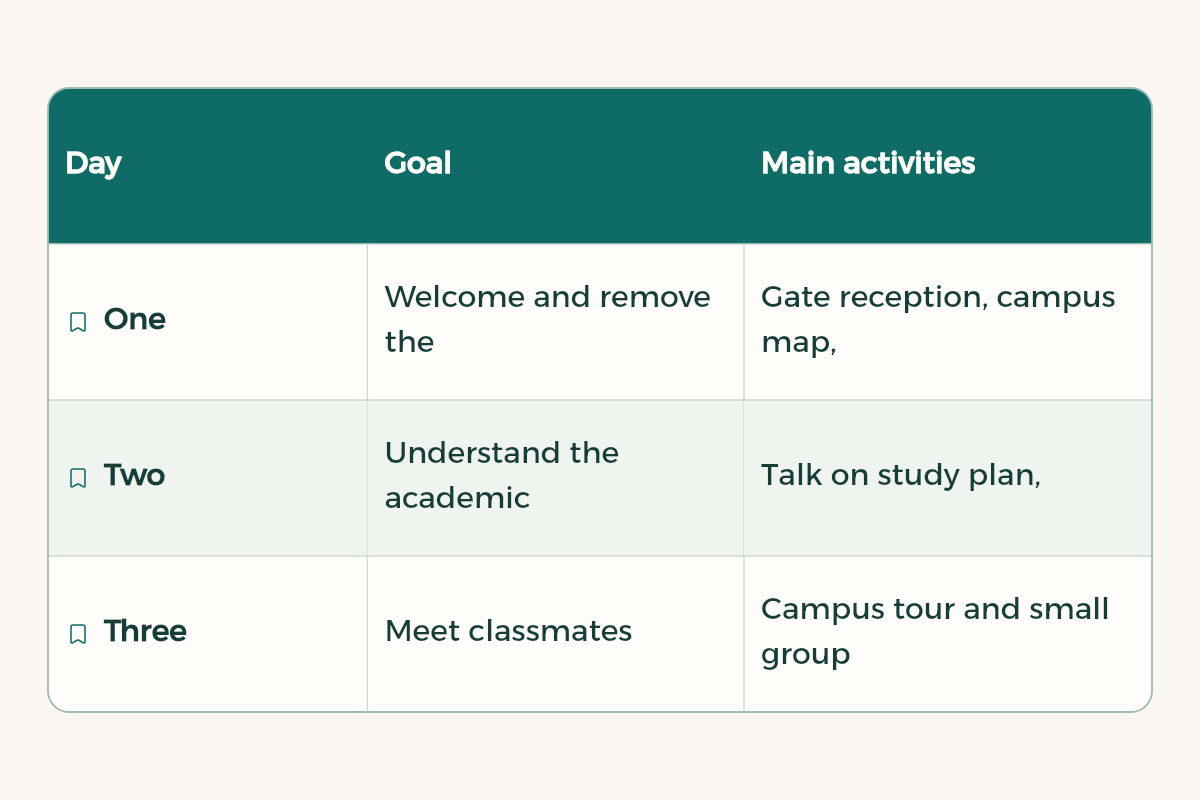
The schedule below runs five days. Universities with very large intakes can compress it into three, but keep the order: information first, then introductions, then belonging. Large programmes follow a similar pattern. The introductory programme for new students run by the common first year and basic sciences deanship at King Saud University's Al-Muzahmiyah campus included a welcome lecture, issuing university ID cards, collecting textbooks, and visiting booths from the deanship, the colleges and the supporting departments.1
| Day | Goal | Main activities |
|---|---|---|
| One | Welcome and remove the first confusion | Gate reception, campus map, student card, attendance check-in |
| Two | Understand the academic system | Talk on study plan, registration and advising, plus a fair of university services |
| Three | Meet classmates | Campus tour and small group meetings with students from senior years |
| Four | Belonging and activities | Clubs fair, a short sports or cultural event, and sign-up for an activity |
| Five | Preparing for real study | Study skills workshop, session on academic and emotional support, and a review of the week |
Which planning steps matter most?
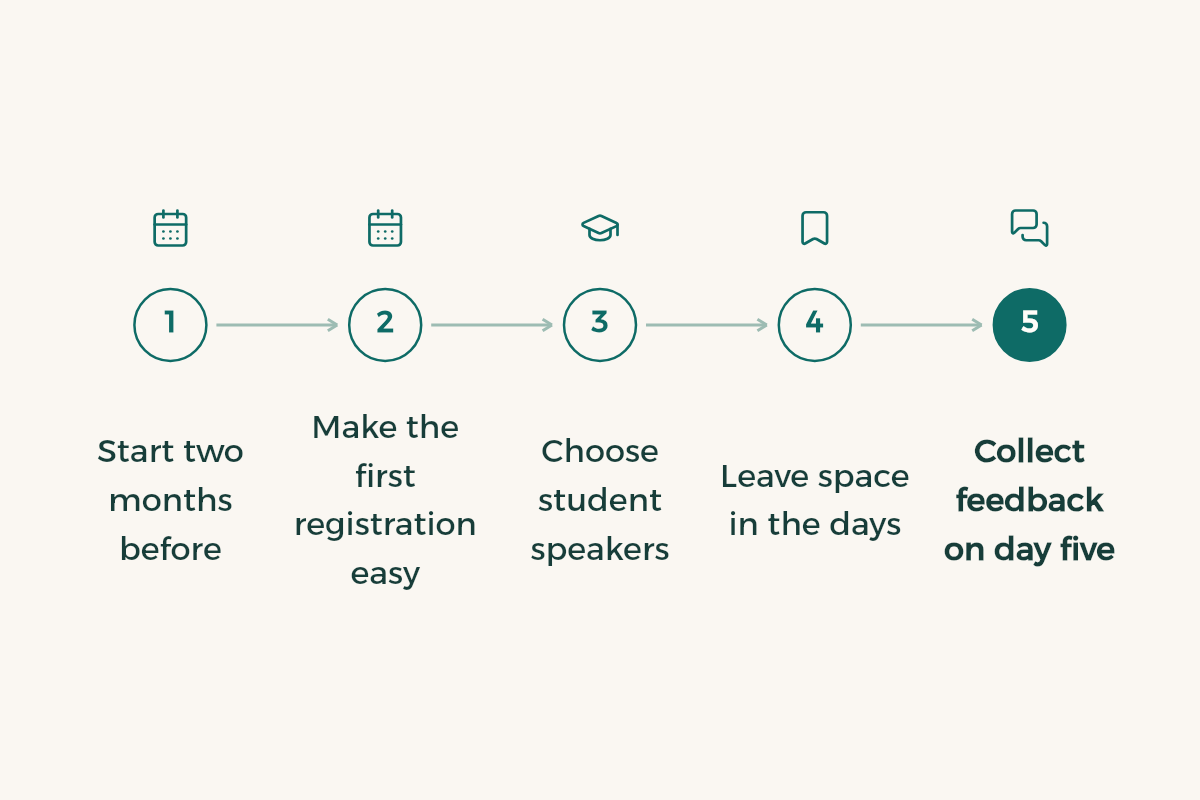
- Start two months before
Set the budget, venues and speakers, and agree the schedule with colleges, housing and campus security. Much of the confusion comes from overlapping units that never coordinated.
- Make the first registration easy
Student card, collecting books and course registration in one place where possible. A student who walks between offices is tired before the week begins.
- Choose student speakers
A second-year student explaining how they study persuades newcomers more than a long lecture. Brief the speakers in a short session first.
- Leave space in the days
Keep free time after each event, because new students need to meet classmates on their own terms.
- Collect feedback on day five
A survey of three questions: what helped most, what confused you, and what should be repeated next term?
Does the week reach students with disabilities?
An orientation that reaches only the majority leaves whole groups out. The Students with Disabilities Centre at the deanship of student affairs at King Saud University held an orientation meeting for incoming students with disabilities, presenting the services, the academic support programmes, university regulations and facilities, followed by an open discussion.2 That format is worth copying: a presentation, then real questions, rather than a lecture delivered at people.
Plan arrival times and transport for students who moved from other cities as well. For the arrangements that are possible, see the guide on supporting students with disabilities.
I am planning an orientation week for new students at a Saudi university. Number of students: [number]. Length: five days. Venue: [campus or colleges].
1) Suggest a daily schedule that starts with a welcome and ends with activity sign-up.
2) For each day give one goal, one main event and a free time block.
3) Suggest three survey questions for the last day.
Do not add official dates or figures. Leave any official detail blank so I can check it with the responsible unit.
How do I run student mentors well?
A new student asks an older student far more easily than a member of staff, so the week depends heavily on its mentors. Choose them from second and third year students, using a short interview on communication and commitment. Train them in one session on common questions and on when to refer a student to a specialist service.
- Give each mentor a small group to follow through the week and for a month after.
- Give them a sheet with the numbers for student services, advising and counselling.
- Thank them formally with a certificate that counts in their activity record.
How do I measure whether the week worked?
Attendance alone is not enough. Send a three-question survey at the end of the week: do you know where to go if you need help? Did you meet at least one new classmate? What did you wish you had been told? After the first term, compare students who attended with those who did not on retention and participation, using a student satisfaction survey to measure the longer-term effect.
Do not force a student who lives with family in the city to attend every event. The week is for introductions, not compulsory attendance. Separate what must be attended, such as registration and the ID card, from what is optional, such as clubs and sports.
How do we keep students after the week ends?
The biggest loss in orientation week is when it ends with its last day. Give every student a follow-up date in the first weeks, and link attendance to the lectures and activities that follow. Offer a club or nearby event two weeks later, and follow up with those who did not reply. The student retention guide explains those steps in more detail, and the guide to student engagement programmes covers the activities that come next.
What mistakes do planners make most?
Planners often fill every hour with lectures, which leaves no room to meet anyone, or announce events without a contact number for students who need special arrangements. A small university can skip large group sizes entirely. One mentor with ten students usually does more good than one mentor with a hundred.