By the tiswa editorial team, from the official sources listed at the end of this guide. How we write our guides
A recommendation letter from a professor is required by most master's programmes and scholarships, and by many placements and first jobs. The trouble is that most students ask late, ask someone who barely knows them, and give them nothing to write about, so the letter comes out generic. This guide takes you from choosing the right person to the thank-you note, with ready request templates.
Who to ask
A strong letter comes from someone who knows your work in detail, not whoever has the biggest title. Rank your options like this:
| Person | When they are the best choice |
|---|---|
| Your graduation project or research supervisor | Almost always for a master's, because they saw your independent work up close |
| A professor of a core course where you scored high and took part | When they know you by name and can cite specific work |
| Your co-op or summer training supervisor | For jobs, professional programmes and applied master's |
| The adviser of a club or activity you led | As an extra letter showing leadership, not the main one for a master's |

Most programmes ask for two or three letters. For graduate study make at least two academic, and read each university's rules since some specify the type of referee.
When to ask
At least four to six weeks before the deadline. Professors write for dozens of students in the same season, and late requests are either declined or rushed. Better still, build the relationship long before: go to office hours, ask about the material, and join extra projects. A professor who has known you for a year writes a far stronger letter than one who only recognises your face.
How to ask
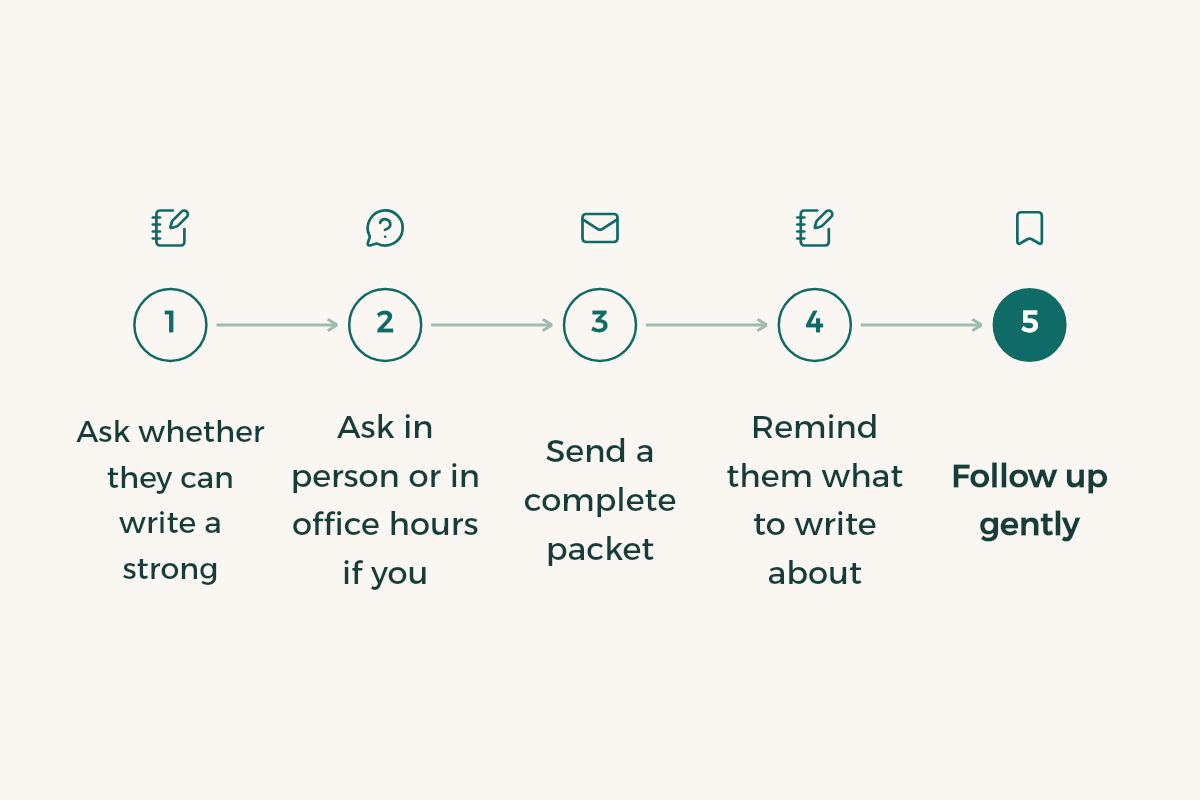
- Ask whether they can write a strong letter
This phrasing lets them decline politely if they do not know you well, which is better for you than a weak letter.
- Ask in person or in office hours if you can
Then send an email with the details straight after.
- Send a complete packet
Your CV, statement of purpose, transcript, a list of programmes with deadlines, and the submission method for each.
- Remind them what to write about
Three specific points: the course and grade, a project or moment that stood out, and a skill they saw. This turns a generic letter into a specific one.
- Follow up gently
One reminder a week before the deadline, and another two days before if the letter is still not in.
- Thank them and share the result
A thank-you after submission, and another note when you get in. It keeps the door open for future letters.
Request templates
Subject: Recommendation letter request: [your name], [course]

Dear Dr. [name],
I took your [course] in [term], where I [specific work: project, paper, presentation]. I am applying to [programme] at [university], with a deadline of [date].
Would you be able to write a strong letter of recommendation speaking to [specific skill or work]? I have attached my CV, statement of purpose, and a list of programmes with submission instructions.
Thank you for considering it, and I completely understand if your schedule does not allow it.
Best regards,
[name] | [student ID] | [mobile]
عنوان الرسالة: طلب خطاب توصية: [اسمك]، [المقرر]

سعادة الدكتور/ة [الاسم]،
السلام عليكم ورحمة الله،
أنا [اسمك]، درست معكم مقرر [اسم المقرر] في [الفصل]، و[عمل محدد]. أتقدم حالياً إلى [البرنامج] في [الجهة]، وموعد التقديم [التاريخ].
هل تستطيعون كتابة خطاب توصية يتحدث عن [المهارة أو العمل المحدد]؟ أرفقت سيرتي الذاتية وخطاب الدافع وقائمة بالبرامج وطريقة الرفع.
أقدر وقتكم كثيراً، وأتفهم تماماً إن كان الوقت لا يسمح.
مع خالص الشكر،
[اسمك] | [الرقم الجامعي] | [الجوال]
The packet that helps your professor write
- A table of programmes: name, deadline, submission method (a link from the university or a letter you send), and any specific question for referees.
- Your updated CV and statement of purpose, so the letter matches your story.
- A three-point summary of what you did in their course, with grade and term.
- For paper letters: the required form filled in with your details, and an envelope if needed.
How submission usually works
Most universities now email a link straight to your referee once you enter their details in the application system, and you never see the letter. You are usually asked to waive your right to read it, and waiving gives the letter more credibility with the panel. Enter your professor's official university email, and tell them in advance that a link is coming so it does not get lost.
Mistakes that ruin a letter
- Asking a professor whose class you rarely attended or where your grade was average.
- Asking days before the deadline.
- Sending a bare request and leaving them to hunt for your CV and deadlines.
- Entering the wrong email in the university system so the link never arrives.
- Forgetting to say thank you. You will probably need them again.
Letters for placements and jobs
Do not wait until you need one. In the last week of your co-op or summer training, ask your supervisor for a letter, or at least for permission to list them as a referee. If they use LinkedIn, ask for a short recommendation on your profile, where every visitor sees it. And if you are heading for the Saudi scholarship programme, collect your letters well before university applications open.