
By the tiswa editorial team, from the official sources listed at the end of this guide. How we write our guides
Medical terminology is the first wall that health preparatory year, medicine, nursing and pharmacy students hit. Words like gastroenteritis and tachycardia look long and frightening, but they are built from a small set of parts that repeat across thousands of words. Learn those parts and you can understand terms you have never seen, instead of memorising every word on its own. This guide explains the method, gives you tables of the most common parts from an official source, and a practical memorising plan.
How a medical term is built
Most English medical terms come from Greek or Latin and are made of three kinds of parts, as the US National Library of Medicine explains in its MedlinePlus guide to understanding medical words:
- The root carries the core meaning and usually names an organ or body part, such as cardi for heart and hepat for liver.
- The prefix comes before the root and changes its meaning, such as tachy for fast and hypo for under or deficient.
- The suffix comes at the end and tells you what kind of word it is, such as itis for inflammation and ectomy for removal.
- A linking vowel, usually o, is often added between the root and what follows to make the word easier to say, so cardi becomes cardio in cardiology.
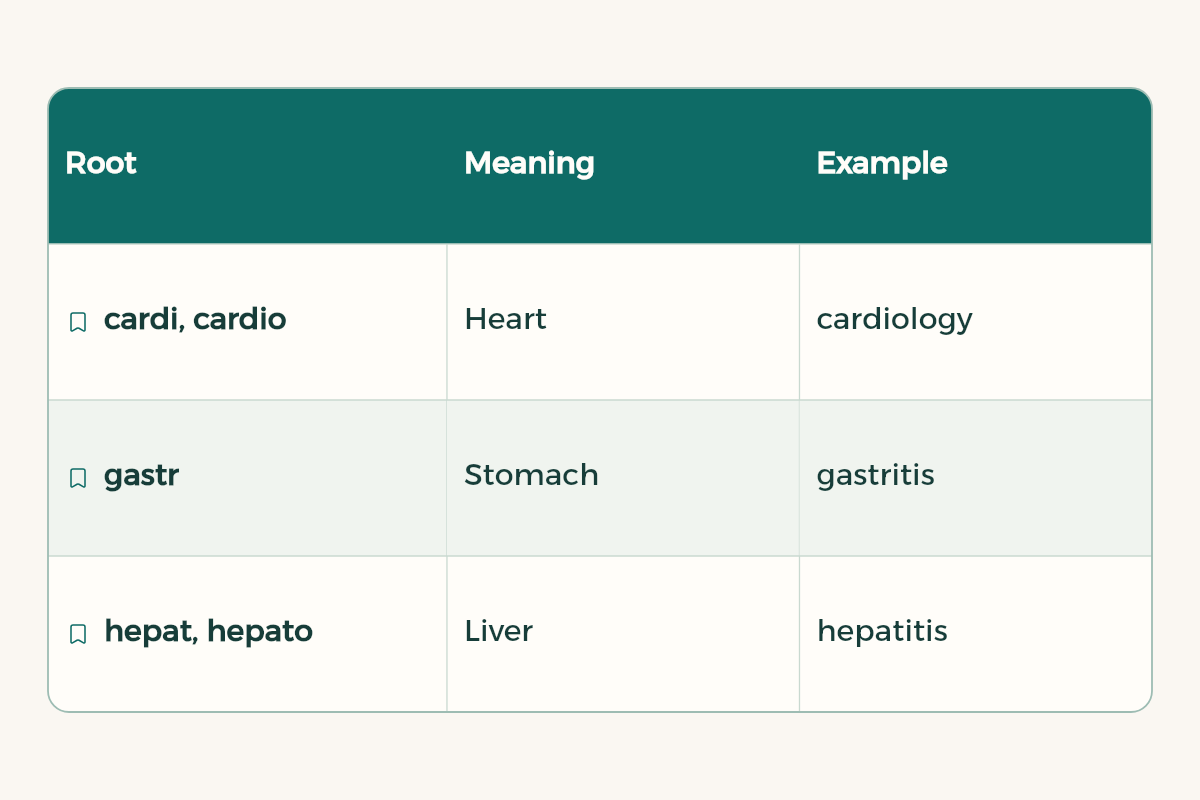
The most used organ roots
| Root | Meaning | Example |
|---|---|---|
| cardi, cardio | Heart | cardiology |
| gastr | Stomach | gastritis |
| hepat, hepato | Liver | hepatitis |
| nephr, nephro | Kidney | nephrectomy |
| oste, osteo | Bone | osteoporosis |
| my, myo | Muscle | myopathy |
| cyt, cyto | Cell | cytology |
| derm, dermato | Skin | dermatitis |
| neur, neuro | Nerve | neurology |
| pharmaco | Drug, medicine | pharmacology |
Prefixes that change the meaning
| Prefix | Meaning | Example |
|---|---|---|
| hyper | Above, beyond, excessive | hypertension |
| hypo | Under, deficient | hypoglycemia |
| tachy | Fast | tachycardia |
| brady | Slow | bradycardia |
| poly | Many, excessive | polyuria |
| hemi | Half | hemiplegia |
| bi, tri, tetra | Two, three, four | bilateral |
| neo | New | neonate |
| erythr, erythro | Red | erythrocyte |
| iso | Equal, like | isotonic |
Suffixes that set the type of word
| Suffix | Meaning | Example |
|---|---|---|
| itis | Inflammation | appendicitis |
| ectomy | Cut out, removal | appendectomy |
| otomy | Incision | tracheotomy |
| oma | Tumour | lipoma |
| pathy | Disease | neuropathy |
| plasty | Surgical reconstruction | rhinoplasty |
| scope, scopy | Instrument for examining, examination | endoscopy |
| cyte | Cell | leukocyte |
| logy | Study of | physiology |
Watch the difference between ectomy and otomy, one of the most common exam mix-ups: the first removes a part or organ, the second only cuts or opens. MedlinePlus keeps a longer list of word parts and their meanings you can go back to.
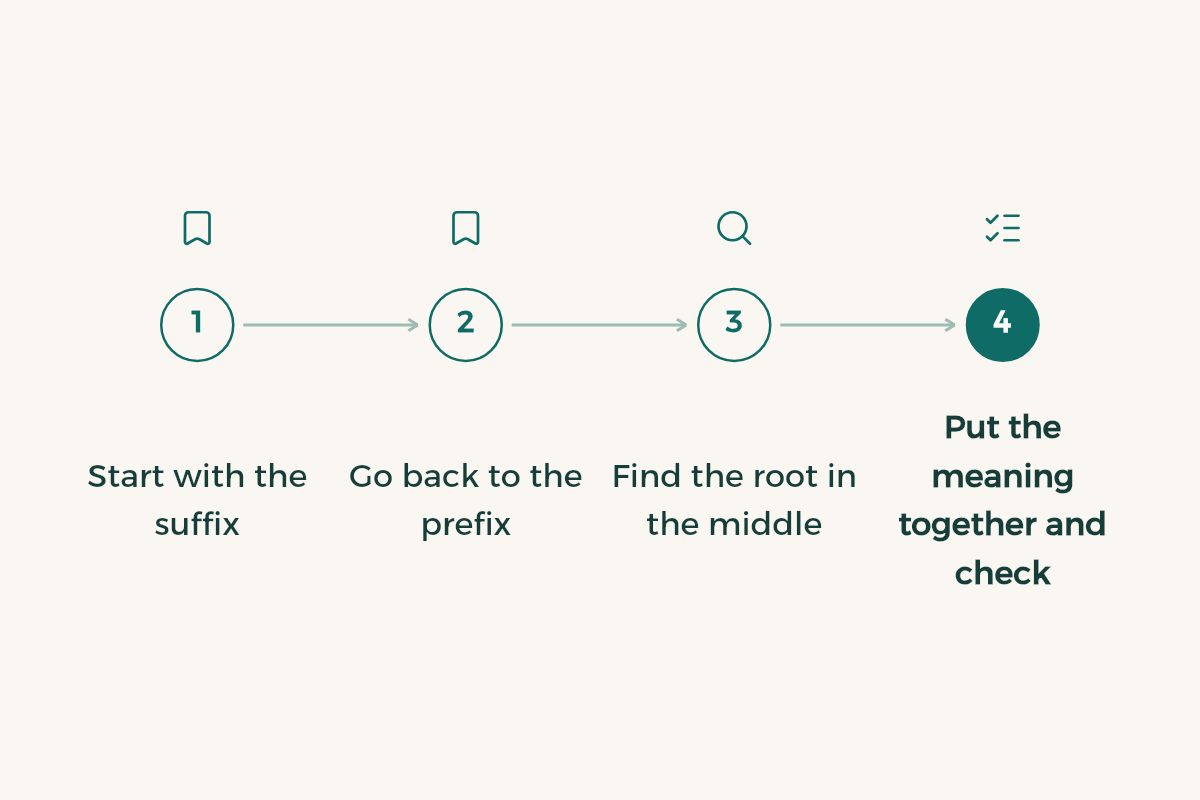
Break down any term in four steps
- Start with the suffix
Find the last part and its meaning. In nephrectomy the suffix is ectomy, removal.
- Go back to the prefix
If there is a prefix at the start, it describes the condition. In tachycardia the prefix is tachy, fast.
- Find the root in the middle
The root is usually the organ. In nephrectomy the root is nephr, kidney, so the term means removal of a kidney.
- Put the meaning together and check
Join the parts in a sentence: tachy fast, cardi heart, ia condition, so a fast heart rate. Then check the meaning in a dictionary or your textbook.
Try the method on these words before you look them up: gastroenteritis, nephritis, osteitis and erythrocyte. You will find you understand most of them from the parts alone.
Abbreviations
In medical records and lectures you will meet many abbreviations, such as BP for blood pressure and CPR for cardiopulmonary resuscitation. Do not memorise a long list in one go. Learn each abbreviation when it appears in a lecture. MedlinePlus has a list of common medical abbreviations to check against. Some abbreviations can mean different things in different specialties, so always follow what your lecturer and course use.
Group terms by body system
Most anatomy and physiology courses are split by body system: circulatory, digestive, respiratory, urinary, nervous and musculoskeletal. Group your terms the same way so each system's roots sit together. In the digestive system, for example, the roots for stomach and liver keep returning with the suffixes for inflammation, removal and examination, so new words become extensions of what you know. Before the first lecture of a new system, list its roots, and half the terms will make sense before your lecturer explains them.
A flashcard plan
- One card per part, not per word
Make a deck in Anki called word parts, with one part, its meaning and two examples on each card.
- Ten parts a day
Start with the tables above. Ten new parts a day, plus the reviews the app asks for, covers the basics in a few weeks.
- One card per lecture term
In a second deck, add the terms from today's lecture, with the breakdown into parts on the back, not just the meaning.
- Pronunciation on the same card
Hear the term in the Cambridge Dictionary and write the stressed syllable in capitals, like cardiOLogy. Pronunciation drills are in how to improve your English pronunciation.
- Test yourself on new words
Once a week, take five terms from a chapter you have not studied yet and break them down before reading. It measures how well you really know the parts.
Use AI for practice
Ask an AI assistant to quiz you and build drills, but do not treat it as the final source for medical facts. Your textbook and lecturer are the reference. Try this with ChatGPT or Gemini:
I am a first-year health sciences student. Quiz me on medical terminology word parts. Give me one medical term at a time from [the cardiovascular / digestive / renal] system. I will split it into prefix, root and suffix and guess the meaning. Then tell me if I am right, show the correct breakdown, and give one more term that uses the same root. After 10 terms, list the parts I got wrong.
Here are the terms from my lecture: [paste list]. For each term make one flashcard line in this format: term ; breakdown into parts with the meaning of each ; simple English definition in one line ; stressed syllable in CAPITALS. Do not add terms that are not in my list.
Health majors have full guides with their own tools and prompts: AI for medical students, nursing students, pharmacy students and dentistry students.
Common mistakes
- Memorising a term and its Arabic meaning without breaking it down, so you cannot read a new word from the same family.
- Mixing up look-alike parts such as hyper and hypo, or ectomy and otomy. Put them on one card to compare.
- Leaving terminology for exam week. Terms pile up from the first lecture, and short daily review is the fix.
- Ignoring pronunciation. You will need to say terms in labs and discussions, and the wrong stress makes them hard to follow.
If you are still in the preparatory year, terminology is part of a bigger skill: academic English. A full daily plan is in learn English for university, and the general academic words that appear in every source are in academic English vocabulary.