By the tiswa editorial team, from the official sources listed at the end of this guide. How we write our guides
How do you write an English essay that is clear, convincing and earns a good grade? Most students start writing straight away, then stall after one paragraph because they do not know where they are heading. An English essay has an almost fixed structure, and once you know it, writing becomes filling a clear template rather than a gamble. This guide explains essay types, how to write a thesis statement, how to build a paragraph, linking words, and a six-step plan from reading the question to the final proofread.
First: what type of essay is it?
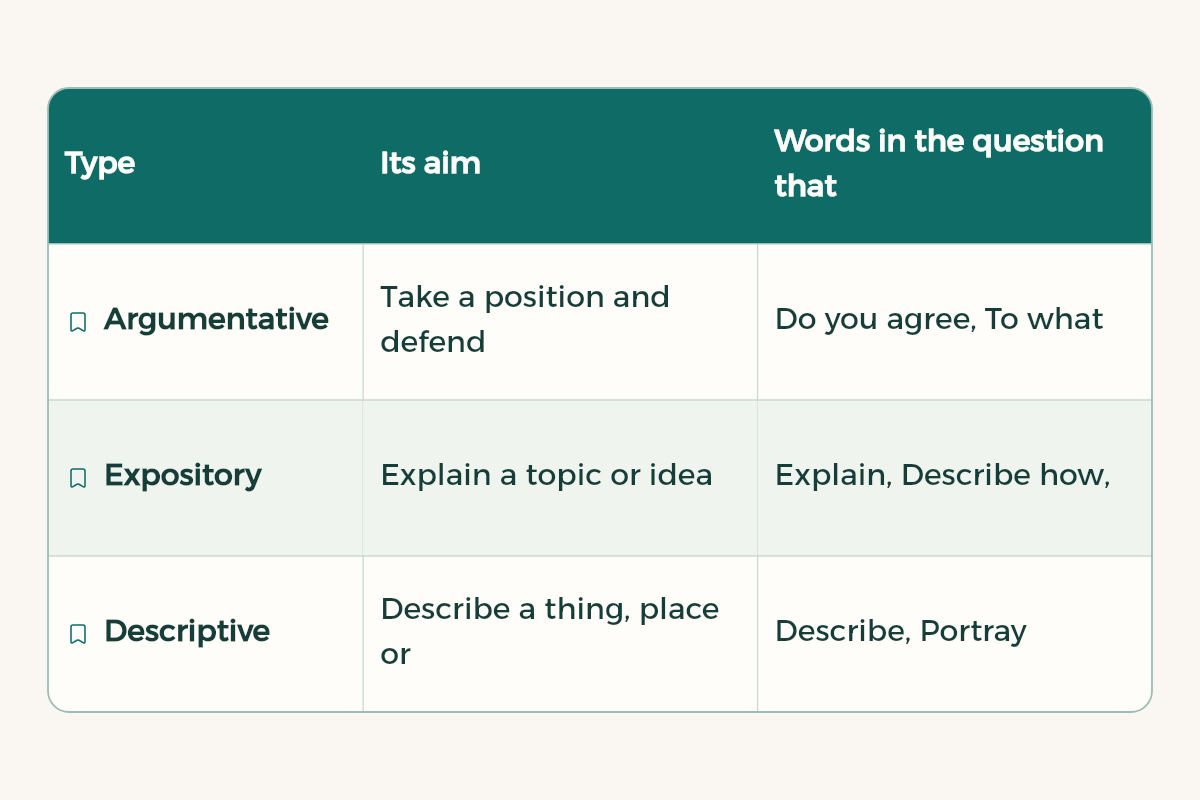
The Purdue University writing lab (Purdue OWL) lists four common essay types in university assignments. Read the question and identify the type before anything else, because the structure and tone differ:
| Type | Its aim | Words in the question that point to it |
|---|---|---|
| Argumentative | Take a position and defend it with evidence, and answer the opposing view | Do you agree, To what extent, Argue |
| Expository | Explain a topic or idea objectively, without personal opinion | Explain, Describe how, Discuss |
| Descriptive | Describe a thing, place or experience with sensory detail | Describe, Portray |
| Narrative | Tell a story or personal experience with a point or lesson | Tell about a time, Write about an experience |
At university you will mostly write argumentative and expository essays, which are also closest to what language tests ask for in their writing sections. So this guide focuses on those two.
The basic structure: introduction, body, conclusion
| Part | What it contains | Typical length |
|---|---|---|
| Introduction | A hook, short background, then the thesis statement at the end of the paragraph | One paragraph |
| Body paragraphs | One idea per paragraph that supports the thesis, with a topic sentence, evidence, explanation and link | Two to four paragraphs |
| Conclusion | The thesis restated, the ideas summarised, and a final sentence that widens the meaning | One paragraph |
The thesis statement: the most important sentence
The thesis statement tells the reader clearly what the essay will prove or explain. According to Purdue OWL's tips, it usually comes at the end of the first paragraph, it should be specific and cover only what the essay discusses, and you should revise it if your direction changes while you write.
| Weak | Strong | Why |
|---|---|---|
| Technology is important for students. | Universities should teach first-year students how to use AI tools responsibly, because it improves research skills and reduces plagiarism. | The second takes a specific position and names two reasons the body will explain |
| This essay is about online learning. | Online learning saves students time and money, but it requires stronger self-discipline than classroom learning. | The second sets three clear points for the essay |
Building a body paragraph
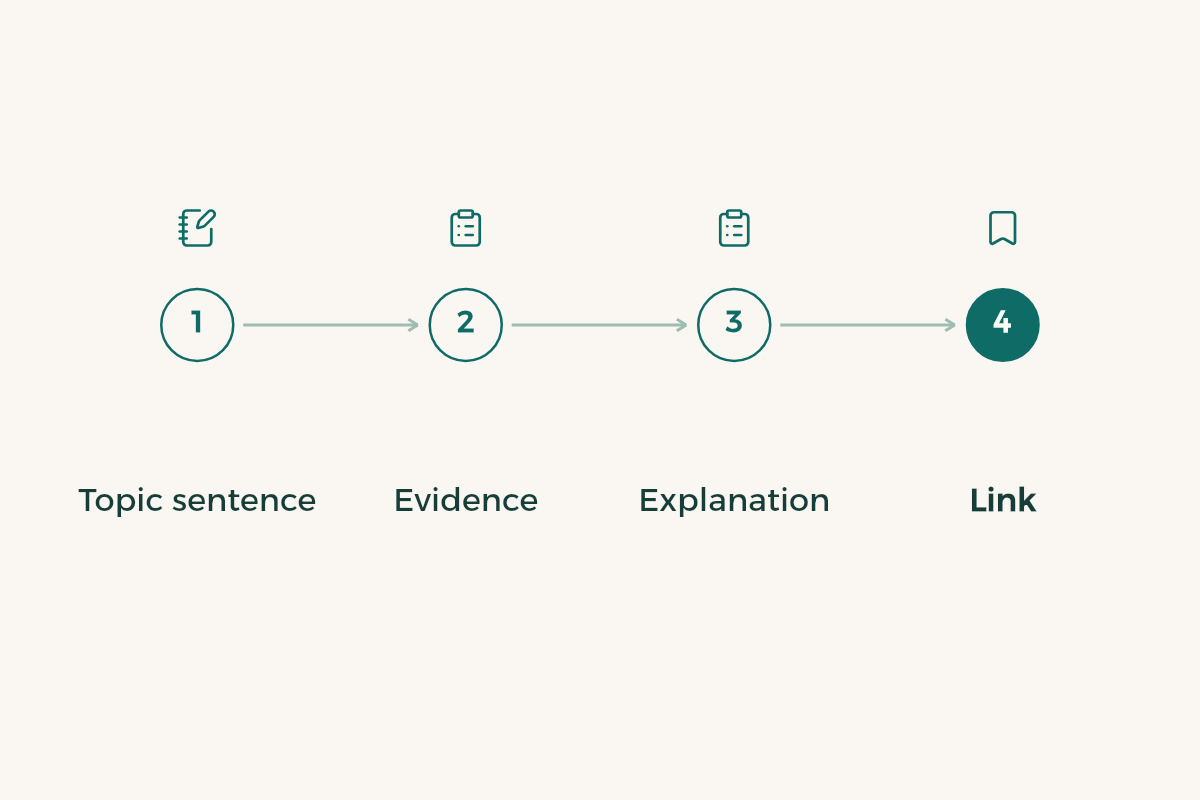
Every body paragraph follows a fixed pattern that makes you easy to follow. Use this order in each one:
- Topic sentence
The first sentence states the paragraph's idea in one line and links directly to the thesis. Example: First, online learning saves students a significant amount of time.
- Evidence
A figure from a reliable source, an example or a short quotation. If you use a source, cite it in the style your lecturer asks for.
- Explanation
Two or three sentences on how the evidence supports your point. This is what sets a good essay apart, because evidence alone is not enough.
- Link
A final sentence that ties the paragraph back to the thesis or leads into the next one.
The linking words you need
| Function | Linking words |
|---|---|
| Order | First, Second, Finally, To begin with |
| Adding | Furthermore, In addition, Moreover |
| Contrast | However, On the other hand, Although, In contrast |
| Cause and effect | Because, Therefore, As a result, Consequently |
| Examples | For example, For instance, Such as |
| Concluding | In conclusion, To sum up, Overall |
Do not put a linking word at the start of every sentence, which makes the text sound mechanical. Use them when you move between ideas. More academic words that lift your writing are in academic English vocabulary.
In an argumentative essay: answer the other side
A strong argumentative essay does not ignore the other view. Give a paragraph, or part of one, to the strongest objection to your position, then answer it with evidence. Useful phrases: Some people argue that ... However, ... and It is true that ... but ... This makes your case stronger because it shows you have thought about the topic from every side.
A six-step writing plan
- Analyse the question
Underline the task verb (Discuss, Argue, Explain), the topic and any limits such as word count. Most lost marks come from answering a different question.
- Brainstorm
Five minutes writing down every idea on the topic, with no order and no judging.
- Write the thesis and outline
Pick the three strongest ideas, write your thesis, then an outline with each paragraph's topic sentence and the evidence you will use.
- Write the first draft
Write quickly from the outline without stopping to correct. Start with the body if the introduction is hard, and write the introduction last.
- Revise the content
After a break, read the essay and ask: does each paragraph support the thesis? Is the explanation enough? Are the transitions clear?
- Proofread the language
Read aloud to catch long sentences and mistakes. Then check your repeated errors, such as verb tense and the third person s. Grammar basics are in English grammar basics.
Use AI the right way
Having AI write the whole essay and submitting it as your own counts as academic misconduct at most universities, and it costs you the skill itself. Read your university's policy, and more in AI detection at university. The useful role for AI is reviewer and coach: you write, it critiques and asks questions. Try these with ChatGPT or Gemini:
Here is my essay question: [paste question]. Here is my thesis statement and outline: [paste]. Do not write the essay. Tell me: 1) is my thesis specific and does it answer the question, 2) does each topic sentence support the thesis, 3) what is the strongest counterargument I should address. Answer in short bullet points.
Here is my essay draft: [paste]. Act as a strict university writing tutor. Do not rewrite it. Give me: the three biggest problems in structure or argument, any paragraph where the explanation is too weak, and my five most repeated grammar mistakes with one corrected example each.
- Google AI: Google AI offers Google AI Plus free for a year to university students in Saudi Arabia.
- Notion: Notion offers Notion Education plan for students to university students in Saudi Arabia for free.
- WPS Office: WPS Office offers WPS Office for free to university students in Saudi Arabia.
Common mistakes in English essays
- A long introduction that repeats the question with no clear thesis.
- Paragraphs with more than one idea, or a paragraph of one sentence.
- Evidence with no explanation, as if you drop a number and leave the reader to work it out.
- Translating long Arabic sentences word for word. Academic English prefers shorter, clearer sentences.
- A conclusion that adds a new idea the essay never discussed.
- Forgetting to cite sources. How to cite is in APA citation.
If the task is a longer research paper rather than an essay, the steps for gathering sources and building sections differ. The details are in how to write a research paper.