By the tiswa editorial team, from the official sources listed at the end of this guide. How we write our guides
The radiology major in Saudi Arabia, usually called radiological sciences or medical imaging at university, prepares you to work as a technologist who performs imaging exams: X-ray, CT, ultrasound and MRI. This guide covers how long the degree takes, the courses year by year, the key difference between a radiologic technologist and a radiologist, the usual admission route and career paths.
Technologist or radiologist?
Settle this question first. A radiologist studied the full medicine degree, then specialised in radiology through board training after graduation; they read the images and write the diagnostic report. A radiologic technologist studies a bachelor's in radiological sciences and performs the exam itself: preparing the patient, setting up the machine, choosing the right protocol and getting a clear image at the lowest radiation dose possible. Both are essential, but the paths are completely different. If your goal is to become a radiologist, read the medicine major guide.
How many years is radiological sciences?
A documented example is the Bachelor of Science in Radiological Science at Imam Abdulrahman Bin Faisal University (IAU): five years including the preparatory year and the internship year, for a total of 135 credit hours. The internship rotates through hospital departments including diagnostic radiography, diagnostic sonography and diagnostic CT, with periodic evaluations and certificates at the end.
Radiology courses year by year
| Year | Example courses |
|---|---|
| 1 (preparatory) | Health-track prep year: Biology 1, Physics, Computer Skills and English |
| 2 | Basic Anatomy and Physiology, Fundamentals of Radiation Physics, Radiobiology, Imaging Equipment, Radiological Anatomy and Physiology, Radiography Clinical Practice 1 |
| 3 | Professional Ethics in Radiological Sciences, Radiological Pathology, Radiation Protection, Biostatistics, Medical Imaging |
| 4 | Research Methodology, Digital Radiography, CT and MR Clinical Practice, Graduation Project, Medical Imaging Modalities |
| 5 | Internship rotating through imaging departments |
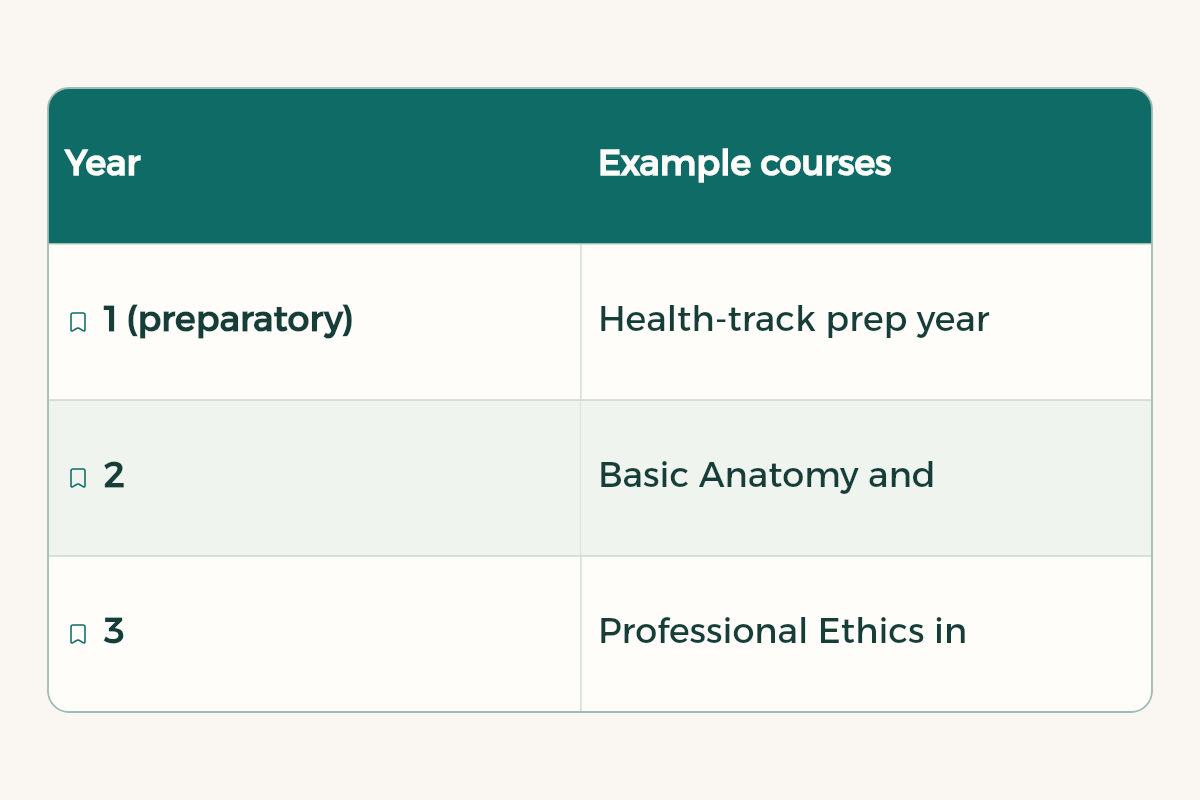
Notice how much physics sits in year two. Radiation physics, radiobiology and radiation protection are what make you a safe technologist, so do not treat them as theory to scrape through. Radiological anatomy is the course you will use every day to judge whether the image you took shows what was needed.
Admission requirements
Admission usually follows the health-track preparatory year, with placement based on GPA and available seats. Physics and maths matter more here than in some other health majors, so watch those grades. The documented programme page notes that the department started for male students and that a similar programme for female students is in the planning stages, so check what your university offers before you apply. To plan your GPA, read the preparatory year guide.
Professional classification and localisation
After graduation you need classification and professional registration with the Saudi Commission for Health Specialties (SCFHS), which classifies health certificate holders, registers practitioners and sets the standards for practising health professions.
One important official labour-market signal: the Ministry of Human Resources and Social Development, with the Ministry of Health, raised the private-sector localisation rate for the radiology profession to 65%, in two phases, the second covering all facilities in every region of the Kingdom.
Career paths for radiologic technologists
The documented programme page says graduates can work as technologists in:
- Diagnostic radiography.
- Diagnostic sonography.
- Diagnostic CT.
- Diagnostic MRI.
- Special procedures such as fluoroscopy and angiography.
- PACS administration (the medical image archive system).
With experience you can specialise in one modality, move into quality and radiation protection, work with medical equipment companies in training and application support, or take a master's in radiological sciences.
A study plan for radiology students
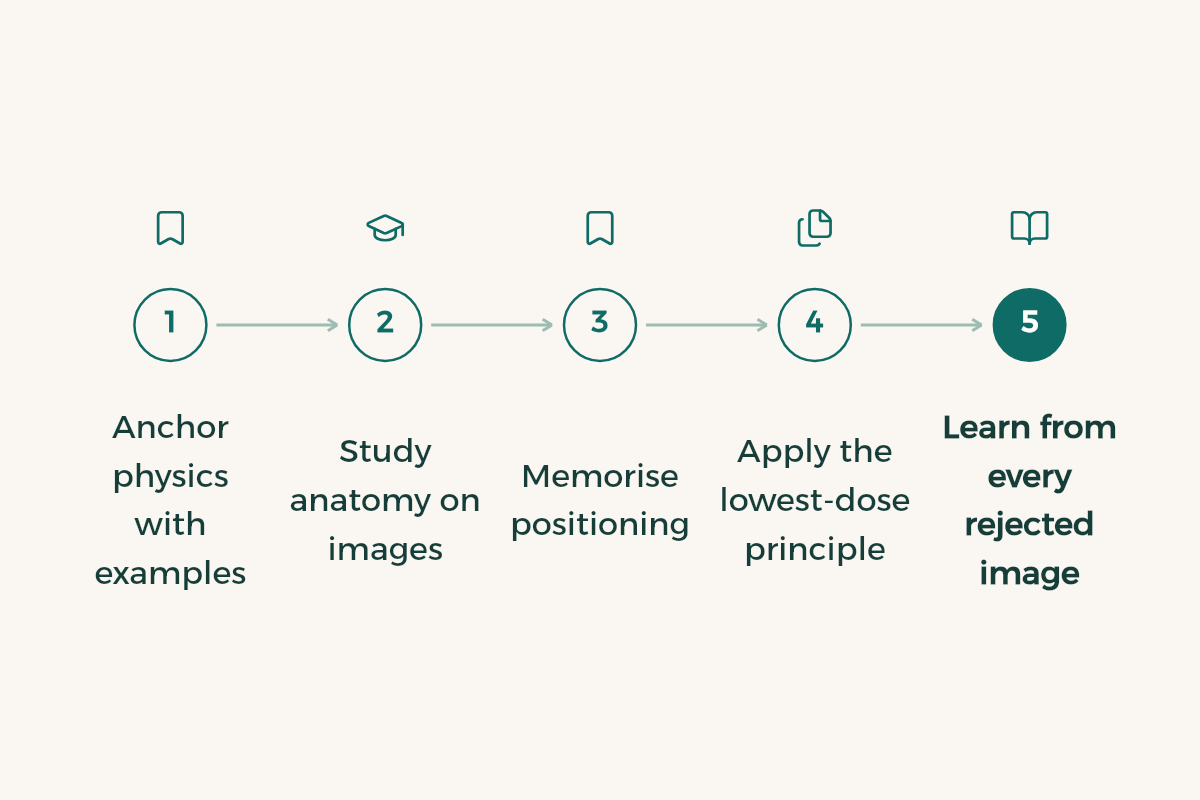
- Anchor physics with examples
For every radiation physics law, write a practical example: what happens to the image and to the dose if you change this factor?
- Study anatomy on images
Do not learn anatomy from drawings alone. Look at real radiographs and cross-sections in your references and label every structure.
- Memorise positioning
For each exam, note the patient position, beam direction and what must appear in the image, then practise in the lab.
- Apply the lowest-dose principle
In every practice case, ask how to get a diagnostic image at the lowest dose. That is the heart of radiation protection.
- Learn from every rejected image
On placement, write down why each image was repeated. It is the fastest way to improve.
You are a radiological sciences lecturer. Describe a made-up chest X-ray with a quality problem, without naming it. Ask me: what is the likely problem? What caused it in positioning or exposure settings? How do I fix it without raising the dose unnecessarily? Then correct me, and repeat with [a lateral knee view].
Common mistakes radiology students make
The most common mistake is seeing the major as just operating machines, neglecting physics and anatomy, then struggling to understand why an image comes out the way it does. The second is neglecting patient communication, when explaining the exam and reassuring the patient reduces movement, improves image quality and cuts repeats. The third is getting careless with safety, especially in MRI, where the patient and room must be checked for prohibited metal.
Is radiology right for you?
Radiology suits people who like technology, physics and the human body together, enjoy precise work with equipment, and prefer shorter interactions with patients. If you are comparing it with nearby majors, read the medical laboratory major and best majors in Saudi Arabia.
Common mistakes among radiology students
- Memorising equipment names without understanding the physics behind them.
- Neglecting cross-sectional anatomy, even though it is the basis of reading CT and MRI images.
- Being careless with radiation protection rules during training.
- Not practising how to talk to the patient and explain the procedure before imaging.
How to prepare now
Strengthen physics and English in the preparatory year, because radiology courses rely on both. Use summer training to see radiology departments in person, and record your experience in a student CV.