
By the tiswa editorial team, from the official sources listed at the end of this guide. How we write our guides
The medical laboratory major in Saudi Arabia, called clinical laboratory sciences at some universities, sits behind most medical decisions: blood counts, bacterial cultures, tissue examination and matching blood before a transfusion. This guide covers how long the degree takes, the courses year by year, the usual admission route, professional classification, career paths and a practical study plan.
What does a lab specialist do?
A lab specialist rarely sees the patient, but sees what nobody else can. One blood sample can reveal anaemia, infection or a liver problem, and the specialist's job is to run the test accurately, check the quality of the result, and spot and report abnormal values. So the major combines biochemistry, microbiology, haematology, immunology and blood banking with strong skills on laboratory instruments.
How many years is the medical laboratory major?
A documented example is the Bachelor of Science in Clinical Laboratory Sciences at Imam Abdulrahman Bin Faisal University (IAU): five years including the preparatory year and the internship year, for a total of 132 credit hours. The internship rotates through approved sites and, as the page puts it, is meant to give a smooth transition from university to the working world. The programme also requires a written dissertation.
Medical laboratory courses year by year
| Year | Example courses |
|---|---|
| 1 (preparatory) | Health-track prep year: Biology 1, Physics, Computer Skills and English |
| 2 | Laboratory Practice and Instrumentation, Biochemistry, Physiology, Introduction to Microbiology, Clinical Chemistry 1, Hematology, Medical Genetics |
| 3 | Immunology and Serology, Clinical Chemistry 2, Coagulation and Hemostasis, Bacteriology and Mycology, Immunohematology and Blood Banking, Parasitology and Virology |
| 4 | Clinical rotations in haematology, diagnostic microbiology and histopathology, plus a graduation research project |
| 5 | Internship rotating through laboratory sections |
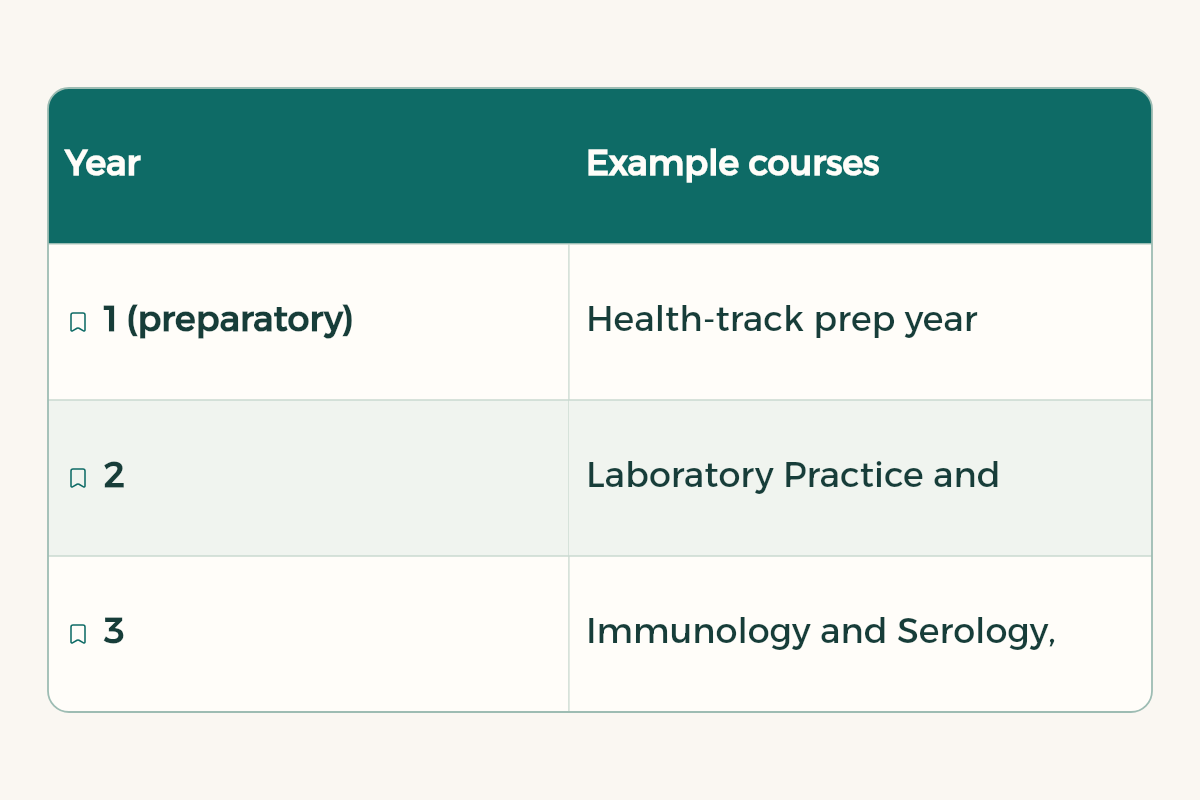
In the documented example, year four is built on rotations inside laboratories, and you must pass every year two and year three course first. Failing a course in the middle years can delay your move into the practical stage.
Admission requirements
Admission usually runs through the health-track preparatory year, followed by placement into majors based on GPA and available seats. Because the major rests on chemistry and biology, your grades in those subjects in the prep year matter even where they are not a published condition. Every university posts its own rules and percentages on its admission portal, so check yours. Read the preparatory year guide to plan your GPA.
Professional classification and localisation
After graduation you need classification and professional registration with the Saudi Commission for Health Specialties (SCFHS), which classifies health certificate holders, registers practitioners and sets the standards for practising health professions. Check the classification requirements on the SCFHS website as graduation approaches.
One important official labour-market signal: the Ministry of Human Resources and Social Development, with the Ministry of Health, announced a decision raising the localisation rate for the medical laboratory profession in the private sector to 70%, in two phases, the second covering all facilities in every region of the Kingdom. Private health facilities must therefore fill most of these roles with Saudi staff.
Jobs for medical laboratory graduates
The documented programme page lists these career areas:
- Private and public hospitals.
- Academic institutions.
- Research laboratories.
- Forensic laboratories.
- Companies, including marketing and sales of laboratory equipment and supplies.
Inside a hospital you can specialise in one section such as clinical chemistry, haematology, microbiology, blood bank or histopathology. With experience come roles in quality and laboratory management, or a master's degree in a specific branch.
A study plan for lab students
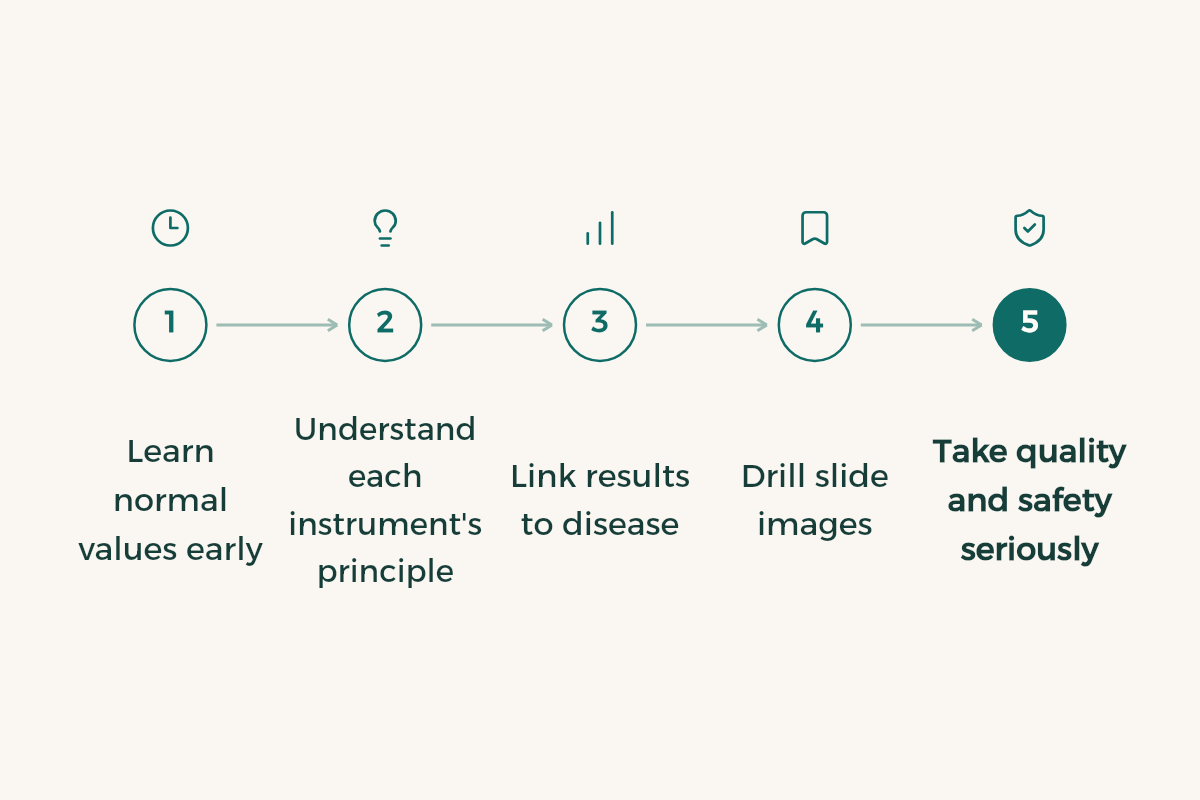
- Learn normal values early
Build a table of reference ranges for the key tests and review it until any abnormal result jumps out at first glance.
- Understand each instrument's principle
Do not stop at the operating steps. Learn the science behind each instrument, because that is how you catch an error in a result.
- Link results to disease
For every test ask which conditions raise or lower it, and which test the doctor usually orders next.
- Drill slide images
In haematology, parasitology and microbiology, look at slide images again and again until you recognise cells and organisms quickly.
- Take quality and safety seriously
Quality control and biosafety are part of daily work, and mistakes there are costly.
You are a laboratory sciences lecturer. Write a complete blood count for a made-up patient with some abnormal values, without a diagnosis. Ask me: which values are abnormal? What are the possible causes? Which extra test makes sense? Which pre-analytical errors could produce this result? Then correct my answers.
Common mistakes in this major
What trips up most lab students is studying each branch in isolation: clinical chemistry on its own, haematology on its own, then getting stuck on a case that needs both. The second mistake is ignoring the pre-analytical stage, such as how a sample is drawn, stored and transported, when many wrong results come from that stage rather than the instrument. Study each test as a full story that starts with the patient and ends with the report.
Is the medical laboratory major right for you?
This major suits people who love science, experiments and precision, enjoy calm focused work with instruments and samples, and do not mind less direct contact with patients. If you are comparing it with nearby majors, read the pharmacy major and the radiology major, and for a wider list read best majors in Saudi Arabia.
Skills a laboratory student needs
- Precision and patience, because a small mistake in a sample or label can change the whole result.
- Following safety and infection control procedures at every step.
- Working with numbers and tables, because result analysis and quality control are central to the job.
- Organised documentation, because every result must be traceable.
Because the work runs on data, learn spreadsheet basics with the Excel guide for students, and record your lab skills and training in a student CV from now.