
By the tiswa editorial team, from the official sources listed at the end of this guide. How we write our guides
On the second day, a lawyer at a Riyadh firm asks a new trainee to write one paragraph summarising the labour regulation on ending a contract, with the article number. This is an imagined case, but it resembles what trainees are given. The one who wrote “the worker has rights on termination” rewrote it. The one who named the article, quoted its text and said who carries the burden of proof moved on to a second task. The firm does not want to know what you studied; it wants to see how you read a text and write from it.
What skills should you show for law co-op training?
Firms and bodies differ, from litigation to contracts to advice to in-house legal work, but four skills are wanted nearly everywhere. Each has a small piece of proof you can make from your courses.
| Skill | Course that supports it | Proof that fits your file |
|---|---|---|
| Researching regulations | Introduction to law and regulation courses | A table of five regulations relevant to an issue, with article numbers and official sources |
| Drafting a memo | Legal drafting | A one-page memo on imagined facts: facts, text, application, conclusion |
| Organising a case file | Civil and commercial procedure | An index of papers for an imagined case, in date order |
| Keeping confidences | Professional ethics | A short paragraph on how you would handle a client’s information in one specific situation |
The examples in the last column are illustrative, so make your own. And never use a real case you saw or heard about in any example; confidentiality starts here.
How do you write a one-page memo to attach to your application?
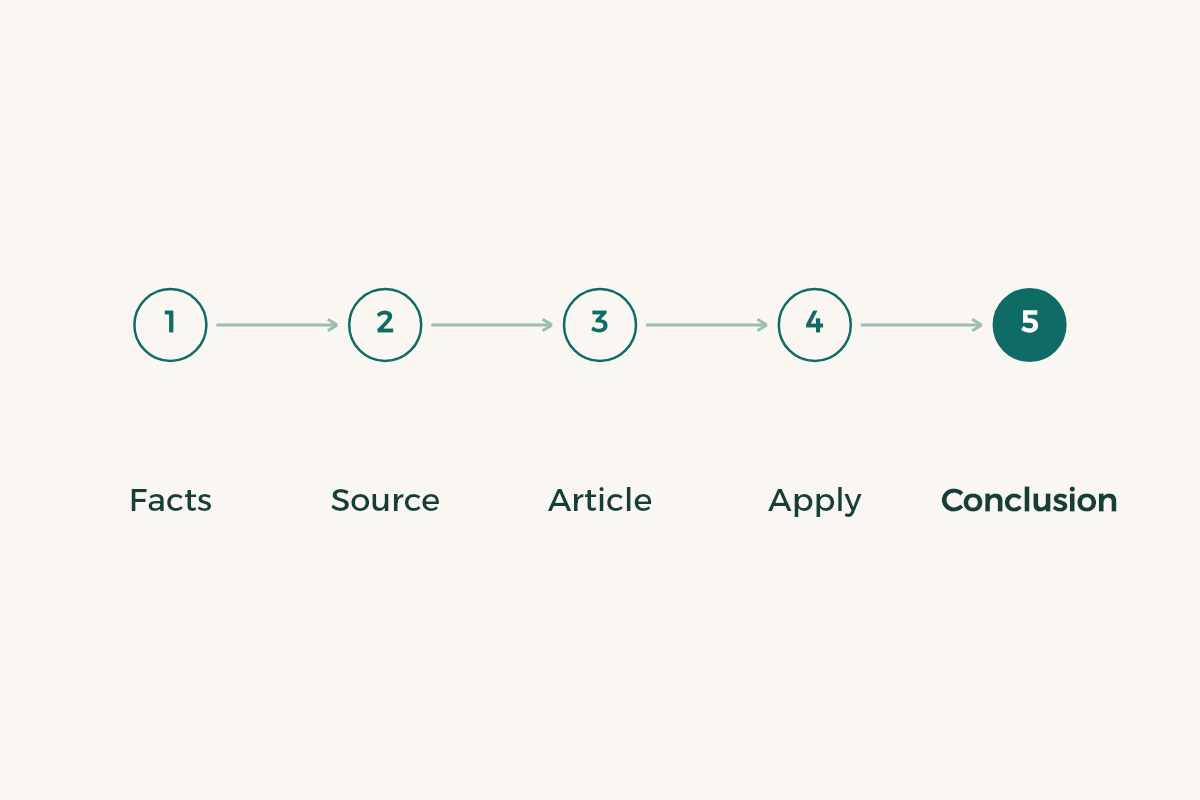
A short memo takes about two hours if you follow a fixed order. Choose a simple issue from your courses, build an imagined set of facts around it, then write.
- Write the facts in five lines
“A worker received a termination letter with no notice period, and the employer said he broke instructions.” State what happened without opinion.
- Research the official source
Open the regulation from the official site of the Bureau of Experts or the relevant body, not from a snippet in a chat group.
- Copy the article number and text as published
Do not paraphrase alone, because the lawyer will check the text.
- Apply the text to the facts
Decide whether the text applies, and why, in three sentences. If doubt remains, write the doubt plainly.
- Write a two-line conclusion
The result, and what could change it. Ask a lecturer to read it before you send it.

Keep a copy with no names and no real case number. If the lawyer finds the memo good, it will be the basis of your first conversation.
Is training different in a law firm and in a company legal department?
Yes, and the difference is pace. In a firm the work moves between cases, contracts and hearings, and the lawyer sits closer to you, but you may spend days organising files and preparing copies of documents. In a company legal department you work on contracts, internal policies and replies to authorities; the work is calmer and more repetitive, but it teaches you how an organisation runs from inside.
Choose what suits your aim. Someone who wants to plead needs a firm that pleads, even a small one. Someone who wants to work in companies is better placed in a legal department. If you do not know yet, choose the place that lets you see more than one kind of work, even if it is less glamorous. In Riyadh, Jeddah and Dammam the options are usually there; in smaller cities ask the coordinator what is available.
What should you check with your university before applying?
Universities differ in training rules. Some name approved sites, some leave the choice to you, and how hours are logged and assessed varies. Ask your faculty’s training coordinator three things: do I need an introduction letter? Are private law firms accepted or only named bodies? And who signs my hours and assesses me?
The Ministry of Justice runs judicial and notarial services in the Kingdom, including the Najiz platform for justice services, so read what it publishes officially before you ask a firm about a procedure.1 The Ministry of Human Resources and Social Development’s decision on student training defines the relationship between you and the site, and the guide to co-op training explains what it means for you.3 The Bureau of Experts at the Council of Ministers publishes regulations in their official text, so make it your reference for everything you write.2
How do you show your skills in the CV and the interview?
In the CV write a verb, a subject and a number: “Analysed a contract-termination issue in a one-page memo citing three articles.” In the interview prepare three answers: how do you check that the regulation you rely on is still in force? What do you do if someone asks you about a case? And how would you organise a file of twenty papers? For more questions see the guide to job interview questions, and for wording the guide to the student CV.
Remember too that training in law is a chance to pick a graduation topic. A problem you noticed in a file, or a question you could not answer from the regulation, can become the start of your project, and the guide to the law graduation project shows how to turn it into a question.
What mistakes lose you a place at a law firm?
The first is talking about a case outside the office. Even without a name, someone may recognise the facts. Confidentiality is tested from day one, and a person who slips once is not given a second chance.
The second is writing in lecture language. “This manifests clearly in the legislative framework” is no use to a lawyer who wants a result. Write short sentences and begin with the conclusion, then the reason.
The third is quoting an article from memory or from a post. Regulations are amended, and the number you memorised may not be the one in force. Go back to the official text every time and record its source.
The fourth is applying without knowing what the firm does. Read about its field before you send anything, and put one line in your letter saying why this firm in particular. A generic letter is dropped in the first minute.