By the tiswa editorial team, from the official sources listed at the end of this guide. How we write our guides
Hadaf programs for students go well beyond what most undergraduates assume. The Human Resources Development Fund (HRDF, Hadaf) is not only Tamheer for graduates; it has products that serve you while you are still studying: co-op training recorded in your account, professional experience over the summer, online courses with certificates, and support for the cost of professional certificates. This guide gathers them in one place from HRDF's official product pages, with what suits each stage of your degree.
Before anything: your HRDF account
All the on-the-job training products share two conditions: you are a Saudi national, and you are registered on the HRDF website. You sign in from E-Services, then the individuals login through the national single sign-on (Nafath). Register once, complete your education details, and the programmes appear under "Our Programs".
One rule matters: you cannot benefit from two on-the-job training products at the same time. Plan around your semester instead of applying for everything at once.
Hadaf programs at a glance
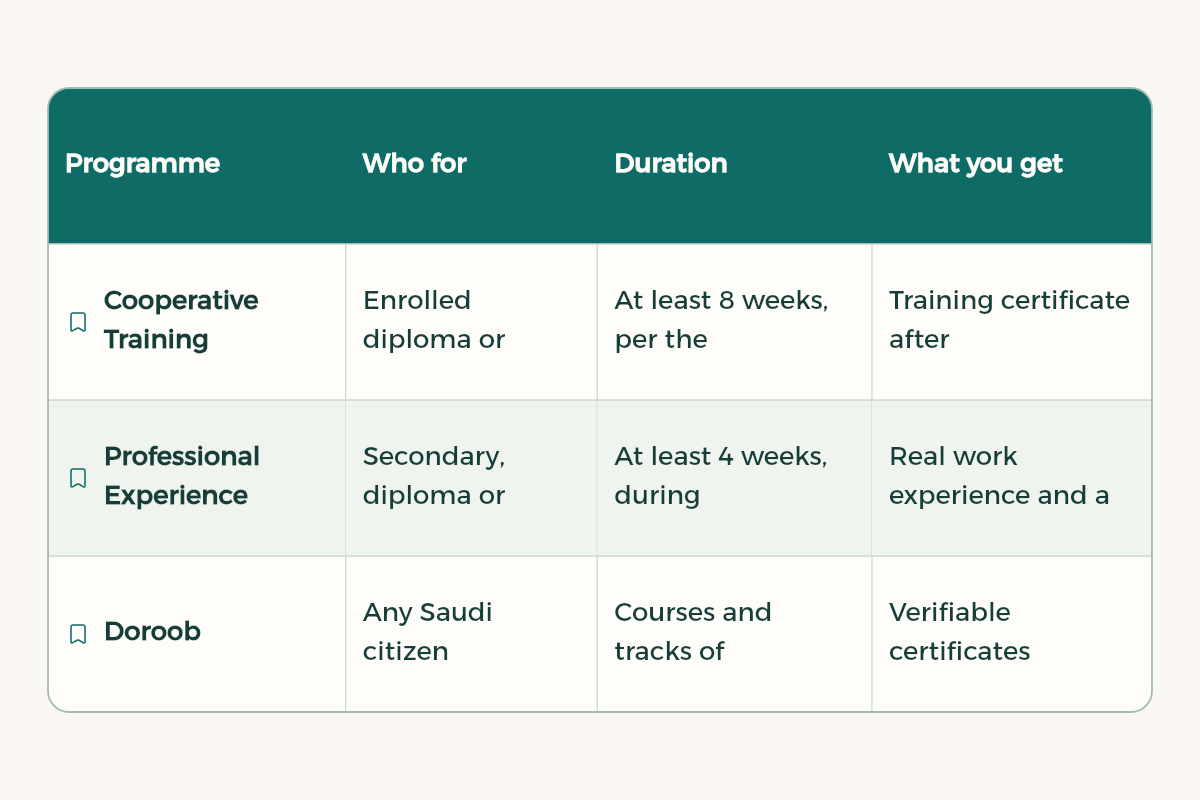
| Programme | Who for | Duration | What you get |
|---|---|---|---|
| Cooperative Training | Enrolled diploma or bachelor's student | At least 8 weeks, per the contract | Training certificate after one month, completion certificate at the end |
| Professional Experience | Secondary, diploma or bachelor's student | At least 4 weeks, during the year and in summer | Real work experience and a training certificate after one month |
| Doroob | Any Saudi citizen | Courses and tracks of varying length | Verifiable certificates |
| Professional Certificates support | Saudi employee or job seeker | Within 6 months of the certificate | Cost compensation for up to two certificates |
| Maharat | Job seekers or private-sector employees aged 18+ | Per course | Training costs covered for general and specialised skills |
| Graduate Development (Tamheer) | Diploma or bachelor's graduates up to 30 | 3 to 6 months | Monthly stipend and a certificate |
1. Co-op training through HRDF
If your study plan requires co-op training, you can apply for opportunities from your account without visiting HRDF. The conditions on the product page: you are currently enrolled in a diploma or bachelor's programme, not currently using another on-the-job training product, and not on the banned list or excluded from the product.
- Training is full-time at the organisation's premises; remote and part-time are not accepted.
- The length follows your training contract with the organisation, must not conflict with your study plan, and is at least 8 weeks.
- HRDF pays no financial reward in this product. Any allowance is an agreement between you and the employer.
- After one month a training certificate appears in your dashboard, and after the training and evaluation a completion certificate.
- Absence above 10% in two months is a reason for exclusion.
Your rights under the training contract itself, and what large employers must do, are covered in co-op training.
2. Professional Experience: summer or term-time placements
The Professional Experience product is for secondary, diploma and bachelor's students, so they can explore professions and pick up basic workplace skills before graduating. Places run during the year and over the summer break, for at least 4 weeks, with the exact length set by the employer. HRDF pays no reward here, but you get a training certificate after one month or more as long as you are not excluded.
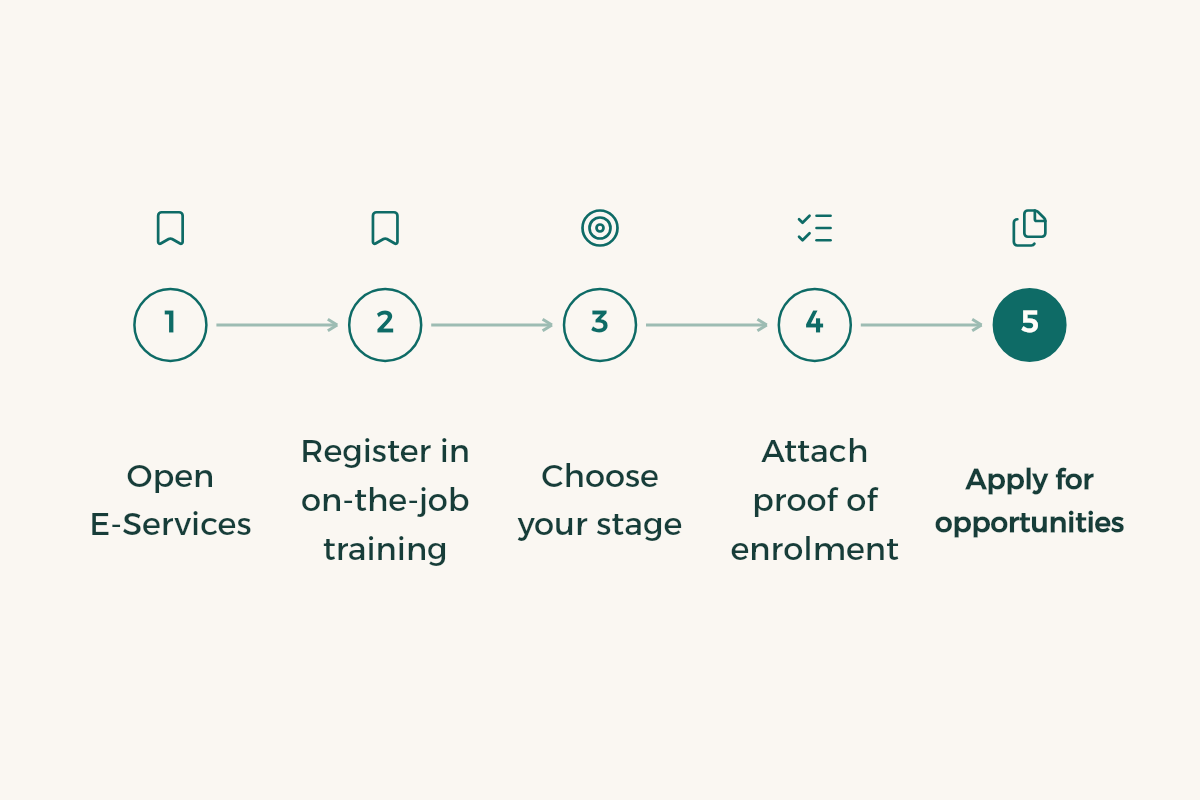
- Open E-Services
On the HRDF site, choose the individuals login and sign in with Nafath.
- Register in on-the-job training
Under "Our Programs" pick on-the-job training and accept the terms and conditions.
- Choose your stage
Select secondary, diploma or bachelor's student and complete your education details.
- Attach proof of enrolment
You need a document from your university or institute confirming you are a student.
- Apply for opportunities
Browse Professional Experience opportunities and accept each one's terms before applying.
If you are looking for summer placements more broadly, summer internships for students covers other routes outside HRDF.
3. Doroob: online courses with certificates
Doroob is HRDF's national e-training platform and is open to any Saudi citizen, male or female. It offers training courses, training tracks, live webinars of one to two hours, and certificate verification. For a student, the advantage is that it is available any time and anywhere, so you can build core workplace skills between lectures.
Choose courses that actually serve your CV: communication, computer basics, time management. Do not pad your CV with dozens of short certificates; three that relate to the job beat twenty that do not. For more sources see free courses with certificates.
4. Professional certificates support
If you are close to graduating and plan a professional certificate in your field, this product compensates the cost under conditions. The beneficiary is a Saudi working in the public or private sector or a job seeker; the certificate must be on HRDF's approved list and obtained after it was approved in the product.
- The maximum is two certificates per person.
- The certificate is valid and no more than 6 months old when you claim.
- You confirm your employer did not pay for it.
- HRDF does not cover membership fees, mandatory or optional.
5. Maharat: courses for job seekers
Maharat supports general and specialised skills training with licensed training providers, aimed at job seekers and private-sector employees aged 18 or over, provided you are not an active government employee and have not used it before. HRDF states it covers general skills programmes up to SAR 1,200 for remote training and SAR 2,000 for classroom training. It usually fits the first months after graduation while you job hunt.
6. After graduation: Tamheer
Once you hold your diploma or bachelor's, the Graduate Development (Tamheer) product comes in: 3 to 6 months of training with a monthly stipend paid by HRDF, for applicants up to 30 with no more than a year of experience. Full details and how the stipend is calculated are in the Tamheer program.
A plan by year of study
- Years one and two: register on HRDF, start one Doroob track, and try a summer Professional Experience place.
- Year three: shortlist co-op employers early and prepare a CV and a LinkedIn profile.
- Final year: co-op training, and choose the professional certificate you will claim later.
- After graduating: Tamheer or Maharat, with a structured search following first job after graduation.