
By the tiswa editorial team, from the official sources listed at the end of this guide. How we write our guides
In her last term, a student found that her placement had never included the intensive care unit. She had assumed it would, because a friend at another university trained there. Nobody had misled her; she simply never asked. The right question at the right time spares you that kind of surprise, and this guide collects those questions.
What is a clinical nutrition major?
Clinical nutrition treats nutrition as part of a patient’s care: assessing nutritional status, designing a plan that fits the diagnosis, and following the response. The World Health Organization links better nutrition with stronger immunity and a lower risk of noncommunicable diseases,2 which is why hospitals want dietitians on care teams. General or sports nutrition is a different working environment, even if it shares core courses.
How do you study nutrition: which training questions come first?
The questions below are ranked by importance. Write them on a sheet, take it to the department meeting or open day, and note the answers word for word.
- Where does placement happen?
Ask for hospital and ward names: medical, paediatric, intensive care, diabetes. “Several hospitals” is not an answer.
- How long does the training last?
Ask for hours and weeks, and whether they run in one block or across terms.
- Who supervises you?
A faculty member, a hospital dietitian, or both? And in what speciality?
- How is the training assessed?
Ask about the assessment form and the paperwork, such as a case log or an hours book.
- Is the programme tied to an accrediting body?
Ask for the body’s name and the date of its last review, then verify it on its own site.
- What do graduates do next?
Ask which steps towards professional registration graduates usually take, and who helps them.
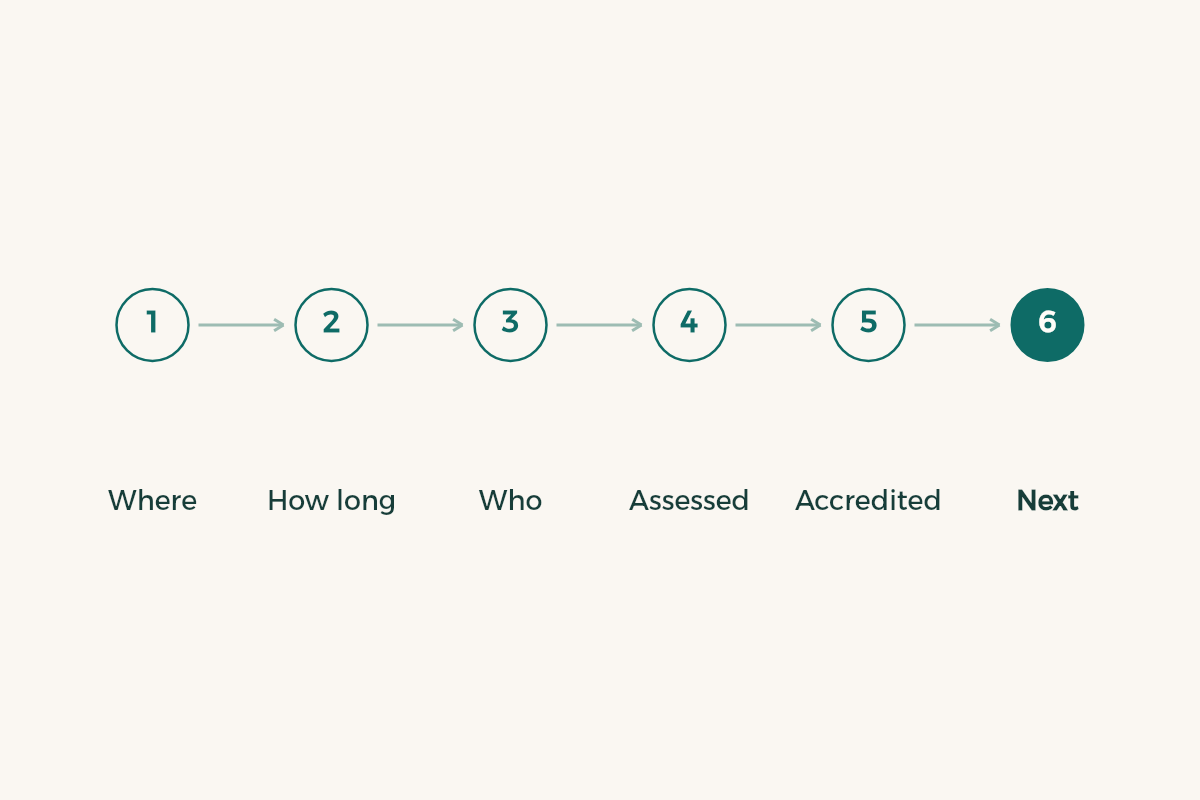
This list is a suggestion, and your department may add questions of its own. What matters is that you leave with written answers rather than a general impression.
How do you check professional accreditation?
Health professions in Saudi Arabia are regulated by the Saudi Commission for Health Specialties, which keeps a register of practitioners and offers a service to verify a practitioner’s registration.1 So do not rely on a friend’s summary or a social media post for classification and registration requirements; open the Commission’s site, find your speciality and read the current conditions.
| What you want to know | Where to look | Note |
|---|---|---|
| Registration and classification requirements | Saudi Commission for Health Specialties website | Conditions change, so read the current page |
| Whether a practitioner’s registration is valid | The Commission’s verification service | Useful to check who supervises you |
| Training details in your programme | The department and academic supervisor | Ask for the answer in writing |
| Graduate experience | Former graduates, via the department or LinkedIn | Ask at least two |
For the Commission’s exams and how to prepare, read the guide to the SCFHS exam. If you are heading for a co-op placement, see the guide to co-op training in clinical nutrition.
What should you record during training?
Start one log on day one: date, ward, supervisor, hours, the skill you practised and one lesson. A single line a day is enough. After eight weeks you will hold a record that proves your training to the department and the accrediting body, and you can draw on it for your CV.
Never write patient names or file numbers. Describe the case in general terms: “type 2 diabetes, fifty years old”. For your graduation project, see the guide to the clinical nutrition graduation project to learn how to turn what you saw into a research question.
Which terms should you know before you start?
You will hear many terms in week one: nutritional assessment, parenteral and enteral feeding, body mass index, malnutrition. Do not wait for the hospital to teach them. Start now with a simple glossary, and use the guide to medical terminology to build a base. A student who arrives understanding half of what is said learns more from the first day.
What if the answers are unsatisfactory?
There are three possibilities: the department does not have details yet, the programme does not provide what you need, or you asked the wrong person. Start by sending the question to the training coordinator, not the front desk. If you get no answer within two weeks, send a formal email with the questions attached, because written correspondence leaves a trail.
If it turns out the programme does not fit the path you want, think about alternatives before a term passes: an internal transfer between health majors, or a programme in another city. The guide to university transfer explains the general steps.
How do the questions differ between Riyadh, Jeddah and Dammam?
The large teaching hospitals sit in different cities, and each has its own wards and training arrangements. A student in Riyadh may train in oncology while a classmate in Jeddah trains in parenteral feeding for critical patients, and both programmes can be sound. So do not compare numbers alone; compare the kinds of cases you will see, how many trainees each supervisor has, and whether you will practise yourself or only watch.
If you will move to another city for placement, ask about housing, transport and night shifts before you accept. These details look minor until week two, and then they become the reason some students drop out.
Which mistakes cost a student a whole term?
The first is assuming that programmes sharing a name lead to the same path. The second is leaving questions until the final year, when a change costs ten weeks or more. The third is relying on a short free certificate in place of accredited training; short certificates add knowledge but do not replace hours on the ward.
If you have made one of these, do not wait. Write to the coordinator today, list the courses you have finished and ask for a written plan for what remains. Universities handle a structured request faster than an open complaint.