By the tiswa editorial team, from the official sources listed at the end of this guide. How we write our guides
A business student walks out of her university career fair with seven business cards, a tote bag and a notebook with nothing in it. Three days later she cannot remember whose card belongs to the person who talked about the training programme. This is an invented example, but it happens all the time. The conversation alone does not do much. What turns it into an opportunity is the message that follows, and most students either skip it or send a pasted template.
When should you send a follow-up after a career fair?
Rutgers career services advises following up after a career fair within 24 hours, or at the very least within the week.1 The University of Oregon says the same about networking events: within 24 hours, by email or a LinkedIn connection request.2 The reasoning is simple: the person you met talks to dozens of students that day and needs to link your name to your face.
Do not treat that as a law. If the fair falls before a weekend or a holiday, send it on the first working day. If the recruiter said they would contact you, wait for the period they gave, then write. What matters is that weeks do not pass until your name means nothing to them.
What should a student write in a message to a recruiter?
The University of Oregon suggests mentioning something specific from your conversation so the message feels personal.2 We add one practical tip: attach your résumé as a PDF so the reader does not have to hunt for the paper copy. Put the two together like this:
- Subject line
Something like “Thank you for speaking with me at the career fair, your name, your major”. The reader decides from the subject whether to open it.
- A short thank-you
One sentence: thank you for your time yesterday at your company’s table.
- The specific detail
Mention what was actually said: a question they asked, a project they described, a piece of advice. Do not invent, and do not flatter.
- One small request
A ten-minute call, the correct application link, or a question about the skills they look for in trainees. One request, not a list.
- Attachment and signature
Your CV as a PDF with a clear file name, and your name, major and LinkedIn link below.

An invented example for an email: “Dear [name], thank you for your time yesterday at the career fair. You mentioned your team is working on [topic they named] and asked how I would handle [their question]. I kept thinking about it afterwards and added the project I described to the CV attached. Would ten minutes on the phone suit you, so I can understand what you expect from a trainee? Kind regards, [your name], [major] student at [university].” Change the bracketed parts, then reword the rest until it sounds like you.
What if the conversation was too short to mention anything?
It happens in a crowd: two minutes at the table, a card, a handshake. Write a shorter message and do not pretend to depth that was not there. Say where you met, what caught your attention in what they said about the company, and that your CV is attached. If you remember nothing specific, ask a real question about something you read on the company page after the event. An honest question beats general praise.
If a classmate or lecturer introduced you, say so in the first sentence. A shared contact gives the reader a reason to reply.
Should you send an email or a LinkedIn message?
Email is clearer if you have a card with an address, because it lets you attach the CV and write a subject line. If you only have a name, send a LinkedIn request with a short note; Oregon lists a LinkedIn connection request as a fitting follow-up within 24 hours.2 The note has a character limit, so keep it tight. For wording that fits the limit, see the examples in LinkedIn connection messages.
| Situation | What to do | When |
|---|---|---|
| Real conversation, card with an email | Four-line email with your CV | Within a day or two |
| Name only, no email | LinkedIn request with a short note | The same day or the next |
| Brief meeting, no real talk | Shorter message and one honest question | Within two days |
| They said “we will contact you” | Wait for the period they gave, then write | After that period |
| No reply to your message | One short reminder, then stop | After one or two weeks |
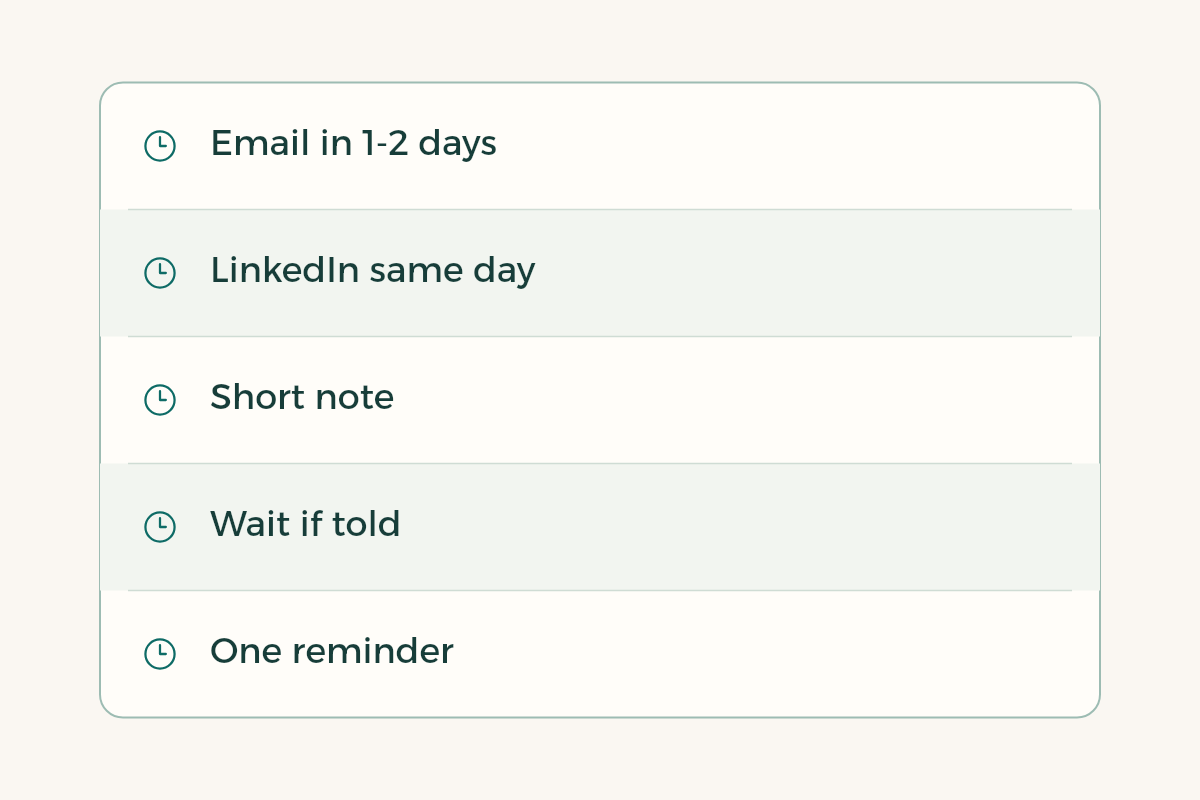
The table is a rough guide for your own thinking, not a rule companies set. If a company names a channel for follow-ups, such as an application portal or a recruiting address, use that channel and no other.
What if nobody replies?
Silence is usually not a rejection. The person may be travelling, or your message may have sunk under hundreds of others after the event. We suggest one short reminder after a week or two, and no more. Keep it to two lines and add something new if you can, such as the fact that you have applied through the company portal or finished the project you mentioned. After that, let it go and move on to the other names in your notebook.
Can ChatGPT write a follow-up email for a student?
It can draft one, and a draft is useful when you do not know how to start. But a tool cannot remember what the recruiter said at the table, so the one thing that makes your message yours has to come from you. Give it the real detail, ask for a short version, then rewrite the sentences that do not sound like you. Cut anything that praises the company in general terms. Read the result as the recruiter would: if it could have been sent to any company, it is not finished.
Check the facts too: a name, a job title or a project the tool filled in by itself will make the message worse than a plain one.
Which mistakes ruin a follow-up?
The first is the copied template: ten identical messages with only the name changed. A reader spots that in seconds. The second is the big ask, such as asking a stranger whether they will hire you or recommend you to their manager. Ask for something easy to agree to. The third is waiting a month and then writing as though nothing happened. The fourth is small errors: the wrong company name, the wrong title, a missing attachment. Read the message aloud before sending, because the ear catches what the eye skips.
One more that few people notice: sending the message but leaving your profile untouched. The reader will probably open your LinkedIn page before replying, so make sure your headline and summary match what you wrote. Review your LinkedIn headline before the event, not after it.
How do you prepare before the event so following up is easier?
Good follow-up starts before you enter the hall. Read the list of participating companies, pick three or four, and write one real question for each. After every conversation, step away for a minute and note three things on your phone: the name, what was said and anything you promised. That takes one minute and saves you a vague message two days later. For a full plan for before and during the fair, read planning for a career fair, and for the questions that may come in the next round, see job interview questions.
Keep a simple log with five columns: name, company, detail from the conversation, date of your message, status. A week after the fair, that sheet is worth more than a pile of cards.