By the tiswa editorial team, from the official sources listed at the end of this guide. How we write our guides
A fair is judged by what happens to students after they leave the hall, not by how many walk through the door. The idea sounds simple: a university hosts employers and students meet them. Yet the gap between a crowded day with nothing to show for it and a day that opens real interviews is set by the planning that comes before. This guide is for student affairs, careers and events teams, and it takes you from the goal to the review one step at a time.
Start with the goal, before the booking
Ask the team what the fair should achieve. Direct hiring is one aim. Raising awareness of fields of work is another, and introducing cooperative training is a third. A fair that tries all three in one day ends with a crowded hall and weak results. Choose one main goal and two secondary ones, write them into a short document, and get the team to sign it before invitations go out.
What is a sensible planning timeline?
- Begin months ahead
Fix the date and venue, coordinate with internal units, and estimate how many employers you want. Teams that start late often find the employers they most want have closed their hiring windows.
- Invite employers early
State which majors and student groups you want, and set a final date for confirming attendance. Ask each employer to say which jobs and training it brings.
- Prepare the students
Announce the fair in the channels students actually use, and run short sessions on CVs and on how to speak with employers.
- Confirm one week before
Check the employer list, timings, hall map and reception equipment, and make sure every employer knows where to go and who to ask for.
- Run the day in clear teams
One team greets visitors, another guides them between stands, and a third follows up interviews and urgent questions. Log anything that needs action.
- Follow up afterwards
Send written thanks to employers, ask students and employers for a short rating, and count how many students were actually contacted by an employer.

Where do the employers come from?
The number of employers is not a measure of success. A fair with twenty employers who want majors close to your students offers more than a fair with sixty who have no link to those majors. Build the list from several sources: graduates, cooperative training partners, past employers, and organisations that asked to get in touch themselves.
Taif University's career development and employability support unit says it coordinates job fairs and Career Day events, and it describes assessing satisfaction among students, alumni and employers afterwards.2 Use that kind of published scope as a checklist for what your own unit should own. Ask every employer to state its hiring and training conditions in writing, and do not allow any request for students to pay a fee to attend or to be interviewed.
How do I write a CV for a student?
Keep it to one page, with the skills and projects that match the employers you plan to visit, and nothing you cannot back up. A student also needs a clear idea of which employers to visit and a one-minute introduction. Help each student pick three preferred employers and two questions for each. An employer remembers the student who arrived with a reason and asked a sharp question, far more than the one who walked between stands without one.
I am a university student studying [your major], and I will attend our university career fair.
Help me prepare:
1) A one-minute introduction about myself.
2) Two questions for each of the three employers I want to visit.
3) Three questions an employer may ask me, with short model answers.
Then ask me about the weak points in my answers, and suggest one improvement for each.
What is the best way to apply for a job in Saudi Arabia?
No single method suits every employer, but one rule helps students at almost any stand: leave the employer with exactly what it needs to remember you. One CV on a single page, a working phone number, and one question about the role. Many students hand out ten different CVs to ten employers without knowing which of those roles they actually want, and the employer can tell.
Fairs also run a second track in parallel. The KFUPM career fair, for example, opened with a panel workshop on CV writing, talent acquisition and job-market competitiveness, and it added coaching sessions led by more than ten certified coaches.1 A short workshop like that works well before the doors open, because the students who attend arrive with sharper questions.
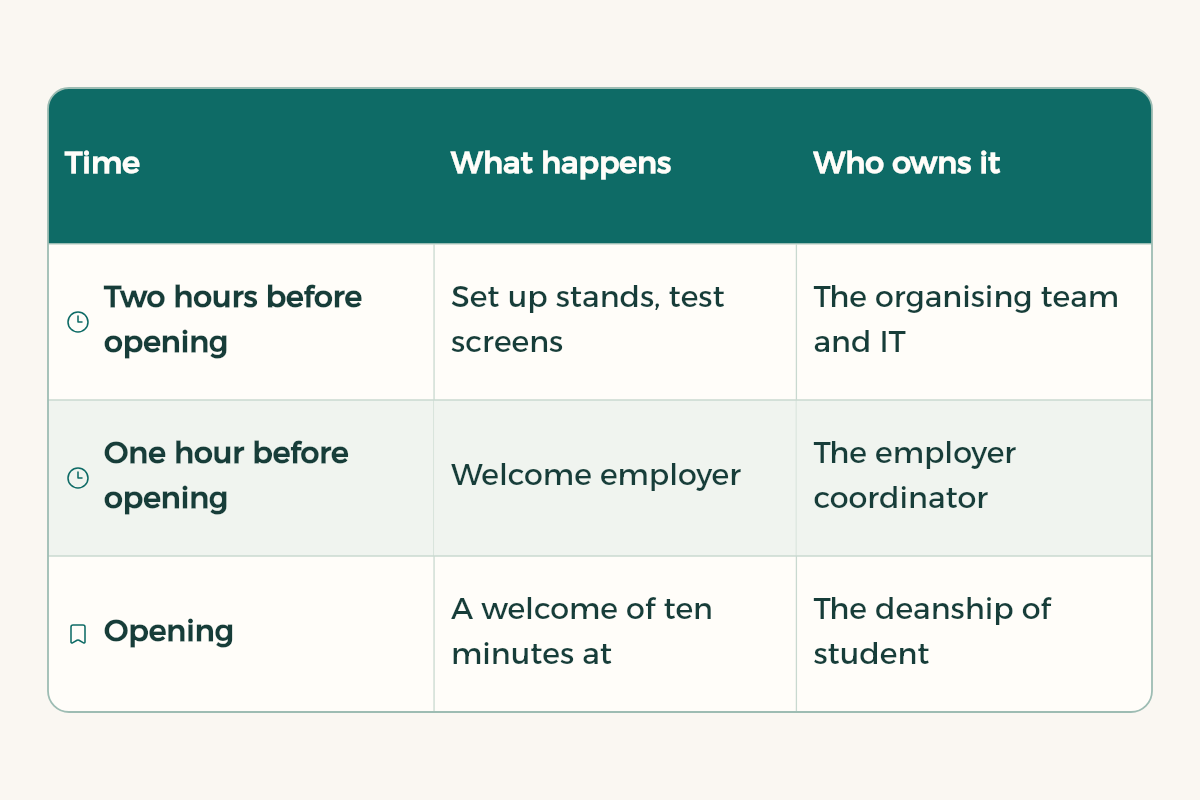
| Time | What happens | Who owns it |
|---|---|---|
| Two hours before opening | Set up stands, test screens and internet, hand out maps | The organising team and IT support |
| One hour before opening | Welcome employer representatives with badges and the session schedule | The employer coordinator |
| Opening | A welcome of ten minutes at most, then open the hall | The deanship of student affairs |
| All day | Short CV and interview sessions in a side room | The career centre |
| Midday | A round of the stands to ask employers what they still need | The employer coordinator |
What happens after the day ends?
A fair does not end when the stands close. It ends when the openings are closed and the interviews are complete. A university that follows up with students and employers sees the effect across the academic year. One that only hosts the day loses most of the results. Write a short report with visitors, employers, interviews and the main comments from both sides, and use it as the starting point for the next fair.
What mistakes do most fairs make?
- Holding the fair in exam week or close to registration.
- Inviting the same employers every year without looking for new ones.
- Leaving students unprepared, so both the employer and the student lose the chance.
- Having no space for interviews, so conversations happen in corridors.
If you want to tidy the whole service, read about university career services. To bring graduates into the same event, see alumni engagement. And to prepare students for the interview itself, send them to job interview questions. For discounts on the tools and software students use, the tiswa deals page lists current offers.