By the tiswa editorial team, from the official sources listed at the end of this guide. How we write our guides
At the end of the lecture the instructor says: “A seminar paper on any topic from the course, due in two weeks, presented to the section.” You leave thinking about a title, and five days later the title is all you have. The time was not the problem. You started researching before you knew what you had actually been asked.
What is a seminar paper and what does the instructor want?
A seminar paper is a short report on a topic from the course, usually presented to the instructor and classmates. It is smaller than a graduation paper and bigger than a one-paragraph assignment. Every instructor sets terms: page count, citation style, minimum sources, and whether an oral presentation is required. Get these in writing from the instructor; every number in this guide is an example, not a rule.
The University of North Carolina’s writing centre advises reading the assignment closely and noticing its verbs, since “analyse” asks for something different from “summarise” or “compare.”1 Write the verb at the top of your page. If the task says “explain the effect of…”, your paper explains causes and results. If it says “compare”, you build a comparison and comment on it. For the longer form, see how to write a research paper.
How do you build an outline for a seminar paper?
An outline is one page you write before the draft. Purdue’s writing lab notes that outlining orders your ideas and shows gaps before you start writing.2 Below is an annotated outline for an imaginary paper called “The effect of sleep on study performance.” It is an illustration, not a published study:
| Part | What goes in it | In the example |
|---|---|---|
| Introduction | Context, then the question, then what you will do | Sleep and study, then: how does too little sleep affect concentration before exams? |
| Section one | The concept or background | What counts as enough sleep and how it is measured |
| Section two | The evidence | What two or three studies say about concentration and memory |
| Section three | Application or analysis | Habits a university student could change |
| Conclusion | The answer to the question in one paragraph | The short answer and the limits of what you read |
| References | Sources in the required style | Every source cited in the text |
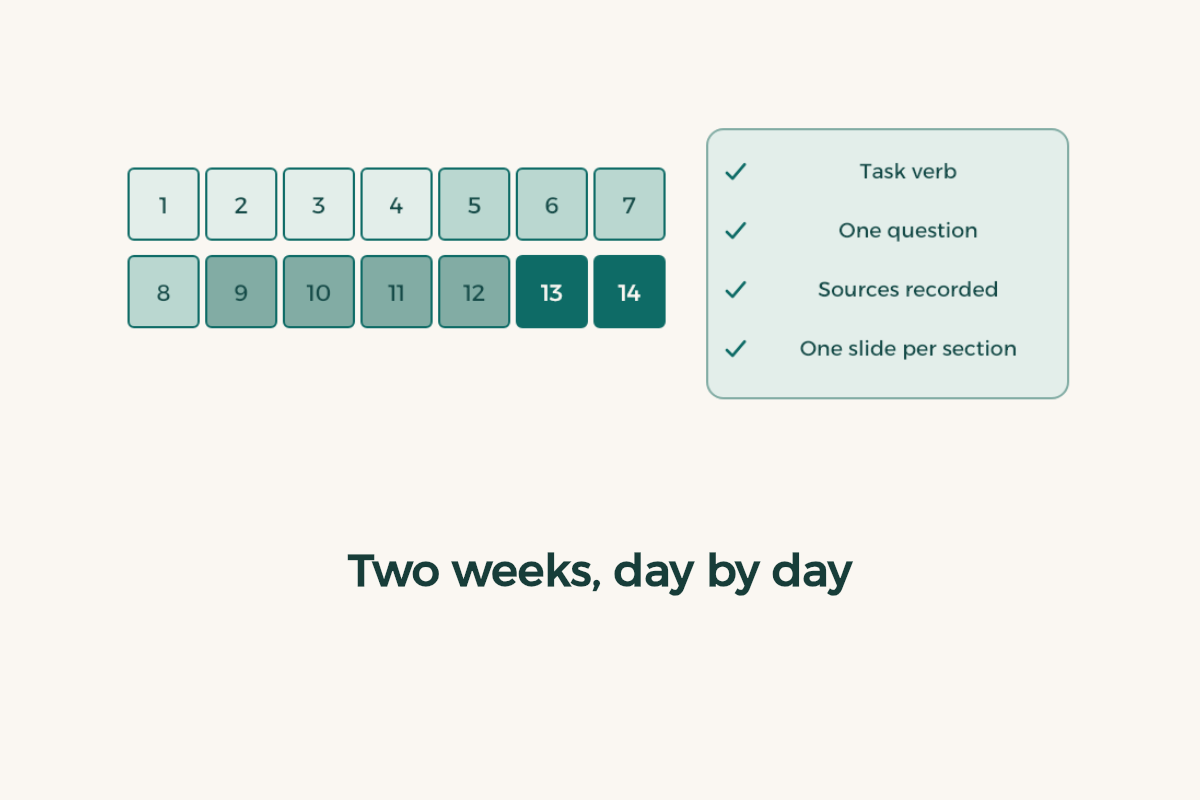
Each section answers a part of the question. A section that does not serve the question is cut, however much you like it. For the parts in more detail, see the research introduction and the research conclusion.
How long does a seminar paper take, and how do you split two weeks?
- Day 1: understand the task
Note the main verb, the rules and the deadline, and ask the instructor about anything unclear.
- Day 2: narrow the idea
Write three possible questions and keep the one you can find sources for.
- Days 3 to 5: read
Read at least three sources, write two sentences on each and record their details immediately.
- Day 6: write the outline
One page; send it to the instructor if you can, to confirm the direction.
- Days 7 to 10: write
About one section a day, with the introduction and conclusion last.
- Day 11: revise
Read the whole thing as a reader: does each section answer the question?
- Day 12: format and cite
Fix references and page numbers, using Word formatting for papers.
- Days 13 and 14: prepare the talk
Three slides, one for each section, and rehearse aloud twice.
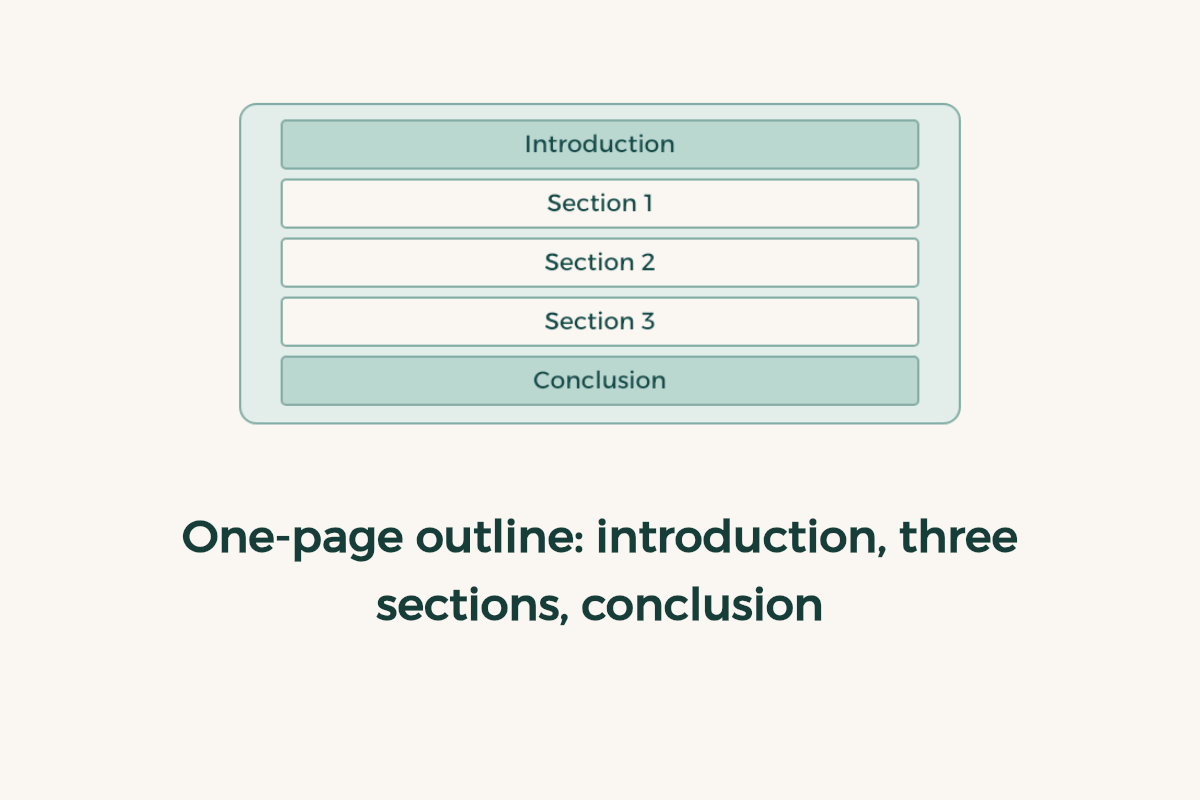
This schedule is an example. If you have only a week, compress the reading and the revision, never the outline. Writing without an outline costs more time in rearranging than the outline would have taken.
How do you choose a seminar paper idea and keep it narrow?
A wide idea sinks you in week one because you cannot tell what to read and what to leave. Test it with one question: can I answer this in three paragraphs and two sources? “Artificial intelligence” is wide. “Uses of AI in reading X-rays” is narrower. “What are the limits of relying on AI to read X-ray images?” is a question you can answer. UNC’s writing centre explains that a thesis takes a position that can be argued and changes as you write,4 so do not cling to your first wording. For help phrasing it, read how to write a research question.
How do you cite sources in a seminar paper without plagiarising?
Record each source when you read it: author, title, year, link and page. Write the idea in your own words and put the page number after it. Anything copied exactly goes inside quotation marks. For the style your instructor wants, see APA or Harvard, and for managing references Zotero. A quick test: if you cannot state the idea aloud without looking at the source, you have not understood it yet.
How do you present a seminar paper to the class?
A talk is not a reading of the paper. Take one sentence and the best piece of evidence from each section and put them on one slide titled with the idea itself. Open with the question and end with the answer. The UNC writing centre advises that a conclusion should carry the answer and the wider meaning rather than repeat the introduction,3 which works for your last slide too. Rehearse aloud with a timer, because a talk that overruns loses its answer. Presentation tips and PowerPoint design tips cover the rest.