By the tiswa editorial team, from the official sources listed at the end of this guide. How we write our guides
A message lands in the class group chat: free courses with certificates accredited by the Technical and Vocational Training Corporation, register before they close. A shortened link, a nice picture and four exclamation marks. You want a certificate for your CV before summer training, but you do not know whether the message is genuine, or whether the certificate would mean anything to the person reading it. Checking takes three minutes. Choosing a short path that does not go to waste takes a little longer, and that comes second.
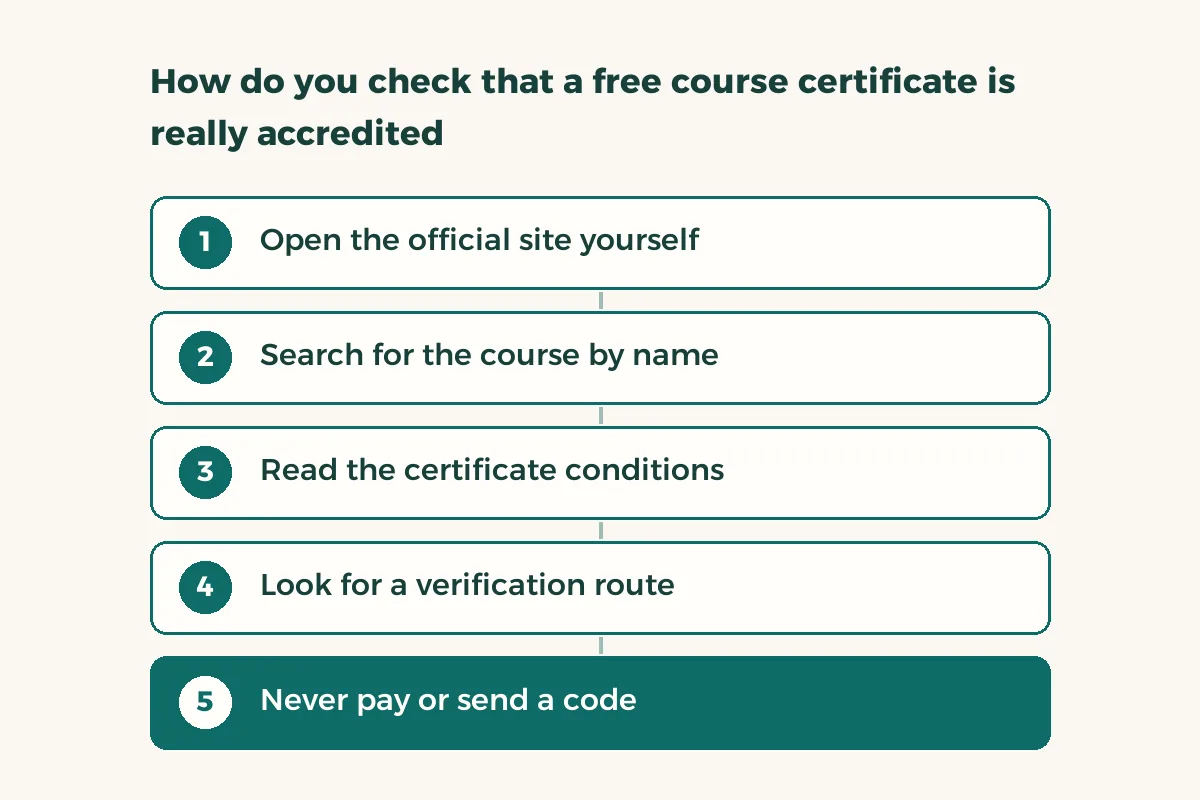
How do you check that a free course certificate is really accredited?
Start from the institution, not from the message. The Technical and Vocational Training Corporation (TVTC) is a Saudi government body in the training field and has an official website where it publishes programmes and services.1 Any course attributed to it or to anyone else should appear on that body’s own site, or on the platform hosting the course, under a clear name. If the only place you find the course is an advert from an anonymous account, stop.
- Open the official site yourself
Type the body’s address into the browser or find it through a search engine. Do not tap the shortened link in the message.
- Search for the course by name
If it exists, read its page: who delivers it, who issues the certificate and what conditions apply.
- Read the certificate conditions
Some courses are free to take but attach a condition to the certificate, such as a final test or a completion percentage. Know it before you start.
- Look for a verification route
A trustworthy certificate carries a number or code a reader can check on the issuer’s page. If you cannot find one, ask the issuer.
- Never pay or send a code
A free course does not ask for a transfer, a verification code or government login details. That is a sign of fraud, not a registration rule.
Doroob describes itself as a Saudi e-learning platform that lists courses for learners.2 That means you should read each course page on its own: a platform can host several content providers, and each course has its own provider. Do not assume every certificate carries the Corporation’s stamp just because it appeared on a Saudi platform.
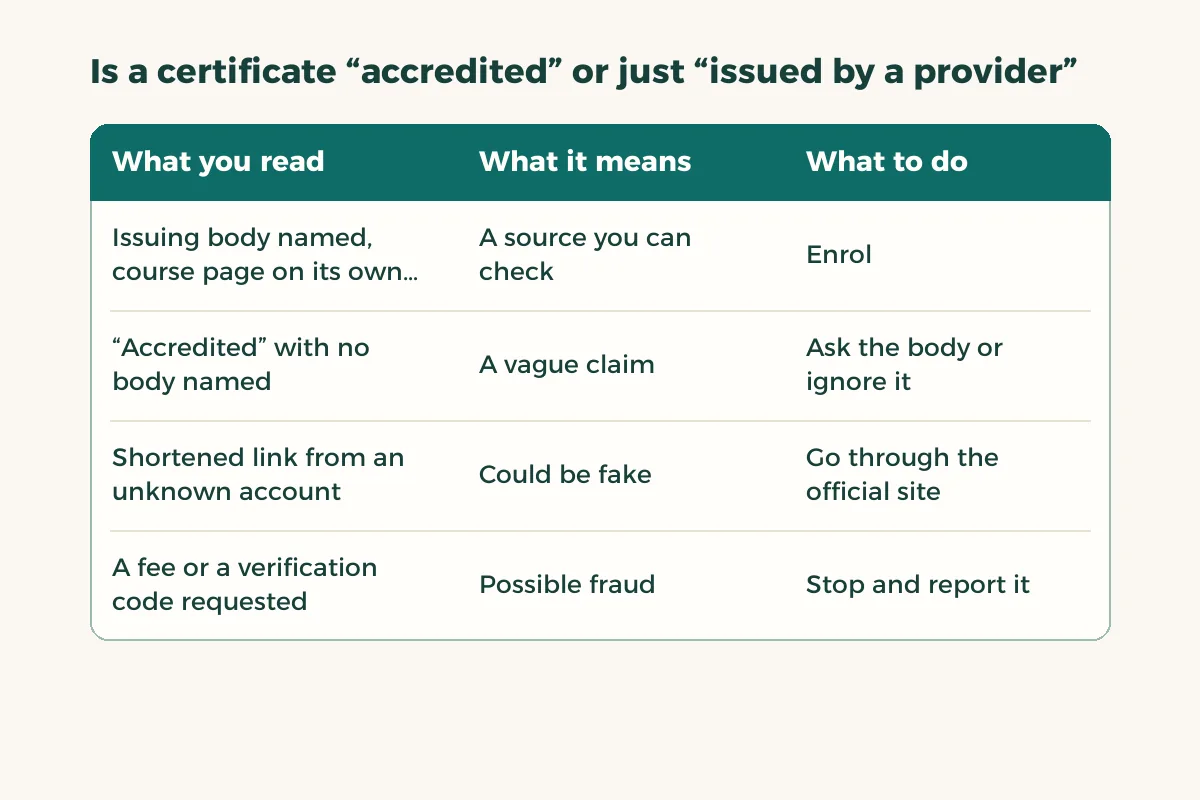
Is a certificate “accredited” or just “issued by a provider”?
The difference disappears in adverts. A certificate issued by a provider means the organisation that ran the course gave you a document. An accredited certificate means a second body with the authority to accredit reviewed the programme and approved it. Both are legitimate, but they are not the same thing. So ask: accredited by whom? If the answer is a name whose website you can open and find the course on, it is clear. If the answer is “by leading organisations,” do not rely on it.
| What you read | What it means | What to do |
|---|---|---|
| Issuing body named, course page on its own site | A source you can check | Enrol |
| “Accredited” with no body named | A vague claim | Ask the body or ignore it |
| Shortened link from an unknown account | Could be fake | Go through the official site |
| A fee or a verification code requested | Possible fraud | Stop and report it |
How do you choose a path that ends in a project?
A path is a set of courses with one purpose. The trouble is that students enrol in ten and finish two. Reverse the order: start from the project you want to show, then pick the fewest courses that get you there. Three courses or fewer is enough for a short path.
Here is an example, not a recommendation of particular courses. A business student wants to show they can analyse simple sales data. The project: a file that analyses a month of sales for an imaginary shop and ends with three recommendations. The path: a spreadsheet basics course, a data analysis or charts course, and a short course on presenting effectively. Each course serves one step of the project, and the result is one file you show instead of three separate certificates.
- Write the project in one sentence
What will you hold at the end? A report, a dashboard, a financial model, a slide deck?
- Work out the skills it needs
What must you know to build it? Keep it to three.
- Find one course per skill
From bodies you have checked, not from group chat messages.
- Give each course a deadline
Two weeks per short course is enough. Without a deadline a course stays open for two months.
- Finish the project and show it
Put it in your portfolio or CV with a line on the courses that helped.
For the portfolio itself, read how to build a portfolio, and for a comparison of free course platforms and certificates see free courses with certificates.
Do free certificates help when applying for training or a job?
They help as far as they can be proved. A verifiable certificate from a known body reassures the reader that you finished the path. It does not replace experience. Put it on one line in the courses section of your CV and tie it to a project. To add it to LinkedIn, the steps are in LinkedIn certificates. Paid professional certifications follow a different road, covered in professional certifications in Saudi Arabia.
If you find an international course you like and its certificate is paid, some platforms let you apply for financial help. Coursera’s help page explains how to apply and the conditions.3 Read the conditions from the page itself, because they change, and do not rely on a social media post.
What should you never do when signing up for a free course?
Do not type your national ID number, a verification code or your government login into a site you reached through a message. Do not pay to “activate” a free certificate. Do not forward the registration link to classmates before you have checked it, because fake messages spread when someone shares them in good faith. If you opened a suspicious link, change the password of the account you used and report it to the body named in the message.