By the tiswa editorial team, from the official sources listed at the end of this guide. How we write our guides
You open a video app and see a headline: “Get a Harvard and MIT certificate for free.” You sign up for three courses in one evening, and two weeks later you cannot recall what any of them covered. The platforms are not the problem. You started from the certificate, and the certificate is the last thing an employer cares about.
Are there really free certificates from global universities?
There are plenty of free courses from global universities, and that part is true. Free certificates are less consistent. edX’s support pages explain that a course can be taken on an audit track at no cost, while the verified track is paid and is the one that gives you a certificate in your name.1 MIT, by contrast, states on its OpenCourseWare page that it does not offer credit or certification to users of those materials.2 So “free” in a headline can mean free content or a free certificate, and they are not the same.
Before you enrol, open the course page and read three lines: what the free track includes, what the paid track adds, and whether your access expires. Those three lines protect you from a disappointment five weeks into the work.
How do you read a course page before enrolling?
| What to look for | Why it matters | What to do |
|---|---|---|
| Track name: audit or verified | Decides whether you get a certificate and graded work | Write down what each track includes before deciding |
| Access period | Some courses close access after a window | Plan a weekly schedule that fits it |
| A final project | The project is what remains after the course | Prefer a course that ends in a project over lectures only |
| Financial aid option | The certificate may be within reach without paying in full | Read the platform’s own aid conditions |
| Who offers the course | A university, a partner or a company | Name the provider exactly when you list it on your CV |

For platforms that run on aid applications, read the Coursera financial aid guide, since it may open a route to the certificate without paying in full. For a wider comparison of platforms, see free courses with certificates.
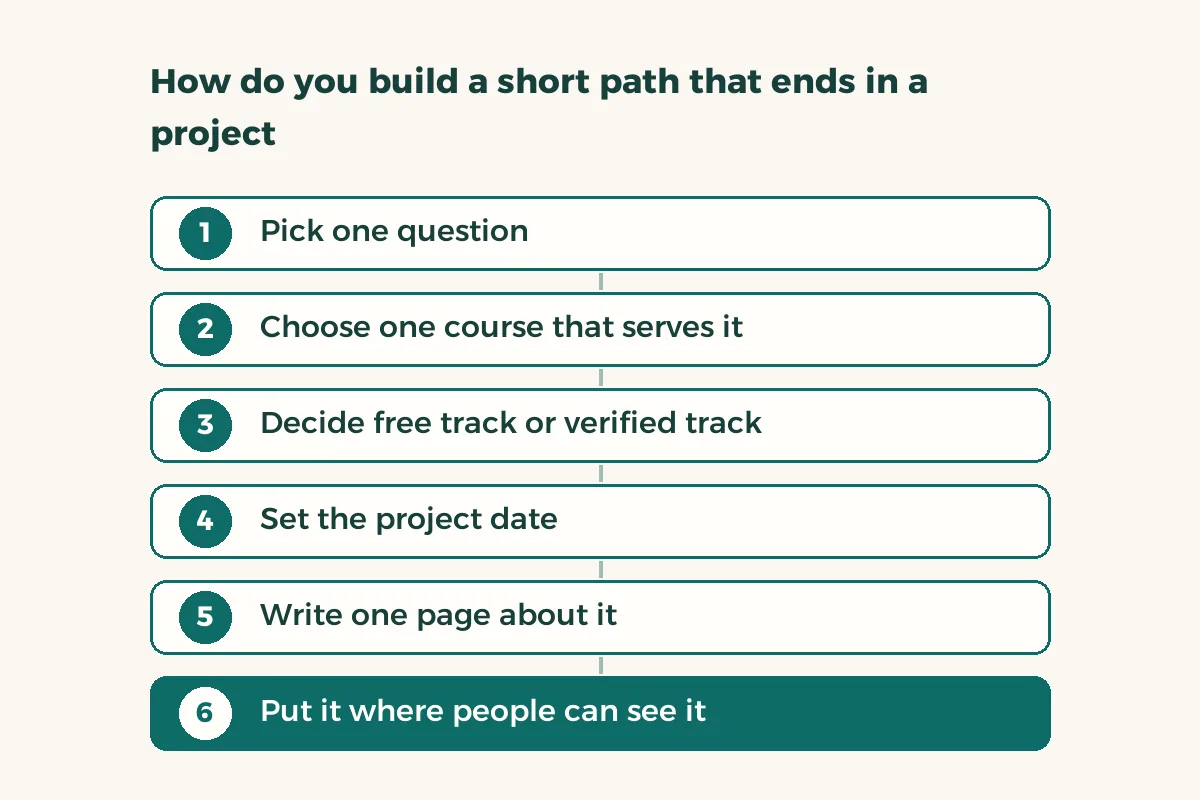
How do you build a short path that ends in a project?
- Pick one question
Not “I want to learn programming.” Try “I want a sheet that calculates my semester GPA” or “I want to analyse the data from one course.” A small question makes the project.
- Choose one course that serves it
Look for an introductory course from a known university that covers the skill your question needs, and read its weekly outline before enrolling.
- Decide free track or verified track
If you only want the content, auditing is enough. If you need a certificate to attach to an application, read the verified track conditions and the aid terms.1
- Set the project date
Give yourself a hand-in date before you finish the lectures, not after. A postponed project never gets built.
- Write one page about it
What you built, what you used, what you learned, what you would change next time. Employers read this page faster than any certificate.
- Put it where people can see it
A link on your CV and your professional profile. The portfolio guide shows how to organise it.
Does a certificate help without a project?
A little. A certificate says you finished a course. It does not say you could apply any of it. If you collect five certificates on one topic with not a single piece of work, the pile can look like name collecting. Choose what you can show: one certificate with a clear project is stronger than five similar ones.
There is one case where the certificate alone helps: when the job ad names it. Then read the wording exactly and compare it with what your chosen path gives you. Do not assume a certificate with a famous logo will be accepted in place of the one the ad asked for.
How do you choose between a free course with no certificate and a paid certificate?
State your goal in one line. If you want to understand a hard subject from your own degree, open materials such as MIT’s are enough, and they need no account and no fee.2 If you want to add something verifiable to a co-op training application, look for a path that gives a certificate and a verification page, and read its conditions. If you want to learn a skill and prove it, the project is the proof in both cases.
An example, labelled as one: a business student wants to learn data analysis. She picks one introductory course, builds a sheet that compares sales for an imaginary shop, and writes a page about what she found. That is enough for her to say in an interview, here is what I did and here is how. For programming basics, learn programming from zero is a good companion.
What mistakes do students make when enrolling in global university courses?
The first is enrolling in several courses at once. A single course needs regular time, and parallel ones usually end with all of them abandoned. The second is leaving language and pace to the last minute, then finding that the lectures are fast English that does not suit you. Try the first lecture before you commit to a plan.
The third is relying on a summary from a social media account instead of the official page. The summary may be old, and conditions change. Open the course page yourself and read what it says today.3