By the tiswa editorial team, from the official sources listed at the end of this guide. How we write our guides
Four subjects in finals week: chemistry, statistics, English and IT. You read chemistry on Sunday and understand it, read statistics on Monday and understand it, and when you return to chemistry on Thursday half of it has gone. That is not a flaw in you. It is what happens to anything we do not return to. Spaced revision is the cure.
What is spaced revision for exams?
It means spreading revision over gaps that widen with time instead of packing it into one session. Cornell’s Learning Strategies Center describes spaced practice as the opposite of cramming, and says it improves learning and retention.1 The Learning Scientists put spacing and retrieval practice at the top of the learning strategies with the most evidence.2
For the full theory, read the guide on active recall and spaced repetition. The question here is practical: how do you put this into a timetable for four subjects before finals?
How to make a study schedule for college finals?
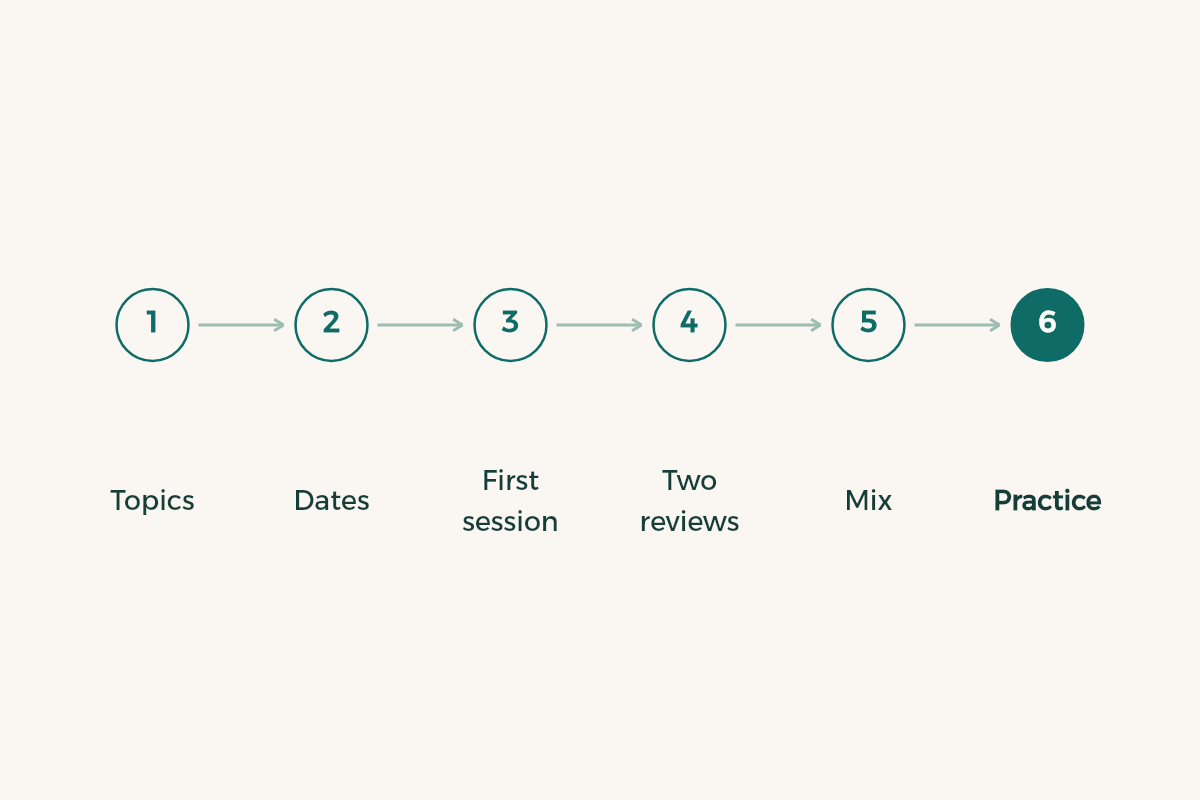
- List each subject’s topics
Write four to six big topics per subject. If chemistry is twenty lectures, group them into six topics.
- Fix every exam date
Order the subjects by exam date and do not give them equal time. The nearest and hardest subject gets the bigger share.
- Give each topic a first session
Reading or problem solving, with a self-test at the end. This is where the count starts.
- Add two reviews after it
One after a day or two and another after about a week. The gaps are examples; if you forget a lot, shorten them.
- Mix subjects in one day
Two subjects a day: one new, one review. That way you never sit a whole day on one subject.
- Keep the last days for practice
The final three days before the first exam go to practice tests and correcting mistakes, not new topics.
How to spread four subjects over three weeks?
| Week | What you do | Note |
|---|---|---|
| One | A first session for half the topics of each subject | Two sessions a day: two new subjects |
| Two | First session for the other half, and a first review of week one’s half | One new subject and one review each day |
| Three | A second review of every topic, plus practice tests | Put the subject with the earliest exam first |

The table is an illustration. If chemistry is in week one, flip the order; if a subject is light, trim it. For the wider frame of finals weeks, see final exams revision.
How many times should I review a subject?
There is no single correct number, but the logic holds: longer gaps as the material sticks. Anki does this for you, showing on each answer button when the card will next appear according to your answer.3 Without an app, write the next review date by hand: after a day, then after a week, then two days before the exam. For the app itself see the Anki guide.
Watch yourself: if you answer everything in the first review with ease, widen the gap; if you miss half, shorten it. A review that is perfectly easy is not a review, and one that defeats you completely needs a fresh learning session.
How should I revise four subjects in one day?
Better two a day than four. The UNC Learning Center recommends short sessions on each course rather than one long session, and warns that hours of unbroken self-testing wear attention down.4 Try two forty-five-minute sessions per subject per day with a break between; on a crowded day fall back to the floor of twenty minutes per subject, just quizzing yourself.
An example, with illustrative numbers, of a day in week two: morning before lectures, forty minutes of new statistics. Afternoon, forty minutes reviewing a chemistry topic from last week. Evening, a new English session, then thirty minutes of IT review. About two hours and a quarter in four sessions, which suits someone with lectures the same day.
Here is a full week as an illustration, with numbers. Sunday: ninety minutes over two sessions, new statistics and new chemistry. Monday: ninety minutes, new English and a first review of statistics. Tuesday: two hours, new IT and a chemistry review. Wednesday: one hour, review English and IT. Thursday: ninety minutes quizzing yourself on two topics per subject. Friday: a light rest and twenty minutes correcting mistakes. Saturday: an empty day for anything that slipped. That is about eight hours in total, which suits a student with lectures; adjust it to your own timetable in Blackboard.
What if time runs short before the exam?
If only one week is left, make spaced revision a compressed version: a first session, a review after a day, and a review the day before the exam. It is not ideal, but it beats reading at night. On the last evening follow the night before an exam, not a new learning session.
The most common mistake is putting reviews in the plan and then skipping them because they feel easier than new material. Review feels easy because you recognise the text, but recognising is not recalling. Answer the questions without looking before you decide a subject has stuck.