By the tiswa editorial team, from the official sources listed at the end of this guide. How we write our guides
Most of us publish office hours, sit at a desk for the first half hour, and then return to our papers. This is common, and it is not the student's fault. Office hours work when you know what you want from them, and when students believe the time is for them.
What makes office hours useful to students?
A study by the London School of Economics analysed around 90,000 bookings from more than 16,000 students, and looked at the gaps between students who used office hours and those who did not.1 The main lesson is that use is uneven. The students who most need contact with their lecturer outside class are often the least likely to ask for it, so the design of the hour is part of fairness.
A review of office-hour research notes one study in which two-thirds of the students surveyed never used office hours, and others in which fewer than half used them regularly. The review links low use to students feeling intimidated about approaching faculty, rather than to a lack of interest in learning.2
How should office hours change with class size?
Not every course needs the same arrangement. A class of a hundred and fifty needs a booking system. A class of thirty can manage with a flexible slot. The need also changes between a practical course, where students ask how to solve one step, and a theoretical course, where a discussion takes longer. Before you publish a time, ask yourself what students will come to ask, and how long you need to answer it.
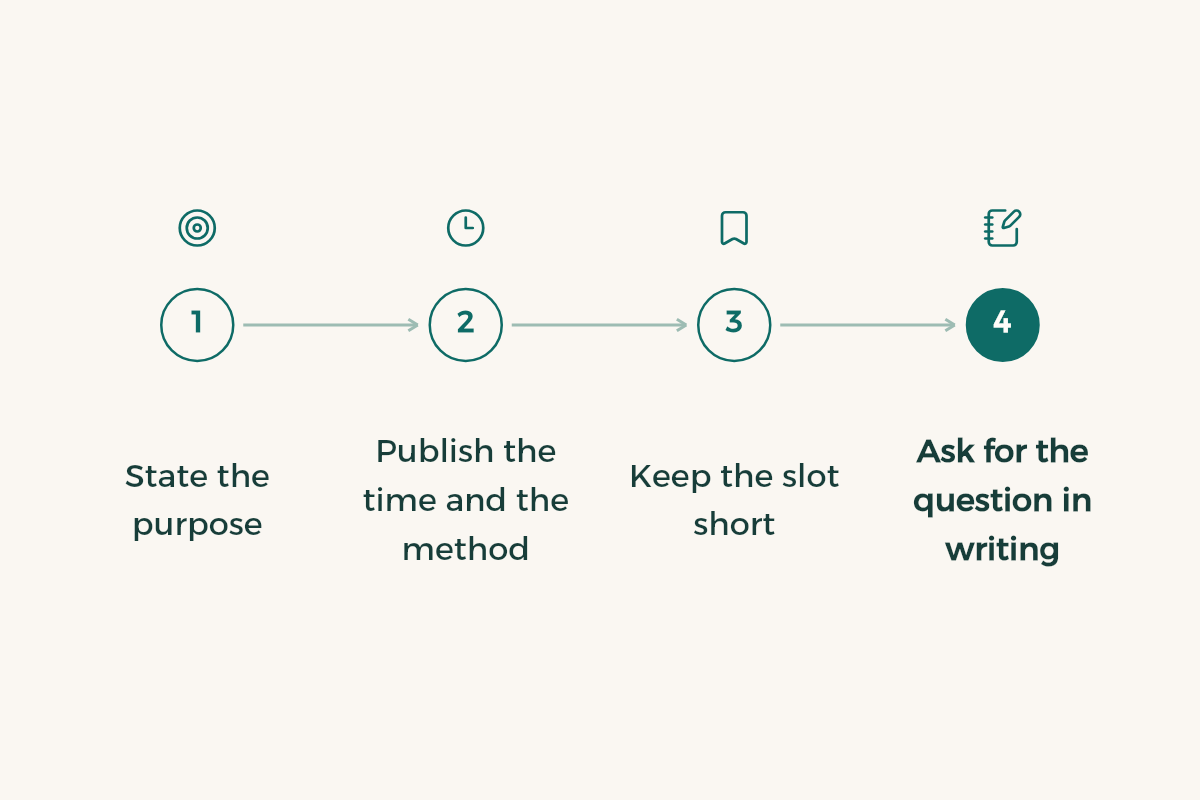
- State the purpose
Write one sentence in the course specification, such as "office hours are for reviewing assignments and framing questions before the exam". A written purpose stops the hour from turning into a general chat.
- Publish the time and the method
Give the days, the hours, the place, and how to book, whether through Blackboard or the department email. A student who cannot find the booking route will give up on the idea.
- Keep the slot short
Ten minutes is enough for a routine visit, with longer slots when needed. A short slot encourages the shy student to book, because it does not feel like a large favour.
- Ask for the question in writing
When students book, they send their question in one line. You prepare, and the visit becomes more useful for both of you.
How do you run a short visit?
Begin with the question they sent, then ask what they already tried. Many questions are solved within a minute once you know the attempt. If the question is too broad, narrow it with one counter-question. End with a single next step you both agree on, and write it down.
What do you reply to a vague message?
A message that opens with "I did not understand anything" needs a reply that asks and directs, not a long explanation. A short template protects your time and gives the student a clear way forward:
Hello [student name], thank you for writing. So I can answer accurately, please send me in one line the exact point in [topic] where you got stuck, and the step you tried before writing.
If it needs a discussion, book an office hour on [day] between [time] and [time] through [booking method].
[your name]
Cut the last lines if the question can be answered in two sentences. A template does not make you cold. It makes you clear.
What happens in the weeks before exams?
Demand rises in the two weeks before the exam, and visits run longer than planned. Fixed extra slots, with a set number of students each, work better than an open-ended period. Note that a student who arrives the night before an exam usually needs an explanation of one topic, not a review of the whole term, which is easier to hold to time if you set the boundary at the start.
Do virtual office hours work?
They work well for short, specific questions and poorly for questions that need a diagram or a page reviewed together. A mix of both is best: a virtual slot for small questions, and an in-person hour for reviewing work. If you rely on the virtual one, pin the link in Blackboard so students do not search for it. A student who needs more than an office hour can be referred to academic advising.
What mistakes empty office hours?
- Publishing a time you do not keep, so students learn the hour is not real.
- Opening the hour to everything, so it becomes a review of the whole course in half an hour.
- Treating the visit like an exam, so the student leaves less confident than when they arrived.
- Judging the hour in its first week, when most students are still learning that it exists.
Office hours cannot fix every problem. A student who misses every lecture and wants the whole term explained the night before needs academic advising, not a chat about one topic.
What should you measure to know it helps?
Track three things: bookings each week, the kinds of questions that repeat, and whether the questions students bring get better across the term. The first shows reach, the second shows need, and the third shows whether the hour does its job. Do not count attendance alone, because one visit with a sharp question beats a crowded room of silent students. If the same grading question keeps coming back, check the rubric guide before the next visit.