By the tiswa editorial team, from the official sources listed at the end of this guide. How we write our guides
You ran a faculty event for 150 guests and it ended without a single complaint. You are proud of it. Then a hotel asks for a portfolio and you wonder what to put in. Photos of the event? Thank-you certificates? The better answer is a third thing: the paper in your hand before the first guest arrived.
What goes into a hospitality internship portfolio?
Three pieces are enough. The run-sheet: hour by hour, who does what, and the fallback if something slips. The guest-journey map: arrival to departure, with one pain point and how you eased it. A sample reply to a complaint, written to an imaginary guest. Each piece is one page, and the whole thing fits in a three-page PDF.
For the general way to present work see how to build a portfolio, and for another field, graphic design co-op portfolio. Hospitality differs because its centrepiece is an operating sheet, not a design file.
How do you write a one-page event run-sheet?
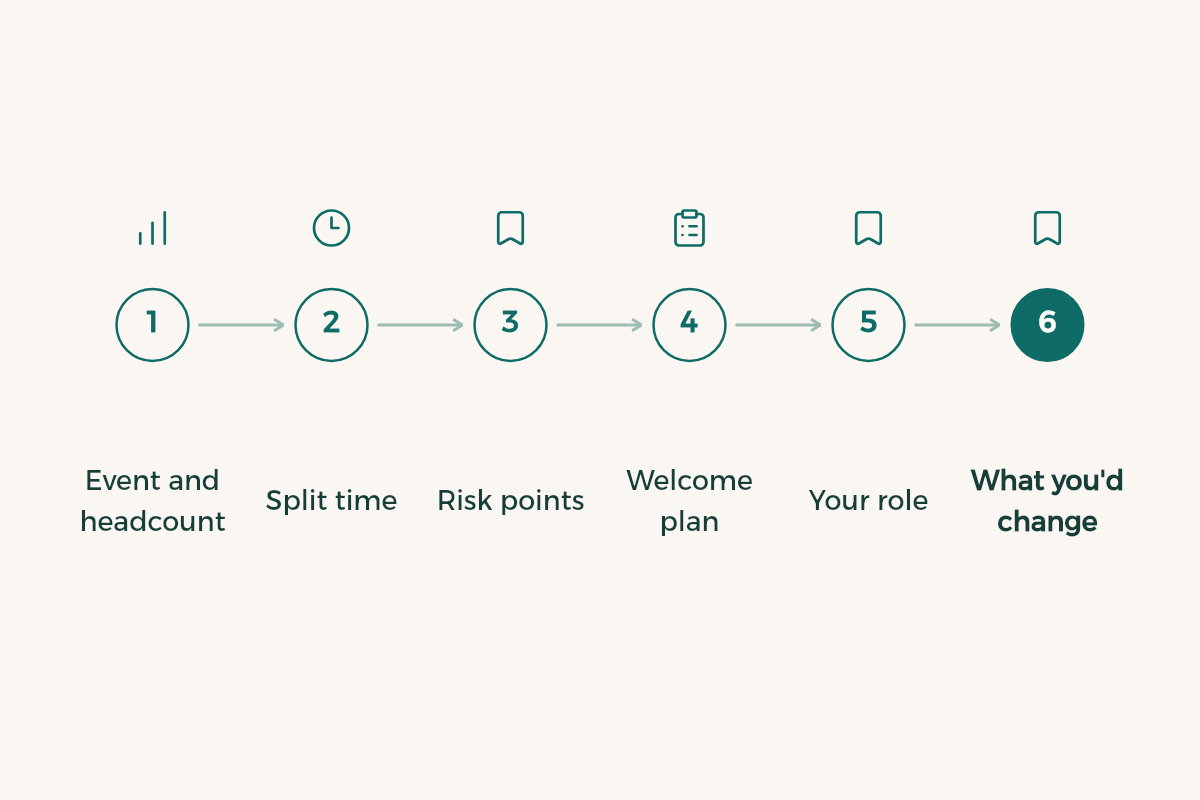
- State the event and headcount
One line: faculty open day, 150 guests, 2 pm to 5 pm.
- Split the time
A table with columns for time, activity, owner and what is needed. Give each hour a row.
- List the risk points
Three: speaker late, queue at the door, refreshments run out. Each with a fallback.
- Add the welcome plan
Where the greeter stands, how guests are routed to the hall, who looks after older guests and guests with disabilities.
- Mark your role
Shade the rows you owned. Shade nothing you did not do.
- Write what you would change
Two lines: what worked and what you would alter next time.
Note: the numbers above are an illustration. Use your real event’s figures, and if you do not know the headcount exactly, write “about” instead of inventing one.
How do you build a guest-journey map?
It is a strip of five stops: arrival, check-in, seating or room, service, departure. Under each, one line on what the guest feels and one on what the team does. Pick one stop with friction, such as waiting at check-in, and write how you eased it. A map this plain shows that you see hospitality from the guest’s side, not only your own.
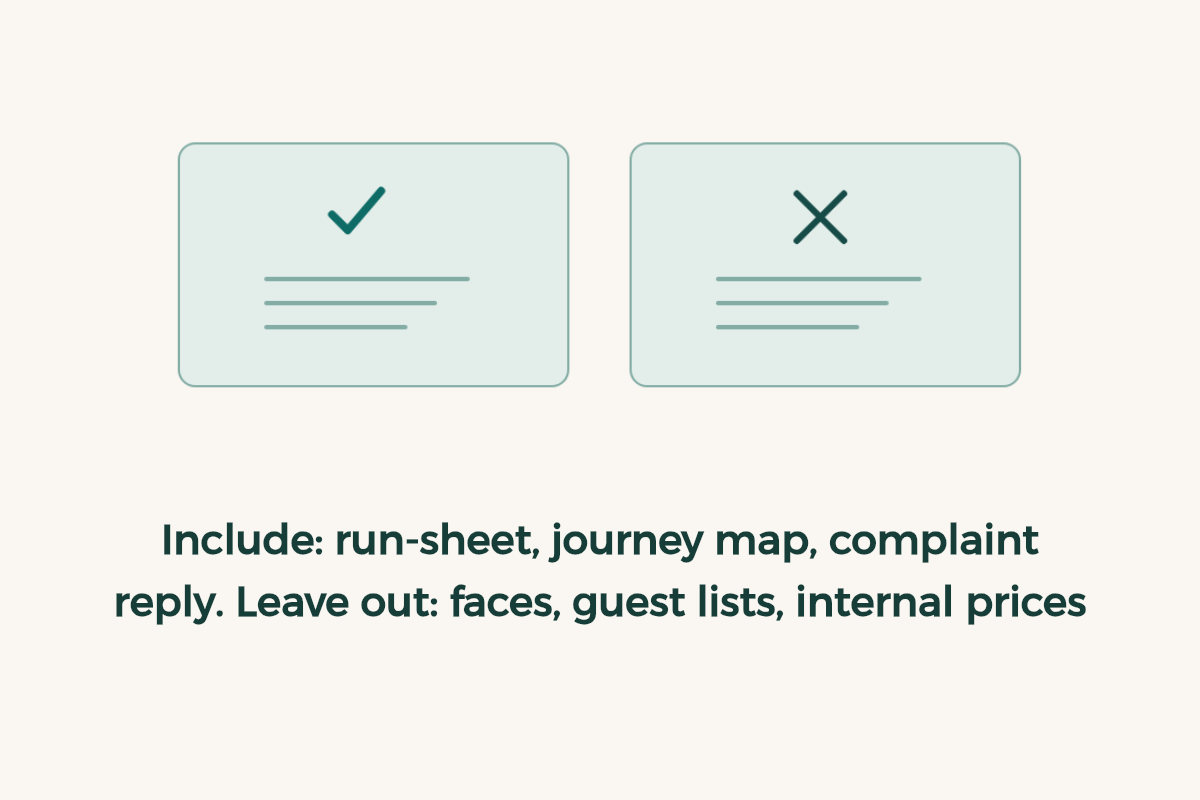
| Item | Include? | Reason |
|---|---|---|
| Run-sheet without guest names | Yes | Shows organisation and exposes nobody |
| Photos with attendees’ faces | No | Faces are personal data; get consent or leave them out |
| Guest list with names and numbers | No | Remove every line |
| A hotel’s internal package prices | No | That is the employer’s information; do not publish without permission |
| Sample reply to an imaginary complaint | Yes | Shows your tone without touching anyone |
| Guest-journey map | Yes | Shows how you think about experience |
Here is a pain point and its fix, as an illustration: a queue at the door because registration ran on one device. The fix you would write: we opened two lanes, one for pre-registered guests and one for the rest, and a colleague at the door handed out name cards. State how many minutes you saved if you measured it; if not, write “the wait dropped” with no number.
Write the complaint reply in five sentences: thanks for reporting it, a specific apology for the error itself rather than “the inconvenience”, what was done, what will change, and an offer to stay in touch. Do not promise compensation you have no authority to give. An intern does not promise what a manager decides, and interviewers notice that line.
What do you remove from a hospitality portfolio for privacy?
Remove guest names, phone numbers and the faces in photos; the Saudi Personal Data Protection Law, published in full by SDAIA, treats individuals’ data with care.2 Do not interpret its articles in your portfolio. Write only: “Names and photos showing faces were removed.” If the event took place inside a hotel or company, do not publish its prices or internal plans without written permission.
If you want a photo, choose an empty hall or a laid table, which shows your styling without exposing anyone, or a shot from behind where nobody is recognisable. Give each photo a one-line caption saying what you see and what your role was.
How do you apply for an internship in Saudi Arabia in hospitality with a portfolio?
Not always, and we do not know every employer’s requirement, so read the posting. But a portfolio gives the interview something tangible. Your CV says what you studied; the run-sheet says what you did. For the CV see CV for students, and for the interview see hospitality internship interview questions.
To apply, begin with your faculty’s co-op unit and place the link in your LinkedIn internship profile. Do not wait for a posting; one piece takes two or three evenings. Resist adding extras, because a hurried reader sees only the first page.
Update the file every term. A new event you organised or a new course in food and beverage management deserves a line. Replace the oldest piece with something stronger and keep the first one in your private archive. Before each application read the file as a stranger would, without your voice explaining it; if a question is left hanging on the page, add the answer.
On delivery, export a PDF and name it with your name and field, such as “hospitality-portfolio-yourname”, because a generic file name gets lost in an inbox. Open it on your phone before sending; many readers open mail on mobile, and a table in small type loses half the page.
Also write a one-minute note on each page for the interview. A student who writes the file and never rehearses it stumbles when asked about a line written two months earlier.