By the tiswa editorial team, from the official sources listed at the end of this guide. How we write our guides
At sixteen, at the end of your first secondary year, you are asked to pick a track. It feels bigger than it is. The track decides which subjects you go deep on for two years and which colleges accept you. It does not write your major for you. What follows links each track to what it actually opens, using admission pages universities have published.
What are the high school tracks in Saudi Arabia?
The Ministry of Education lists five: the general track, computer science and engineering, health and life, business administration, and the sharia track1. The system runs nine terms over three years. Year one is common to everyone, with a mix of science and humanities. Then you are placed in a specialised track for two years, based on your interests, your abilities and measures the ministry sets1.
Two details students often miss. First, you can move between tracks through a process the ministry calls bridging1, so your choice at sixteen is not final. Second, not every school offers every specialised track. Ask your school what is open to your year before you plan around a track it does not run.
Which track leads to which major?
| Track | Closest university fields | Ask the college |
|---|---|---|
| General | a wide spread of science, business and humanities majors, where the college accepts it | is the general track enough, or does the program want a specialised one |
| Computer science and engineering | engineering, computer science, mathematics, physics | any minimum in mathematics or a named subject |
| Health and life | medicine, pharmacy, nursing, applied medical sciences, biology | the English test and the health college's own rules |
| Business administration | business, accounting, finance, economics | whether science colleges accept this track at all |
| Sharia | sharia, theology, Islamic studies | which other tracks the program accepts |
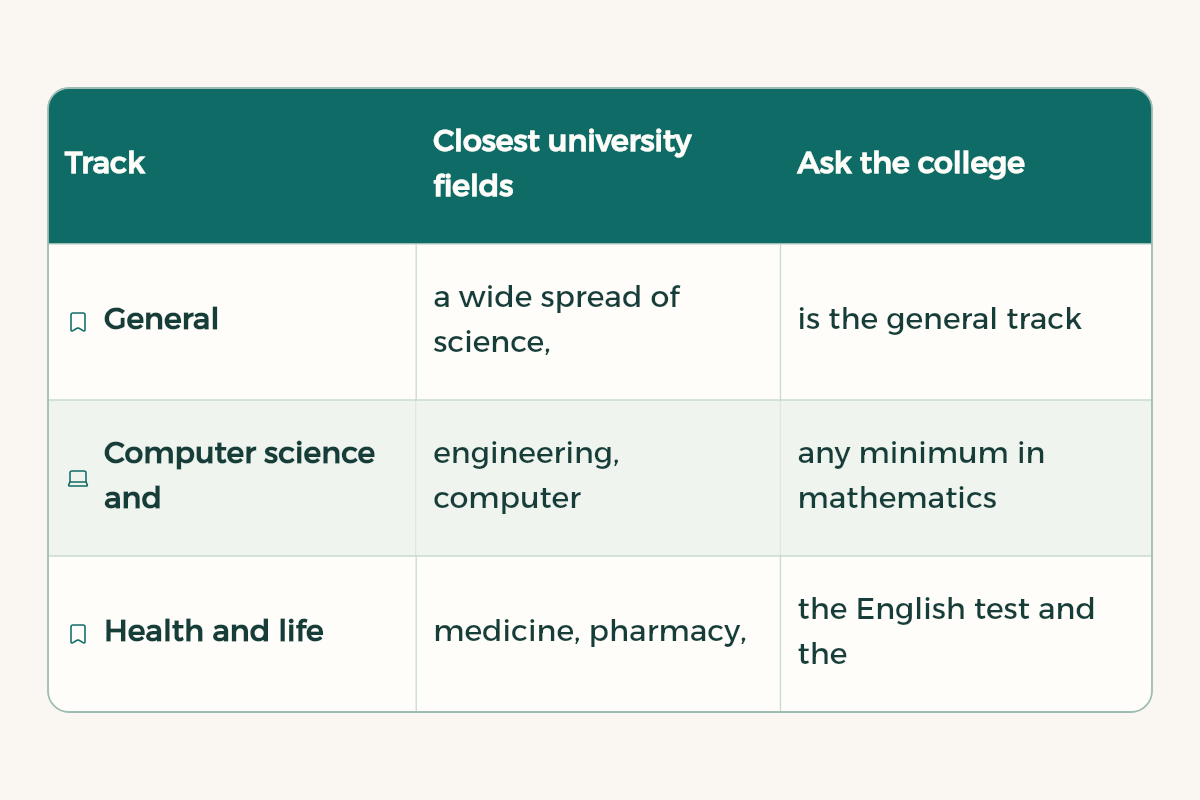
Treat the table as a rough map. The rule that counts sits in each college's notice. Here is a published one: King Saud University's College of Applied Engineering accepts the general, computer science, engineering and health and life tracks, or their equivalent2. Business and sharia are not on that list. That single line is what you are looking for on every college page you care about.
Health track or general track: which should you pick?
Pick health and life if you are sure you want a health college and you like biology and chemistry enough for two more years of them. The health preparatory year will feel lighter, because you have already covered its base.
Pick general if you are torn between fields that sit far apart, say medicine and business. It is accepted by many science colleges, as the King Saud example shows2. Still, check the specific health college you want by name, since some programs set narrower rules. To weigh health against engineering, read our health or engineering track guide.
How is the weighted percentage calculated?
Your track does not change the formula. The university does. Your high school grade goes in alongside the aptitude and achievement tests, and each university sets the weights. Umm Al-Qura uses 40% high school, 30% aptitude and 30% achievement for its scientific and administrative majors4. King Saud's College of Applied Engineering uses 30% high school, 30% aptitude and 40% achievement2.
Notice what that means. A student with a strong school grade and an average achievement score gains more at Umm Al-Qura than at King Saud's applied engineering college. It is also why the track matters: the achievement test covers secondary school subjects, and a track that keeps you close to them keeps you closer to a high score. More in our Tahsili guide.
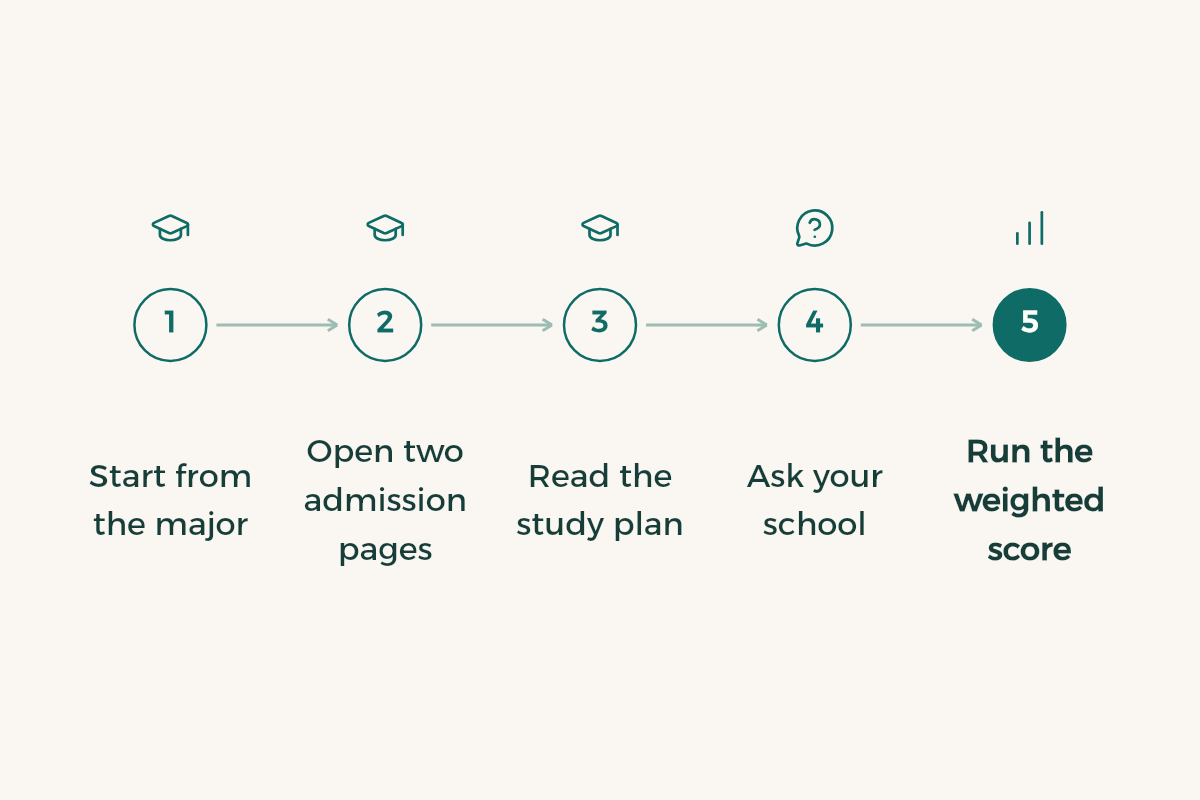
How to choose a major in high school, step by step
- Start from the major
Write down two majors and one honest reason for each. Do not start from the track.
- Open two admission pages
Find the line that says "High School Tracks" or "المسارات المقبولة" and copy it word for word.
- Read the study plan
If year one is mathematics and physics, computer science and engineering is the closer track. If it is biology and chemistry, health and life is.
- Ask your school
Is the track you need open to your year, and how does bridging work if you need to move later?
- Run the weighted score
Apply your target university's weights to your expected marks and compare the result with cut-offs published in past years.
- Decide and write down why
One sentence is enough. You will come back to it in your final year when someone tells you that you chose wrong.
Does the preparatory year count in your GPA?
At King Saud University, yes. Your preparatory-year GPA is counted in your university GPA3. Moving from one preparatory track to another means applying after the term ends and taking the new track's courses, which delays your graduation3. The preparatory year has its own tracks there, and the subjects in each differ from one university to the next, so read your own university's plan. Our preparatory year guide covers it in detail.
Common mistakes
- Choosing a track because your friends did.
- Assuming the general track shuts science colleges, when many accept it.
- Trusting a shared list of tracks and majors without opening the college's own notice.
- Leaving Tahsili preparation for the final year, though it can carry 40% of the weighted score2.
- Treating the preparatory year as a trial year that does not count.
Help me compare my secondary track with the majors I am considering. My track: [track name]. Majors: [two majors]. For each major, make a table with: the core first-year subjects, the question I should ask the college about accepted tracks, and the subject where I need extra preparation. Do not state admission rules yourself; tell me to confirm them on the university website.
If the major itself is still open, start with our guide to choosing a major, then read about the field you lean towards, such as computer science, medicine or nursing.
To see which majors the Saudi job market is asking for, read the best majors in Saudi Arabia.