By the tiswa editorial team, from the official sources listed at the end of this guide. How we write our guides
You opened three English course pages in one evening, saved them all, and have not opened any since. Most students do this, and laziness is not the reason. A course with no finish line turns into a task you keep postponing. A path that ends in something you can show, even something small, makes you turn up every week.
How do you choose free English courses that fit your level?
Know your level before you choose. Some platforms build a level test into their pages, and BBC Learning English splits its content into easy, medium and hard levels, with separate sections for pronunciation, vocabulary, grammar and skills.1 That split helps, because you see what you are missing before you hunt for a full course.
A practical rule: if you follow about half of a simplified news story, you are intermediate, so start there. If you stop at every sentence, start at the easy level and do not be embarrassed by it. The most common mistake is picking a course above your level to feel progress, then quitting after three lessons.
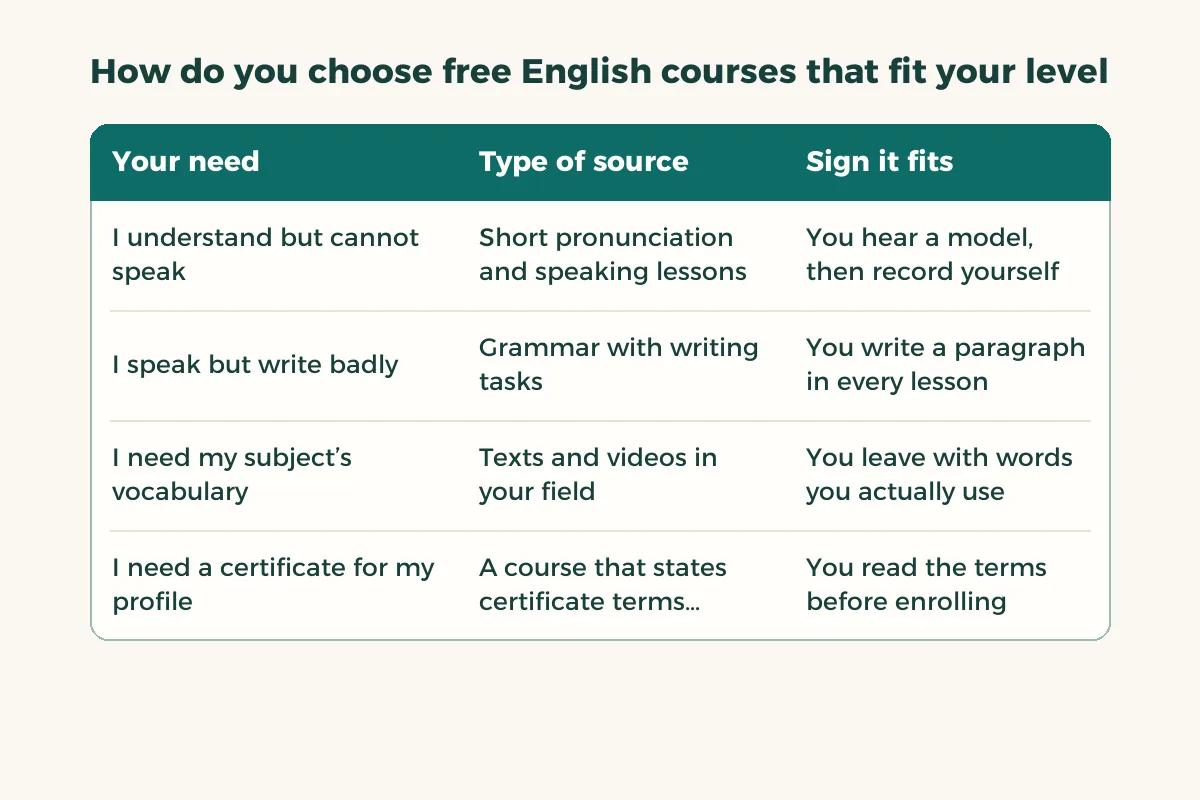
| Your need | Type of source | Sign it fits |
|---|---|---|
| I understand but cannot speak | Short pronunciation and speaking lessons | You hear a model, then record yourself |
| I speak but write badly | Grammar with writing tasks | You write a paragraph in every lesson |
| I need my subject’s vocabulary | Texts and videos in your field | You leave with words you actually use |
| I need a certificate for my profile | A course that states certificate terms clearly | You read the terms before enrolling |
Do free English courses give a certificate?
Some do and some do not, and the difference is in the details. Some platforms let you attend lessons free and treat the certificate or marked assessment as a separate option. Read the page of the course you want, because it is the reference, and do not rely on a post or video that says the certificate is free.3 If the certificate really matters, ask first who will ask for it. Many employers and offices care more about a recognised test score than a completion certificate.
If you need something for your profile, read free courses with certificates and compare the options. If your goal is studying at university in English, the plan in learn English for university is closer to your need.
How do you build a 6-week path that ends in a project?
The idea is simple: decide what you will show at the end of week six, then work backwards. The project below is an example, and you can change it to suit your major: a recorded three-minute talk explaining a topic from one of your courses in English, plus a one-page summary of the main points.
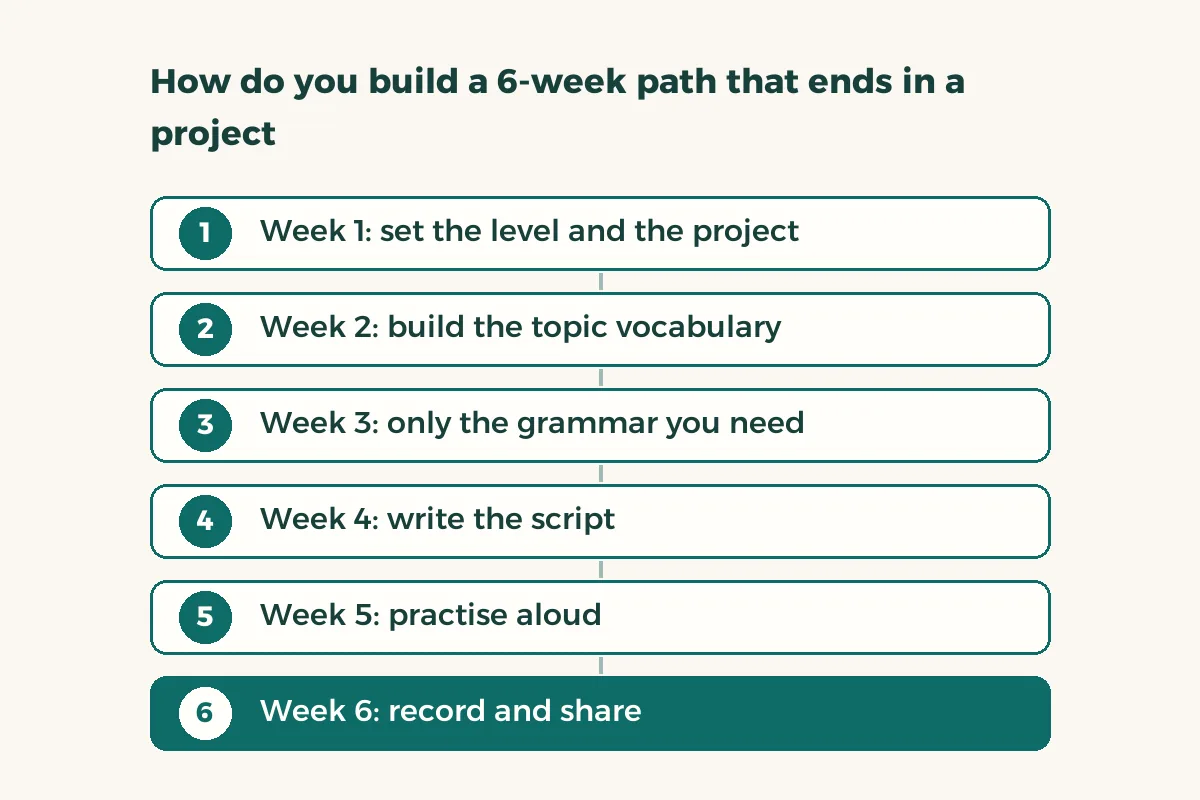
- Week 1: set the level and the project
Choose one source, write the talk topic, and record yourself reading a paragraph from your course so you keep a starting point.
- Week 2: build the topic vocabulary
Collect twenty words from your course and write a sentence of your own for each, not a copied one.
- Week 3: only the grammar you need
Learn the tenses the talk uses, such as the present for explaining and the past for examples. Ignore the rest for now.
- Week 4: write the script
Write the talk on one page, then cut it to half its length. Short sentences are easier to say.
- Week 5: practise aloud
Record the talk three times, listen for mistakes, and fix pronunciation using the pronunciation section of your source.
- Week 6: record and share
Record the final version, show it to a classmate or your instructor, and save the file in your portfolio.
Notice that the plan does not ask for long hours. Thirty minutes to an hour a day is enough, because review spread across days fixes material in memory better than one long session, which is the core idea of the well-known learning course on how the brain learns.2
What are the best free English courses for students?
No single course is best for everyone, and we will not invent a ranking without evidence. What we can offer is how to judge. A good course states its level clearly and has you write and speak, not only watch. BBC Learning English has sections on pronunciation, vocabulary, grammar, skills and English for work, so you can assemble a path yourself.1
If you prefer platforms that carry university courses, browse Coursera and look at each course page for the free audit option and the certificate terms.3 We explain in Coursera financial aid how to request support when the certificate is paid. And if you want YouTube channels for daily practice, see the best English channels.
How do you know a course is worth your time?
Try the course for three days before you commit. If on day three you can say a new sentence to a classmate, it fits. If all you have is a list of videos watched, move on. These mistakes come up again and again:
- Downloading the whole course before you know it fits.
- Measuring progress by videos watched, not by what you can say.
- Putting off the voice recording because you dislike your accent, when it is the most useful exercise.
- Paying for a certificate before you know who will ask for it.
It also helps to pair the path with the academic vocabulary you will meet at university, which is why we suggest reading academic English vocabulary alongside it.
How do you fit the path around a crowded study week?
Midterm week is not the time for new lessons. If one week of the path lands on an exam week, keep ten minutes of review and one voice recording, then carry on the week after. A one-week pause does not break the path; a one-month pause does.
It works best when you tie the lesson to a fixed time: after Fajr before the first lecture, in the gap between two lectures in the university library, or on the road if you listen to pronunciation clips. Pick one slot and keep it for three weeks, because a habit needs a fixed place before it needs motivation.
How do you present the project so it helps you?
The recorded talk is a small file, but how you present it matters. Write only two lines under it: the topic of the talk, and the level you were at when you started. Whoever opens your portfolio sees that you are improving, and does not have to trust a phrase like fluent English. If an instructor asks for a presentation in English, you will already have a version you rehearsed six times before standing in front of the room.
Three questions work for self-assessment. Did a classmate outside your major follow you? Did you stop more than twice to look for a word? Did you use five new words from your list? If the first and third answers are yes, the path worked, even if some pronunciation errors remain.
What do you do after the course ends?
End with one small action: post the project on LinkedIn or save it in your portfolio, and give the next course its own project. Do not start another course with no ending. And if you want more free tools for study, browse student discounts in Saudi Arabia and compare before you pay for any subscription.