By the tiswa editorial team, from the official sources listed at the end of this guide. How we write our guides
The best YouTube channels to learn English are not always the most watched. They are the ones that fit your level and goal and make you learn, not just watch. YouTube is full of content, and most students struggle with too many sources rather than too few: they jump between dozens of channels with no plan. This guide sorts trusted channels by goal, starting with official educational institutions, and gives you an active watching method that turns ten minutes of video into a real lesson.
Start with the official channels
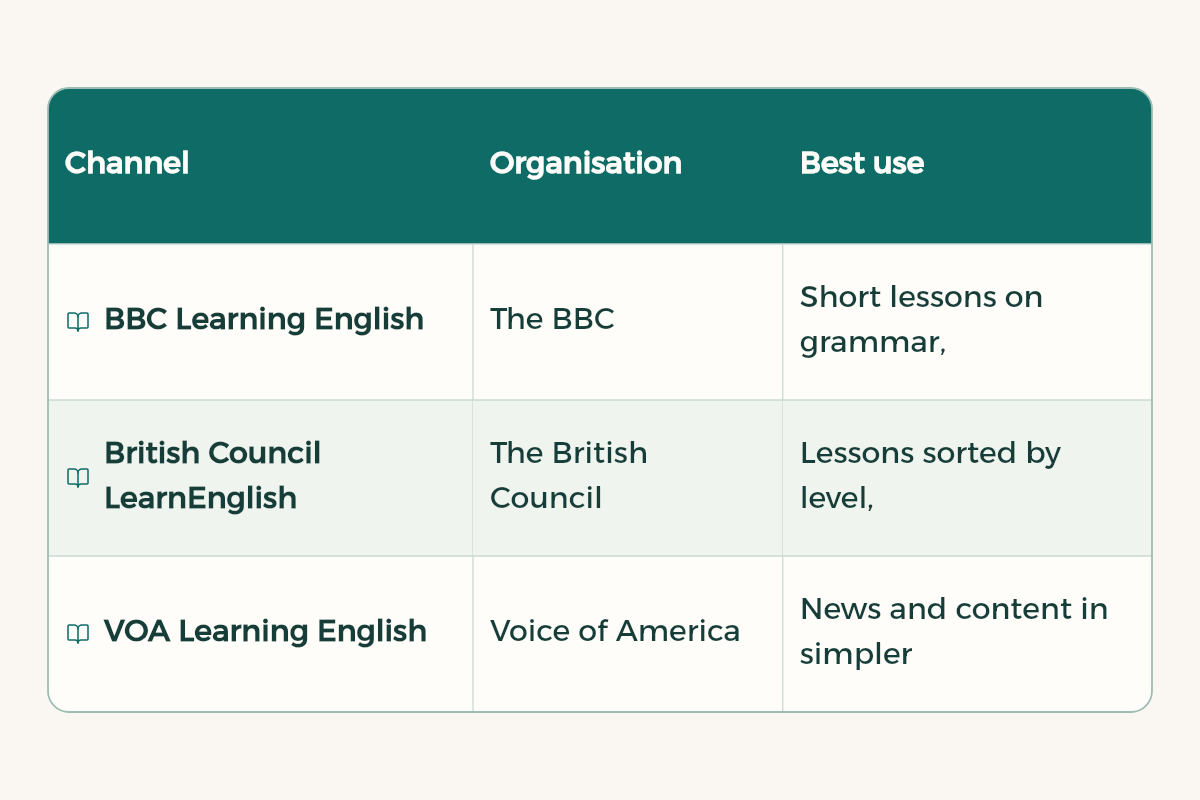
These channels belong to well known organisations. Their content is structured and reviewed, and each has an official site with the same lessons plus exercises and transcripts:
| Channel | Organisation | Best use |
|---|---|---|
| BBC Learning English | The BBC | Short lessons on grammar, vocabulary and pronunciation, and listening programmes with transcripts |
| British Council LearnEnglish | The British Council | Lessons sorted by level, with exercises for each lesson on the site |
| VOA Learning English | Voice of America | News and content in simpler English at beginning, intermediate and advanced levels, plus the Let's Learn English series for beginners |
| TED-Ed | TED | Short animated lessons on science, history and ideas, great for academic listening |
| TED | TED | Real talks by speakers from many backgrounds, most with a transcript and subtitles |
Pick by goal
| Your goal | Start with | Why |
|---|---|---|
| Complete beginner | VOA Learning English and Let's Learn English | Slower speech and simpler words, with a story that continues across episodes |
| Grammar | BBC Learning English and British Council LearnEnglish | Short, clear explanations with examples and exercises |
| American pronunciation | Rachel's English | A channel focused on American pronunciation, mouth position and connected speech |
| British pronunciation and vocabulary | English with Lucy | Lessons on British pronunciation, vocabulary and grammar in a simple style |
| Academic listening | TED-Ed, then TED talks | Science topics and academic vocabulary at natural speed |
| Everyday conversation | mmmEnglish and Speak English With Vanessa | Everyday phrases and how to say them naturally |
Independent creators such as Rachel's English and English with Lucy are very useful, but pick only one or two that match your goal, and do not subscribe to ten at once. The official channels stay a steady base you can return to.
YouTube settings that help
- English captions, not Arabic: turn on captions (CC) and choose English. Arabic subtitles make you read instead of listen.
- Playback speed: in the video settings, slow down to 0.75 at first, then go back to normal speed when you replay.
- The full transcript: many videos have a Show transcript option under the description, so you can read the whole video and tap any line to jump to it.
- Playlists: make one playlist called "English this week" with just five videos, instead of letting recommendations choose for you.
- Listening without the screen: with YouTube Premium for students you can play lessons in the background with the phone locked and download them for your commute.
The active watching method
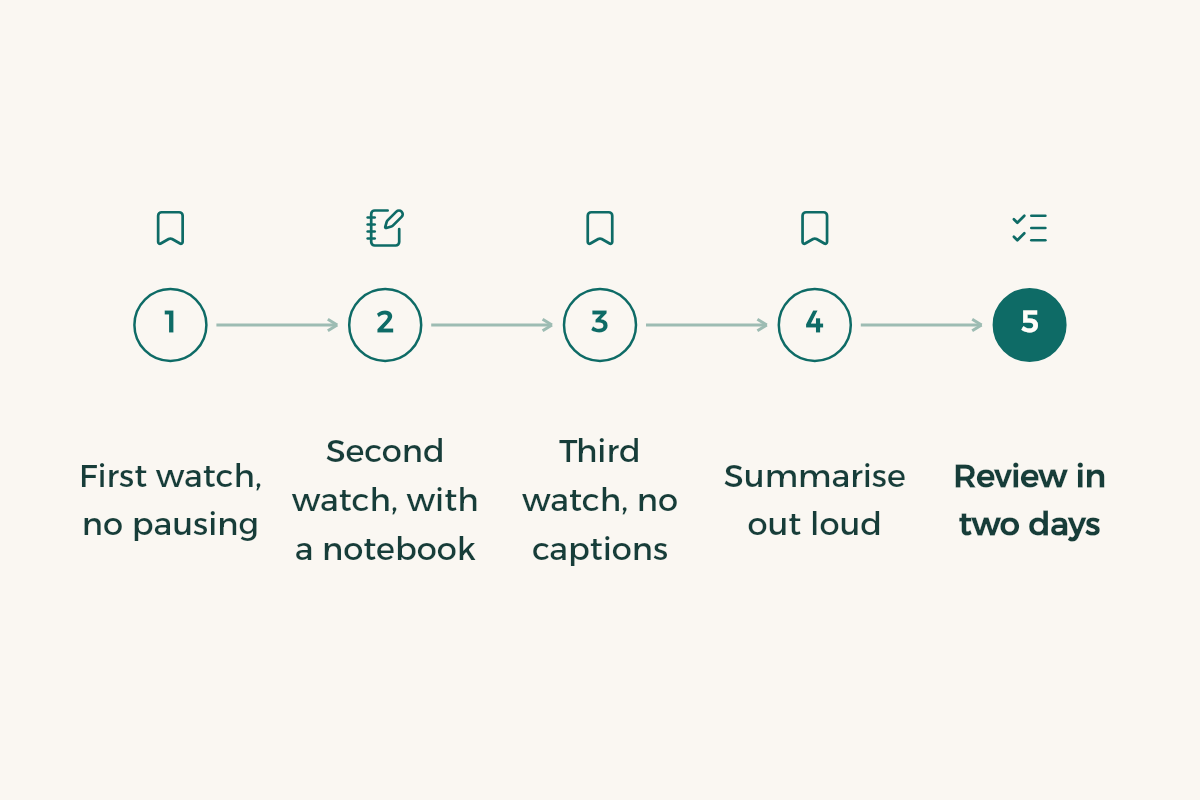
The difference between learning from YouTube and just watching it is what happens during and after the video. This method takes twenty minutes for a five to ten minute video:
- First watch, no pausing
Watch the whole video with English captions and no pauses. The goal is the general idea only.
- Second watch, with a notebook
Replay and pause at each useful new word or phrase. Write five at most, each with the sentence it came in.
- Third watch, no captions
Turn captions off and listen a third time. You will be surprised how much more you understand after two passes.
- Summarise out loud
Record yourself for one minute summarising the video in English, using at least two phrases from your notebook.
- Review in two days
Move the five phrases to flashcards and rewatch the video in two days with no captions.
A weekly plan with three channels
Choose just three channels: one official channel for grammar, one for pronunciation or conversation, and one for academic listening. Then spread them over the week like this:
| Day | Activity | Time |
|---|---|---|
| Sunday and Tuesday | A grammar lesson from an official channel, with the exercises on its site | 20 minutes |
| Monday and Wednesday | A pronunciation or conversation video with shadowing | 15 minutes |
| Thursday | A TED-Ed lesson or TED talk with the active watching method | 25 minutes |
| Weekend | Flashcard review and one video again with no captions | 15 minutes |
Shadowing and sound drills are explained in how to improve your English pronunciation, and the order to learn grammar in is in English grammar basics.
How to tell if a channel fits you
Before you subscribe, watch one video and ask three questions. Do I understand between half and three quarters of it with English captions? Less than that and the channel is above your level for now; if everything is easy, you will not learn much from it. Does the video focus on one clear skill? Focused lessons beat long general videos. Does it give me an example or exercise I can apply? A channel that makes you speak or write beats one that only makes you listen. Make the channel that passes all three your main channel for a full month before you look for others.
Turn a video into practice with AI
If you copy a video's transcript from the Show transcript option, an AI assistant can turn it into exercises. Try this with ChatGPT or Gemini:
Here is the transcript of an English lesson video: [paste transcript]. My level is [A2 or B1]. Make: 1) five comprehension questions, 2) a list of the 8 most useful phrases with a simple meaning, 3) five gap-fill sentences using those phrases. Give me the questions first and wait for my answers before you show the key.
I watched a video about [topic] and wrote this summary: [paste summary]. Correct my grammar, tell me if I missed any main idea, and suggest two phrases from academic English I could have used. Keep the feedback short.
Mistakes that waste your time
- Always watching with Arabic subtitles, which improves your Arabic reading, not your English listening.
- Jumping between many channels with no plan, so you never finish one series.
- Watching only lessons about English explained in Arabic. They help at the start, but spend most of your time with content in English.
- Watching with no output: no notes, no summary, no recording. The video is the start of learning, not the end.
For university students in particular, spend part of your viewing on your own field. A TED talk or TED-Ed lesson in your area gives you words you will need in exams. The full plan is in learn English for university, and if you are preparing for a test, read STEP vs IELTS.