By the tiswa editorial team, from the official sources listed at the end of this guide. How we write our guides
Financial fraud in Saudi Arabia does not only target older people. A student who has just received a stipend, or a graduate looking for a first job, is a favourite target because they deal with so many messages, links and apps. This guide covers the most common scams, the signs that give them away, and what to do in the first minutes if you suspect you have been caught. The golden rule the Saudi Central Bank repeats: never share a verification code or password with anyone, whoever they claim to be.
The most common scams aimed at students
| Scam | What it looks like | The giveaway |
|---|---|---|
| Bank impersonation | A call or message saying your account is frozen and needs updating | Banks never ask for verification codes or passwords |
| Government impersonation | A message about a fine or amount due, with a payment link | The link does not end in the official domain |
| Fake job | A work-from-home offer with high pay in exchange for a fee or bank details | Real employers do not ask you to pay |
| Guaranteed returns | A social media account promising daily or weekly profits | No high return is guaranteed without risk |
| Parcel scam | A message that your delivery is held and needs a small fee | You ordered nothing, or the link is odd |
| Nafath code request | Someone offers to help with a transaction and asks for your Nafath code | Your Nafath code is yours alone |
| Account renting | Money offered for the use of your bank account for transfers | It can make you party to a crime |

Why scammers target students
Students often receive regular payments, use their phones all day, look for jobs and extra income, and may hesitate to ask family if embarrassed. Scammers rely on two things: urgency and fear. They say your account will be frozen within the hour, or the opportunity ends today. Whenever you feel pressured to act at once, that is the first warning sign.
Warning signs not to ignore
- A request for a verification code sent to you by text, for any reason.
- A link in a message instead of you opening the official app yourself.
- A personal number or social media account claiming to be bank or government staff.
- A promise of big, guaranteed profit in a short time.
- A request to transfer a small amount first to activate a service or job.
- Urgent language or threats to freeze your account.
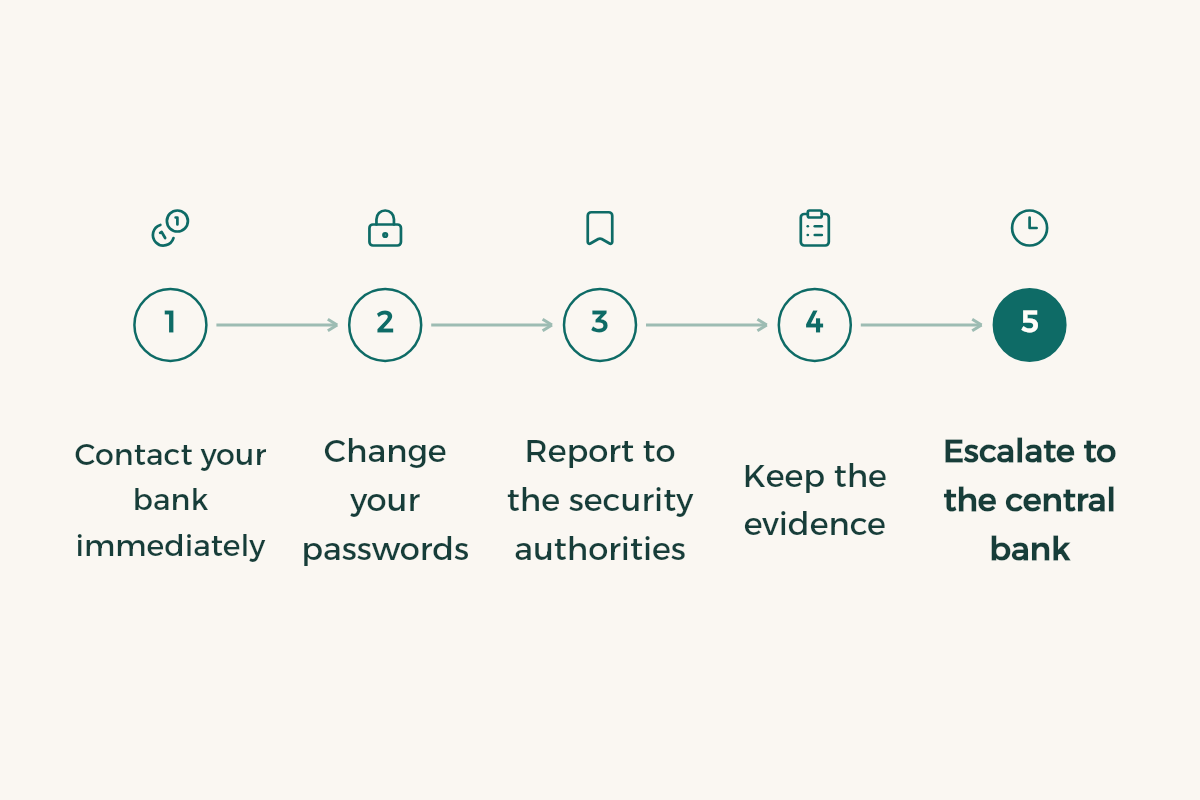
If you think you have been scammed: act now
- Contact your bank immediately
Through the official number or app, and ask to freeze the card or account. Every minute counts.
- Change your passwords
For your bank, email and Nafath, and turn on two-factor verification.
- Report to the security authorities
File an official fraud report through the approved security channels.
- Keep the evidence
Screenshots of messages, numbers, links and transfer receipts.
- Escalate to the central bank
If your bank does not resolve it, file a complaint through the official SAMA Cares platform.
- Tell people around you
Family and classmates, so they do not fall for the same trick.
Do not be embarrassed to report. Scammers are professionals, and people of every age and background fall for them. Reporting quickly is often what decides how much can be recovered.
Protect your account before anything happens
- Turn on alerts for every transaction in your bank app.
- Never store passwords in notes or photos.
- Download financial apps only from the official store.
- Avoid public Wi-Fi for banking.
- Set a sensible daily limit for transfers and online purchases.
- Never hand your card or phone to someone to make a transaction for you.
If you are opening your first bank account, read the student bank account for the settings to turn on from day one.
Fake job offers: stay alert while job hunting
Students looking for part-time or flexible work are easy targets for fake job offers. Real work comes with a contract documented on Qiwa and never asks for fees, full bank details or your Nafath code. Read flexible work in Saudi Arabia and the Qiwa employment contract to see what a genuine offer looks like.
Guaranteed returns: why they are a red flag
The Capital Market Authority regulates securities activity in the Kingdom, and no one may manage other people's money or give investment recommendations without a licence. If a social media account promises large fixed profits, check its licence on the authority's website first. The simple rule: a higher return always comes with higher risk, and anyone who says otherwise is hiding something. To start saving in a clear way, read your personal financial plan.
I received this message: [paste the text without any code or account number].
Analyse the possible fraud signs in it, tell me what I must not do, and the safe step to confirm it through official channels.
Do not ask me for any personal details.
A quick exercise: is this message a scam?
The best way to learn to spot fraud is to practise on examples before a real message arrives. Read the three situations below and think about your response before reading the analysis. All are common patterns that reach students by text message, chat apps and phone calls.
| Situation | Red flag | Right response |
|---|---|---|
| A message says your card is blocked and asks you to update your details through a link | An unofficial link and a request for data with urgency | Do not open the link; open your bank app yourself or call its official number |
| A caller says they are from the bank and asks for the verification code you just received | Banks never ask for verification codes | End the call and share the code with no one |
| An easy, well-paid job offer that starts with a registration or training fee | A real job does not ask you to pay to start | Pay nothing, and check the organisation through its official channels |
The common rule is simple: any request for details, codes or a transfer that comes with urgency or a promise of quick profit deserves a pause before you reply. Share this exercise with friends and family, because many victims had never heard of these patterns. Read credit card basics and the SIMAH credit report to learn how to review your accounts and record regularly.