By the tiswa editorial team, from the official sources listed at the end of this guide. How we write our guides
A business student used an AI tool to order the ideas in a report and handed it in without a word about it. A week later the instructor asked about an oddly worded introduction, and the student had nothing to show. The scene is illustrative, yet it makes the point: disclosure is written while you work, not after someone asks. This guide is for students whose course allows AI and who want a record that holds up.
Do you need to document AI use in an assignment?
If the course allows the tool, ask how the instructor wants it documented. Some want a line in a footnote and others want the chat attached as an appendix. If the syllabus says nothing, write and ask before you use it, then keep the reply. MLA advises citing a generative AI tool whenever you paraphrase, quote or incorporate what it produced, and acknowledging functional uses such as editing or translating in a note or in your text.1 If your course bans the tool, none of this applies and the ban holds. For the wider picture of university rules, read our guide to AI rules at university.
What should you record while you work?
Open one file for the course and log five things at each use. The table is an example template, not a requirement.
| Field | What to write | Example (illustrative) |
|---|---|---|
| Tool and version | Name and the most specific version shown | A chat assistant, version as the interface displays it |
| Date | The day you used it | The day of your chat |
| Prompt | The text you sent | Summarise three paragraphs from my source |
| What you used | The part that entered your work and how you changed it | Kept the heading order, rewrote every paragraph |
| What you rejected | What you left out and why | Dropped a reference I could not find |
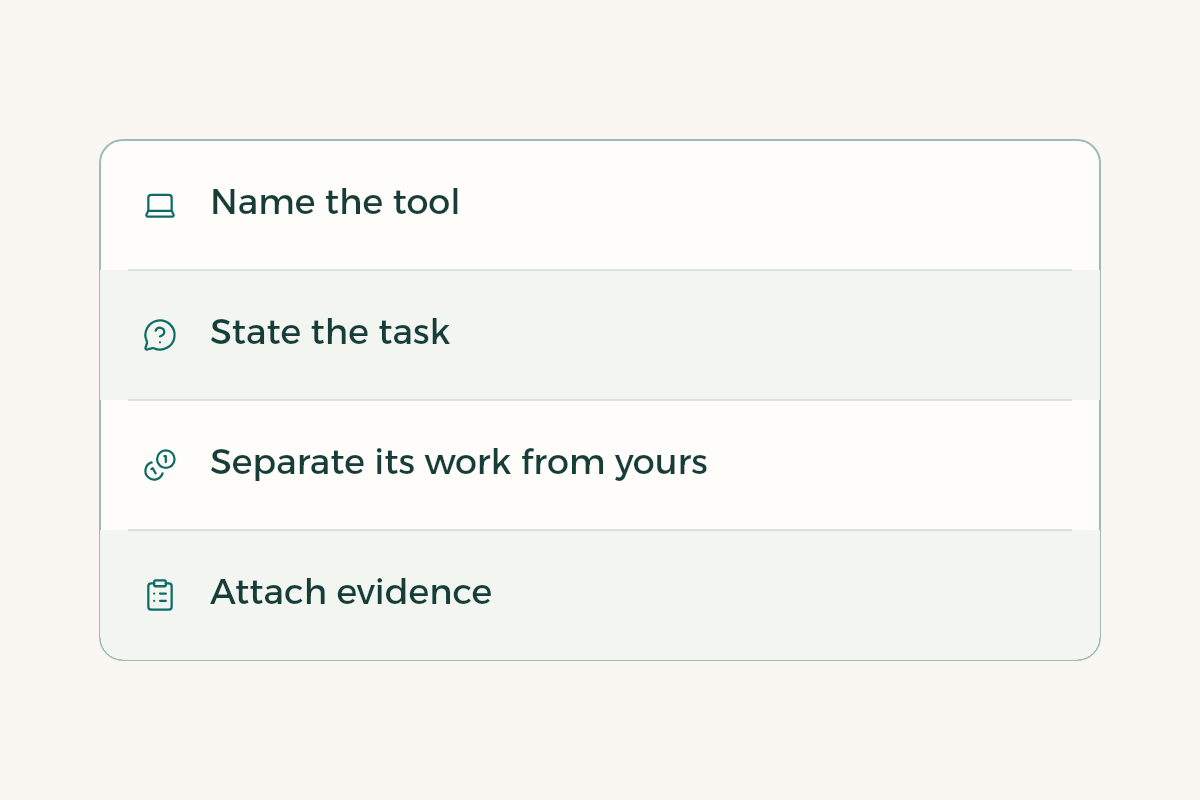
This log replaces a memory you will not trust in a month. MLA warns that a tool may cite sources wrongly or not at all, so check every source it names, and if you rely on one without opening it, treat it as a secondary source.1
What is the APA citation for ChatGPT and how does MLA differ?
Neither style lets the tool be an author. MLA says not to list it as one, and asks you to describe the generated content, name the tool as the container, give the most specific version, the publisher, the date it generated the content, and the tool’s URL.1 APA treats the output as the product of an algorithm, not a personal communication, so it goes in the reference list with the company as author and a bracketed description such as large language model. APA also suggests putting long responses in an appendix that the paper points to, and describing in the method section how you used the tool.2 The details of each pattern are in our guides to APA citation and MLA citation. Guidance changes between editions, so check the style’s own page and what your instructor demands.
How do you write the disclosure statement?
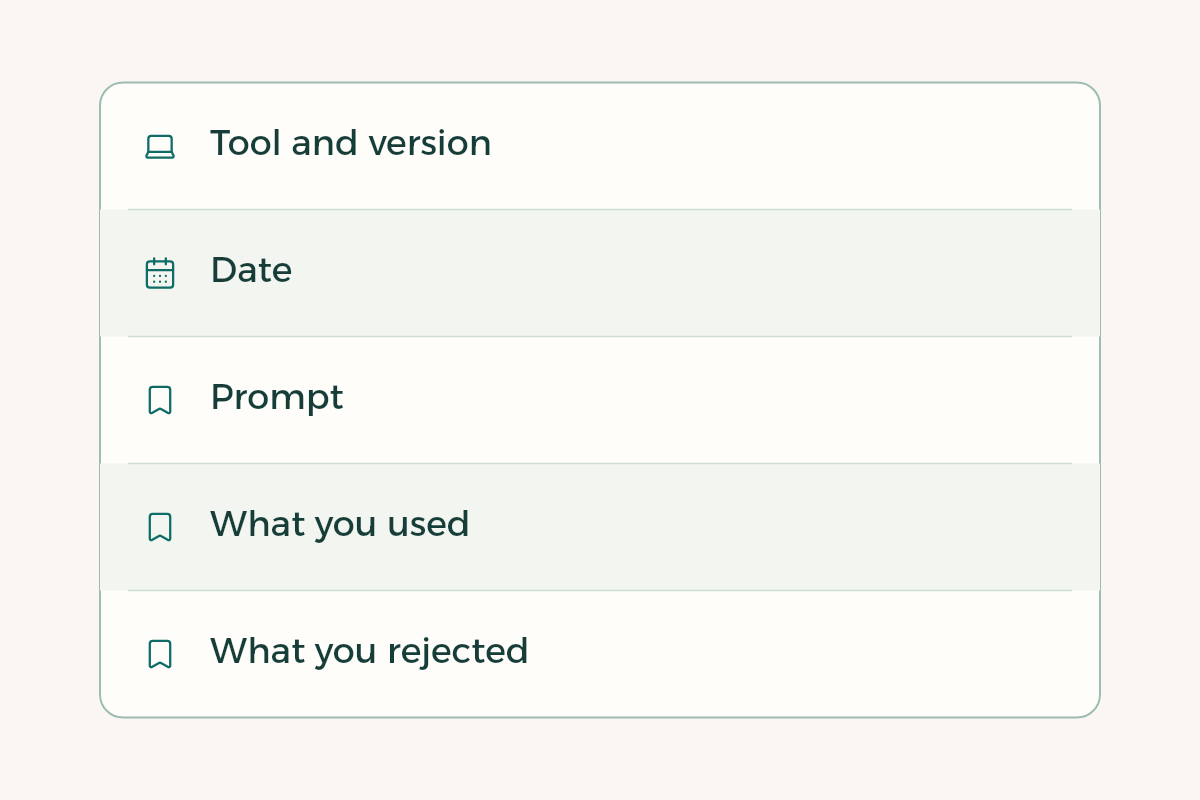
- Name the tool
Give its name, version and the date you used it.
- State the task
Say whether you used it for ideas, summaries, language checking or translation.
- Separate its work from yours
Say what you took, what you wrote and what you verified.
- Attach the evidence
Put key prompts in an appendix if your instructor asks.
A sample you can adapt, written as an example: "I used a chat assistant to suggest an order for my headings and to check the grammar of the last paragraph. I wrote the paragraphs myself, checked every reference against its source, and attached my prompts as Appendix A." It is short, it neither apologises nor boasts, and each clause describes an act you can prove. If your log does not back a sentence, do not write it.
What if you are accused of plagiarism after using AI with permission?
Bring your log and the instructor’s reply to the first meeting, plus the drafts that show how the work developed. Read our guide to AI detection at university to understand what detectors can and cannot show, and our guide to avoiding plagiarism for what universities treat as plagiarism. Talk calmly with the instructor before filing any formal complaint, since many disputes end once the log is on the table. And never deny using a tool you did use, because denial turns a citation question into an honesty question.
If you use AI to study rather than to write, the workflow in our guide to using AI for studying keeps the learning with you. The difference between the two uses also changes what you need to disclose.
How do you keep tool costs down?
Paid tools and devices eat into a budget. The student deals page lists offers for students with a university card, so look there before you subscribe.