By the tiswa editorial team, from the official sources listed at the end of this guide. How we write our guides
MLA citation rests on one idea: every source you use appears twice. A short in-text reference, with the author and a page number, sits inside your sentence. A full entry sits in the Works Cited list at the end. Get those two parts right and any source becomes manageable.
The core idea: short citations in the text, a full list at the end
MLA is issued by the MLA Style Center, and its biggest difference from APA is what goes inside the brackets. MLA uses the author and the page number, not the year. If you are used to APA, check this before you write your first reference.
In-text citations
- One author: write the surname and the page number in brackets, with no comma, such as (Kurlansky 10).
- Two authors: write both surnames joined by and, such as (Jacobson and Kysar 25).
- No author: write a short form of the title in double quotation marks, such as (“Athlete’s Foot - Topic Overview”).
- No page numbers, as is common for websites: write the author or the title alone, such as (Morin).
Building the Works Cited list
- New page
Start the Works Cited list on a new page after the last page of your paper, with the heading at the top.
- Alphabetical order
Sort entries by the first author’s surname. If there is no author, sort by the title of the source.
- Inverted name
Write the first author’s surname first, followed by a comma and the given name, such as Kurlansky, Mark. Write the second author in normal order, joined by and.
- Italics or quotes
Book titles are italicised. Article titles and webpage titles go in double quotation marks.
- Short publisher names
Shorten University Press to UP, and drop words such as Inc., Co. and Publishers.

Worked examples: books, articles and websites
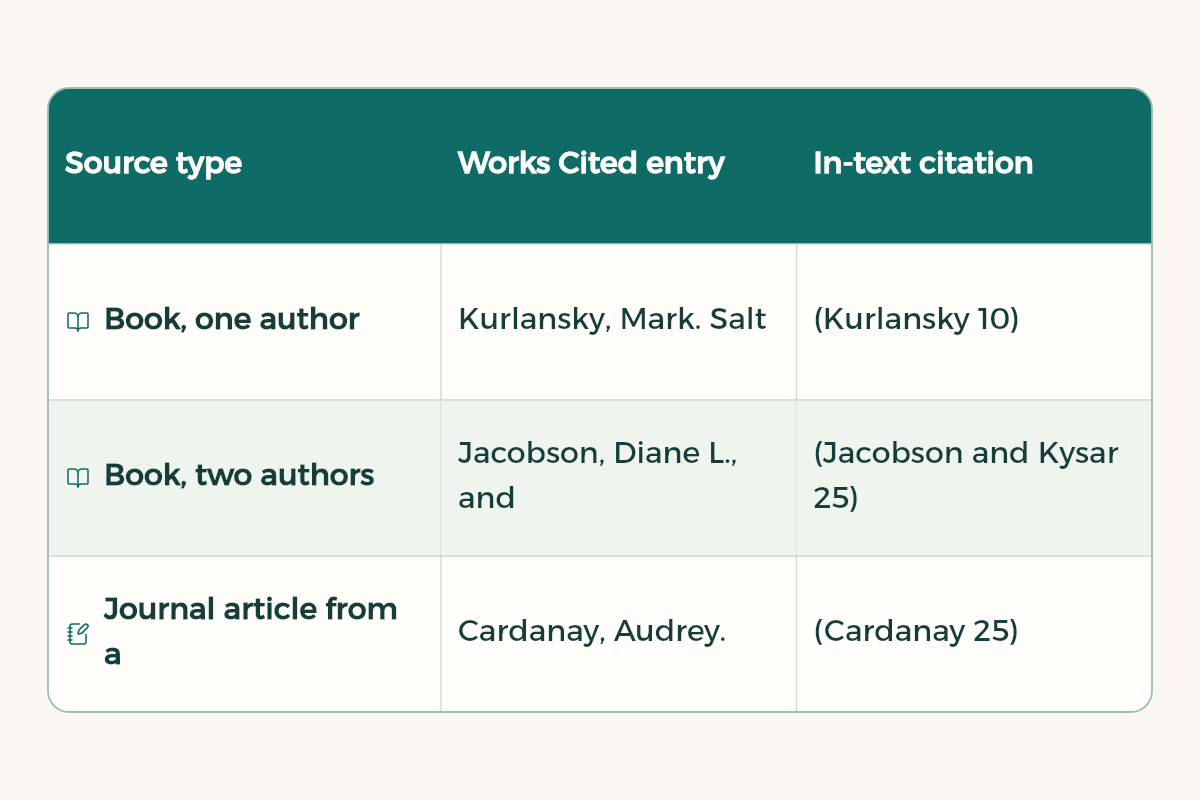
These examples are taken from MLA guides published by university libraries. Titles appear as plain text here because a table cannot show italics:
| Source type | Works Cited entry | In-text citation |
|---|---|---|
| Book, one author | Kurlansky, Mark. Salt: A World History. Walker, 2002. | (Kurlansky 10) |
| Book, two authors | Jacobson, Diane L., and Robert Kysar. A Beginner’s Guide to the Books of the Bible. Augsburg, 1991. | (Jacobson and Kysar 25) |
| Journal article from a database, with a DOI | Cardanay, Audrey. “Illustrating Motion, Music, and Story.” General Music Today, vol. 29, no. 3, 2016, pp. 25-29. Academic Search Premier, https://doi.org/10.1177/1048371315626498. | (Cardanay 25) |
| Webpage, no author | “Athlete’s Foot - Topic Overview.” WebMD, 25 Sept. 2014, www.webmd.com/skin-problems-and-treatments/tc/athletes-foot-topic-overview. | (“Athlete’s Foot - Topic Overview”) |
Publishers, cities and DOIs
- The city of publication is not normally included. It is added only in specific cases, such as books published before 1900, publishers with offices in more than one country, or publishers unknown in North America.
- Write a DOI in full as https://doi.org/ followed by the code. Do not put the word DOI in front of it.
- For a journal article from a database, name the database at the end of the entry, as the example above shows.
- If a source has no DOI and no stable link, give the address as it appears on the site, without https://.
MLA and APA: do not mix them
Mixing the two styles is one of the most common student mistakes. APA puts the year in the brackets and calls its list References. MLA puts the page number in the brackets and calls its list Works Cited. If your course requires APA, follow the APA guide, and compare the two with APA citation format.
Check this entry against MLA 9. Put the elements in order, shorten the publisher, italicise a book title and put an article title in quotation marks. Do not add any detail that is not in the text I send. If something is missing, only tell me what is missing:
AI tools and your references
AI tools can format a reference quickly, but they sometimes invent a title, a page number or a publisher. Open each source yourself and check every element. Then confirm that every in-text citation has an entry in the list, and that every entry is cited in the text.
Related guides: Harvard referencing, IEEE citation and paraphrasing without plagiarism.
What to read next
Once your references are in order, read the whole paper from the start, then follow how to write a research paper to check the structure. If you are presenting it to a panel, read presentation tips. Every writing guide is in the writing and presentations section.
The nine core elements
The official MLA guide does not ask you to memorise a different format for every source type. It gives you a fixed list of elements: take whichever ones your source has, in the same order. Once you know the list, you can cite almost anything, including source types you have never seen.
| Order | Element | Example |
|---|---|---|
| 1 | Author | Smith, John. |
| 2 | Title of source | The article, chapter or book title |
| 3 | Title of container | The journal, website or book that holds it |
| 4 | Other contributors | Editor or translator |
| 5 | Version | For example, 2nd ed. |
| 6 | Number | Volume and issue |
| 7 | Publisher | The publishing house or organisation |
| 8 | Publication date | Year or full date |
| 9 | Location | Page range, DOI or URL |
Formatting the Works Cited page
Put the list on its own page at the end, titled Works Cited and centred. Order entries alphabetically by the first author's surname. Use double spacing and a hanging indent, so the first line of each entry starts at the margin and the following lines are indented. Every entry must be cited in the text at least once.