By the tiswa editorial team, from the official sources listed at the end of this guide. How we write our guides
Get the admission letter before anything else. Study in Saudi lists acceptance from a licensed, accredited Saudi institution as a condition for both visa types1, and students who start on flights and paperwork before that letter arrives often redo half of it.
Once you are admitted, three questions are left. Which visa fits your programme? What do you prepare yourself? Who actually submits the application? The answers below come from the Study in Saudi visa page and from the visa requirements page of King Fahd University of Petroleum and Minerals in Dhahran, which spells out its process step by step.
Short-term or long-term: which Saudi student visa do you need?
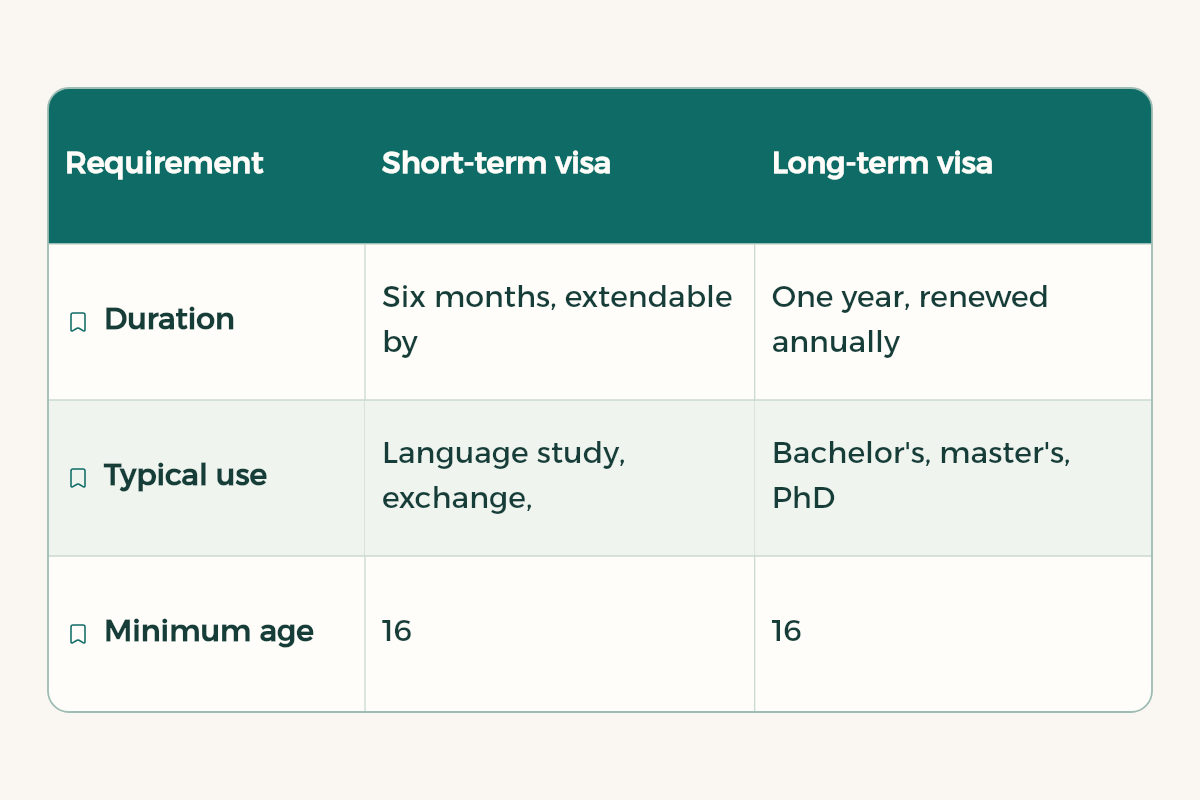
It depends on how long the programme runs, and the line is clear. The short-term visa is for study, training or programmes of up to six months, such as language courses and student exchanges; it lasts six months and can be extended by six more. The long-term visa is for bachelor's, master's and doctoral degrees; it lasts a year and is renewed each year on the institution's recommendation1.
| Requirement | Short-term visa | Long-term visa |
|---|---|---|
| Duration | Six months, extendable by six | One year, renewed annually |
| Typical use | Language study, exchange, short programmes | Bachelor's, master's, PhD |
| Minimum age | 16 | 16 |
| Passport | Valid 6+ months from intended entry | Valid 6+ months from intended entry |
| Admission | Licensed, accredited institution | Licensed, accredited institution |
| Funding | Proof of funds or a financial guarantee | Proof of funds or a financial guarantee |
| Medical report (no infectious diseases) | Not listed | Required |
| Medical insurance for you and dependents | Not listed | Required |
| Proof of language of study | Not listed | Required, except for Arabic students |
What are the Saudi student visa requirements?
Five conditions apply to both types1:
- You are at least 16.
- Your passport is valid for six months or more from the date you plan to enter, not from the date you apply.
- You hold admission from a licensed and accredited institution in the Kingdom.
- You can show you will cover tuition and living costs, or you have a financial guarantee.
- If you are under 18, you have written consent from your guardian.
The long-term visa adds a medical report showing you are free of infectious diseases, medical insurance covering you and any dependents, and proof that you can study in the programme's language. Students whose programme is Arabic itself are exempt from that last one1.
How to get a Saudi student visa: who files it?
Usually the university does. KFUPM is a good example. After you are admitted you email copies of your documents and fill in forms with details such as your full name, nationality and passport number. Then, in the university's words, its admissions team handles the visa application on your behalf, and the visa reaches you by email with instructions for the next step3.
KFUPM asks for these documents3:
- A medical report from your home country
Ask which format they accept before you book the appointment.
- A passport valid for at least six months
If it expires during your first year, renew it now; renewing abroad is slower.
- Your admission letter
The final letter, not a conditional offer.
- An embassy letter
The page lists it without describing it, so ask admissions for a template.
- A copy of your visa referral note
KFUPM issues it through the Ministry of Foreign Affairs, and you take it to the Saudi embassy or consulate.
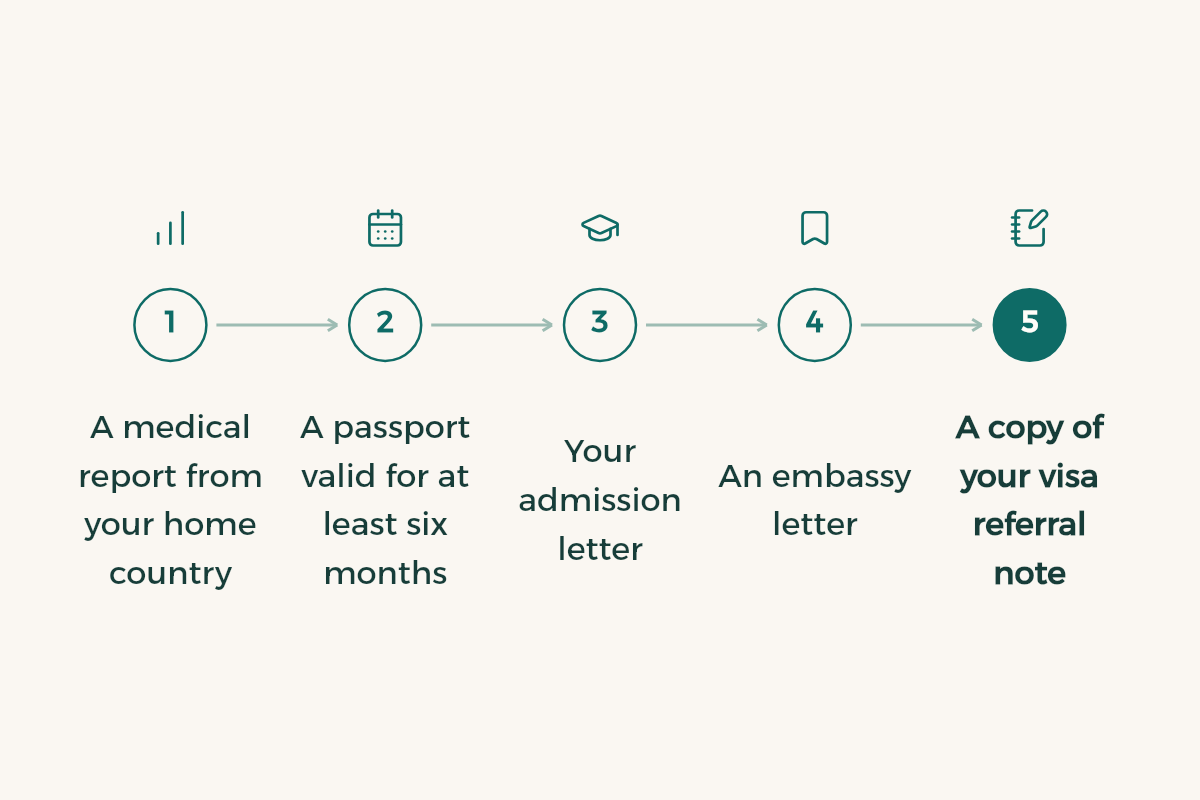
Your university may run things differently, but this list is a fair preview of what you will be asked for.
What is the Saudi Arabia student visa processing time?
There is no fixed figure. KFUPM says processing times vary greatly, tells students to start as soon as their place is confirmed, and says its admissions team can estimate the time for each case3. Study in Saudi does not publish a fee or a timeline either. Forum posts quoting an exact number of days or a fee are worth checking with your admissions office before you plan a flight around them.
Mistakes that hold up a file
The passport, nearly every time. The rule is six months from entry1. A student who applies with seven months left and then travels two months late is already outside it.
Dependents come next. Long-term insurance has to cover accompanying family, and anyone under 18 needs written consent. Mention them in your very first email to admissions, not after the forms are filed.
Last, a language year followed by a degree. Starting on a short course and moving into a bachelor's can mean a different visa from the one you arrived on, so ask how the switch works before you start.
Write a short, polite email to the international admissions office at [university].
I have been admitted to [programme], which runs for [length]. Could you tell me: does the university file the student visa for me? Which visa type applies? What format do you need for the medical report and the embassy letter? Does the insurance cover my accompanying family? How long do you expect processing to take in my case?
My name is [name] and my admission number is [number].
What happens after you land?
The visa gets you in; the residence permit keeps you there for the length of your degree. See the student iqama guide for that part. If you need a scholarship that covers tuition and housing, start with scholarships in Saudi Arabia for non-Saudis or the KFUPM scholarship guide, and if you want Arabic before your major, read learn Arabic in Saudi Arabia.