By the tiswa editorial team, from the official sources listed at the end of this guide. How we write our guides
The dentistry major in Saudi Arabia combines core medical science with fine hand skills, so it differs from most health majors in how you study and how you get in. This guide covers how long the degree takes, the preclinical and clinical courses, the usual admission requirements, and what you need after graduation to be a dentist classified by the Saudi Commission for Health Specialties (SCFHS).
How many years is dentistry?
A documented example is the Bachelor of Dental Surgery (BDS) at Imam Abdulrahman Bin Faisal University (IAU): six years including the preparatory year, followed by an additional internship year. Graduation requires 201 credit hours and a minimum GPA of 2.75 out of 5 for students on the current plan.
In the same programme the internship is designed to give the widest possible experience across every discipline of dentistry. It combines clinical work with seminars, treatment planning, case presentations, article critiques, research projects and hospital rounds. So the full journey is around seven years in this example.
Dentistry courses year by year
You start with basic sciences, move to preclinical labs where you practise on models, then move to the clinic with real patients. This table comes from the documented study plan:
| Year | Example courses |
|---|---|
| 1 (preparatory) | General English, Biology 1 and 2, Physics, Chemistry, Computer Skills |
| 2 | Human Anatomy, Biochemistry, Dental Morphology, Microbiology and Immunology, Oral Biology 1, Preclinical Restorative Dentistry 1 |
| 3 | Preclinical Removable Prosthodontics, Preclinical Fixed Prosthodontics, Oral Diagnosis, Clinical Restorative Dentistry 1, Dental Pharmacology |
| 4 | Clinical Periodontics, Preclinical Endodontics, Clinical Oral and Maxillofacial Surgery, Oral Epidemiology and Biostatistics |
| 5 | Comprehensive Care Dentistry Clinic 1, Clinical Pediatric Dentistry, Oral Medicine 1 |
| 6 | Comprehensive Care Dentistry Clinic 3, Research Project, Clinical Orthodontics, Comprehensive Pediatric Dentistry |

Preclinical labs start early, in year two. This is where you learn to prepare teeth on models and build restorations, and those practical hours build your hands before you ever face a patient. Treat them as daily training, the way an athlete treats practice, not as a chore.
Admission and the manual dexterity test
Because dentistry depends on your hands, some colleges add steps you will not see in other majors. In the documented programme the college requires:
- Passing the preparatory year requirements in the university's health track.
- At least a C+ in Biology, Chemistry, General English, Academic English and Physics.
- Passing a manual dexterity test.
- Passing a personal interview.
A dexterity test measures hand precision, control and eye-hand coordination. If you are considering dentistry, try activities that need precision, such as detailed drawing or small models, to see whether you enjoy that kind of work. To protect your prep year GPA, read the preparatory year guide.
Licensing after graduation: SCFHS and the SDLE
SCFHS classifies health certificate holders, carries out the professional registration of practitioners and sets the standards for practising health professions. Dental graduates sit the Saudi Dental Licensure Exam (SDLE), and according to the applicant guide its pass score is 542.
Once classified, you can work as a general dentist or apply for specialty training in fields such as endodontics, orthodontics, oral and maxillofacial surgery, pediatric dentistry, periodontics and prosthodontics. The documented college itself offers fellowships in these fields, which gives you a sense of the paths open after the bachelor's.
Career paths for dentistry graduates
The programme page says excellent opportunities exist in academia and research, in careers with government agencies or in public hospitals, as well as in private practice. With experience you can combine clinical work with teaching, or specialise in a field that patients ask for often.
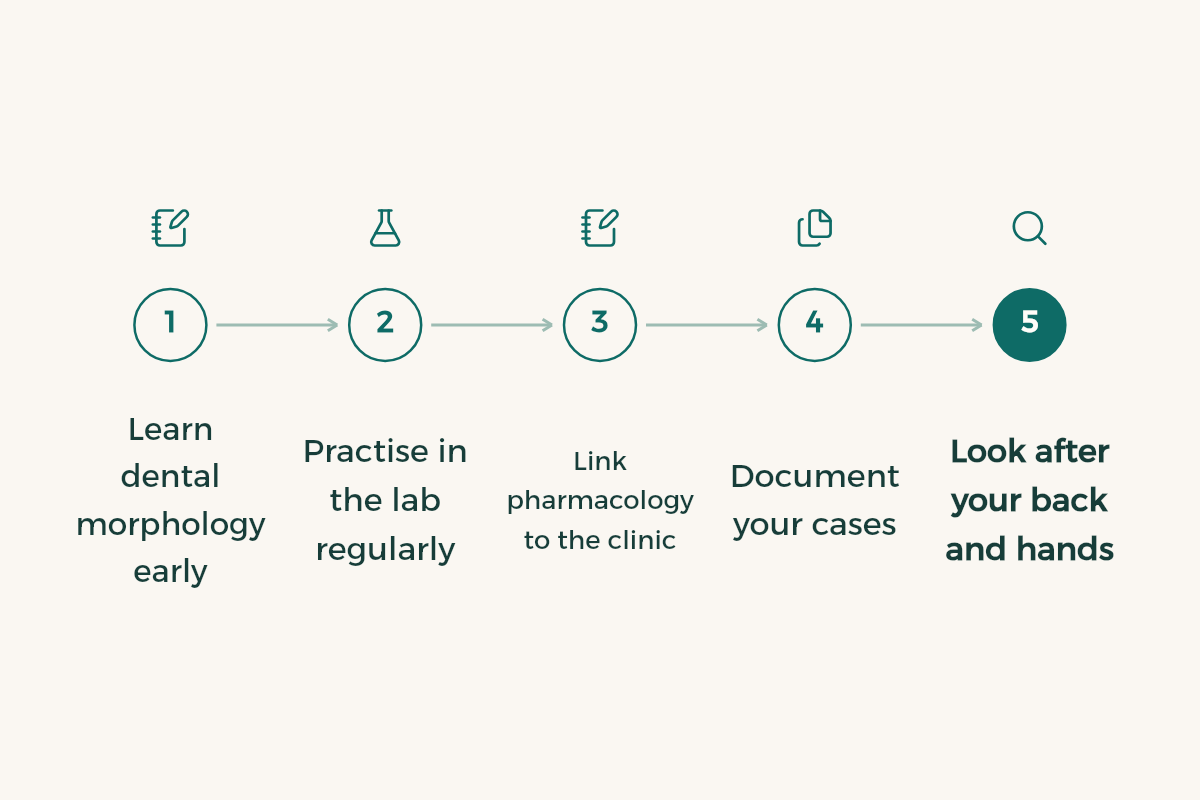
A study plan for dentistry students
- Learn dental morphology early
Dental morphology underpins everything after it. Draw every tooth and learn its surfaces and landmarks until you can recognise it from any angle.
- Practise in the lab regularly
One extra hour a week in the preclinical lab makes a big difference to the speed and precision of your hands.
- Link pharmacology to the clinic
Focus on local anaesthetics, antibiotics, painkillers and their interactions, because you will use them daily.
- Document your cases
In clinics keep a log of your cases and treatment plans, with nothing that identifies the patient, and review it before practical exams.
- Look after your back and hands
Good chairside posture is a habit you build from the start, and it protects you for your whole career.
You are a dentistry tutor. Ask me 10 short questions about the morphology of permanent teeth in the [maxillary arch]: number of roots, surfaces, distinguishing landmarks and how to tell similar teeth apart. Ask one question at a time and correct my answer before moving on.
What does a dentistry student's week look like?
In the preclinical years your week splits between basic science lectures and long hours in the lab, where a session can run for hours on a single model until your supervisor signs it off. Once you enter clinics you have your own patients to follow from diagnosis to the end of treatment, plus clinical requirements you must complete before the year ends. Time management in dentistry is not a luxury; it is a condition for passing.
A practical tip: at the start of each semester, list your clinical requirements and the number of cases needed, track them weekly and contact patients early to book appointments. Many students fall behind because they wait until the end of the semester and then cannot find suitable cases. To balance lab time and study, read how to study effectively.
Getting your instruments ready early saves time and stress, so ask your college for the required kit list for each year before term starts.
Is dentistry right for you?
Dentistry suits people who enjoy precise hand work, have patience for detail and like seeing the result of their work straight away. If you are comparing it with the medicine major or the pharmacy major, note that dentistry gets you into the clinic early and leans more on practical skill. For help deciding, read how to choose a university major.